Thin Shells, Soft Shells and Misshapen Eggs: Causes and Fixes
Why layers produce thin, soft, rough or misshapen eggs: calcium, phosphorus, vitamin D3, hen age, heat and disease, with practical fixes for Ghanaian farms.
Halaal Farms Ghana team4 October 2026 · 13 min read
Key points
Each shell holds about 2 grams of calcium and most of it is laid down at night, so hens need coarse calcium in the gizzard at dusk.
Check feed intake first: a layer feed with 3.8% calcium supplies enough at 115 grams a day and too little at 95 grams.
Offer oyster shell or limestone grit of 2 to 4 mm in the afternoon, and never guess with bone meal, because excess phosphorus weakens shells.
Sudden pale, wrinkled or shell-less eggs across the flock point to disease and need a vet, not more calcium.
Candle a sample at the nest, after collection and after packing to learn whether cracks come from weak shells or rough handling.
A hen puts about 2 grams of calcium into every shell, and she does most of that work in the dark. The egg spends around 20 hours in the shell gland, the greater part of it in the evening and night, when she is on the perch and not eating. Whatever calcium she needs during those hours must already be sitting in her gizzard or stored in her bones. Keep that picture in mind and most shell problems, and their remedies, make sense.
Weak shells cost money in three ways. Eggs break before they are collected, cracked eggs sell at a discount or not at all, and broken eggs in the nest teach hens to eat eggs. A flock can be laying well and still lose a crate a day at the collection round.
Name the defect before you look for the cause
Different faults have different origins. Set aside the day's rejects, sort them by type and count each pile. The table links what you see to where to look first.
Defect
What it looks like
Look first at
Shell-less egg
Yolk and white held only in a soft membrane, often found under the perches in the morning
Pullets just coming into lay, frights, egg drop syndrome and other viral disease
Thin or soft shell
Shell gives under thumb pressure, breaks in the tray
Calcium intake and particle size, vitamin D3, heat, old flock, salty water
Hairline and star cracks
Fine lines seen when candled, or a small impact point with cracks running out
Handling, cage floors and nests, then shell strength
Body-checked egg
A ridge or belt around the middle where the shell cracked inside the hen and was repaired
Crowding and disturbance in the evening, older hens
Rough, sandpaper or pimpled shell
Gritty surface or small lumps of calcium
Infectious bronchitis, old flock, excess calcium, disturbed laying pattern
Wrinkled or corrugated shell
Ripples running across the surface
Infectious bronchitis, Newcastle disease, stress
Flat-sided egg
One side flattened and often wrinkled
Two eggs in the shell gland together, commonly after a fright or in young pullets
Pale shell in a brown-egg flock
Eggs lighter than the flock normally lays
Disease, stress, age, medicines or contaminated feed
White dusting or chalky coat
A powdery layer of extra calcium over the normal colour
An egg held too long in the shell gland after a disturbance
The pattern over time matters as much as the type. Defects that creep up over weeks point to nutrition, age or season. Defects that appear across the house within a few days point to disease, water or a bad batch of feed.
Calcium: the amount, the particle and the hour
The shell is almost entirely calcium carbonate. A hen absorbs only about half of the calcium she eats, so to build a 2-gram shell every day she needs roughly 4 grams of calcium in her daily feed. That is why layer rations are made with about 3.5 to 4.2% calcium, several times the level in grower feed.
Check intake before you blame the formula
A ration that is correct on paper fails if the hens do not eat enough of it. At 3.8% calcium, a hen eating 115 grams of feed takes in 4.4 grams of calcium. In hot weather, when she eats only 95 grams, the same feed gives her 3.6 grams. Nothing in the bag has changed, yet she is now short every day and her shells show it within a fortnight. Weigh the feed going into the house, divide by the number of hens, and you will know which problem you have.
Look in the trough as well. In mash feed the limestone is a fine powder that settles to the bottom. If feeders are topped up before they are emptied, hens pick out the maize and leave the powder. Let the troughs be eaten clean once a day so that the fines are finished.
Why coarse particles matter
Powdered limestone dissolves quickly and passes through the gut within a few hours of the afternoon feed. By midnight, when shell building is at full speed, little of it is left. Particles of about 2 to 4 mm are held in the gizzard and dissolve slowly through the night, releasing calcium when the shell gland is asking for it. Nutritionists commonly aim to supply around half to two-thirds of a layer's calcium in this coarse form, with the rest as powder.
When the gut cannot supply enough, the hen draws on medullary bone, a store of calcium inside her long bones that is built in the two weeks or so before her first egg. This is the reason pullets are moved onto a pre-lay or layer ration as they approach lay, and the reason full layer feed should not be given to young growers, whose kidneys can be damaged by so much calcium. A hen that has to rob her bones every night to make up a daily shortfall ends up with thin shells and weak legs.
Oyster shell and limestone grit: how to offer them
Both are calcium carbonate and both carry close to 38% calcium. Crushed oyster shell comes naturally in flakes of the right size. Limestone must be bought as grit or chips, not as flour. Either should be clean, dry and free of sand. There are three practical ways to use them.
In the feed. If you mix your own ration or use concentrate with maize, ask for part of the limestone to be supplied as grit and mixed in. This is the most reliable method because every hen gets it.
On top of the afternoon feed. Scatter grit along the troughs at about 3 pm. Hens have a real appetite for calcium late in the day and will pick it up.
In a separate hopper. On deep litter, a hopper of oyster shell lets each hen take what she needs. Keep it dry and topped up.
More is not better. A heavy surplus of calcium makes the feed unpalatable, lowers intake and can produce rough shells with pimples of excess calcium. If the base ration is already correct, the supplement is a small top-up.
Phosphorus and vitamin D3, the two partners
Calcium does not work alone. Phosphorus is needed to rebuild the bone store each day, but the hen needs far less of it than calcium, and layer feeds are usually formulated with about 0.35 to 0.45% available phosphorus. Too little and the bones weaken until hens go down on their hocks in the cages. Too much and calcium absorption suffers and shells get thinner. This is why adding bone meal or dicalcium phosphate by the handful to fix shells is a mistake. Both supply phosphorus as well as calcium and can push the balance the wrong way. Leave the phosphorus level to the person who formulates the feed, and use plain limestone or oyster shell when you want extra calcium.
Vitamin D3 is what allows calcium to cross the gut wall and to move in and out of bone. It comes from the vitamin premix, and it is fragile. Premix that is old, has been stored hot or damp, or has been measured carelessly leaves the flock short of D3 even when the calcium level is perfect. Buy premix with a clear manufacture date from a seller who turns stock over quickly, keep it sealed and cool, weigh it accurately and mix it thoroughly. The premix also carries manganese, zinc and copper, trace minerals the shell needs in small amounts.
The body has to convert D3 into its active form in the liver and kidneys. Anything that damages those organs weakens shells indirectly, and mould toxins in maize are the commonest culprit. If shells deteriorate after a new delivery of grain, read our guide to aflatoxin and mouldy feed before you buy more calcium.
Why shells weaken as hens age
A hen at 70 weeks lays a noticeably heavier egg than she laid at 25 weeks, often by 10% or more, but she deposits about the same weight of shell on it. The same shell is spread over a bigger surface, so it is thinner. Her gut also absorbs calcium less efficiently as she ages. Expect the share of cracked eggs to rise steadily from around 50 weeks even in a well-fed flock.
You can slow the decline. Late-lay rations are normally made with calcium towards the top of the range, slightly less available phosphorus, and a larger share of coarse grit. Controlling egg size helps too, and that is a formulation matter for your nutritionist or feed supplier. A rest from laying restores shell quality for a time, which is one of the arguments weighed in our article on moulting in layers. When cracks and rejects are eating the margin of an old flock, that belongs in the decision on when to sell it.
Heat and thin shells
Farmers across Ghana notice that shells are at their worst in the hot months before the rains. Two things happen together. First, hens eat less, so calcium intake falls as shown above. Second, a panting hen breathes off carbon dioxide faster than normal, and that shifts her blood chemistry so that less carbonate and less free calcium reach the shell gland. She can have calcium in her gut and still lay a thin shell.
Feed early in the morning and again from late afternoon, when hens will eat.
Give the coarse calcium in the afternoon so that it is in the gizzard overnight.
Keep drinking water cool by shading tanks and pipes, and never let drinkers run dry.
Reduce heat in the house: moderate stocking, clear air flow through the open sides, a white or insulated roof.
Ask your nutritionist about a hot-season ration. Options include a denser feed and replacing part of the salt with sodium bicarbonate. These are formulation decisions, not things to add by guesswork.
Diseases that write on the shell
Several infections attack the oviduct, and the shell is often the first place the farmer sees them. Three matter most for layers.
Infectious bronchitis is a viral respiratory disease, but in adult hens the coughing can be so mild that it is missed. What you notice is a fall in production with wrinkled, rough, thin and pale shells, and whites that run like water when the egg is broken onto a plate. Shell quality may stay poor for weeks after the flock looks well again.
Egg drop syndrome is caused by a virus that settles in the shell gland. The hens look healthy and eat normally. Brown eggs lose colour first, then thin-shelled, soft-shelled and shell-less eggs appear in numbers and production falls or never reaches its expected peak.
Newcastle disease in a partly protected laying flock can show as a sharp drop in eggs with soft and misshapen shells, sometimes with greenish droppings, twisted necks or deaths.
All three are controlled by vaccination before and during lay, on a programme set by your vet. Halaal Farms Ghana vaccinates layer chicks at the hatchery before they leave, so ask what your batch has had and give that list to your vet as the starting point for the rest of the schedule. If shell faults spread quickly through a house, do not treat by guesswork. Calcium will not help and antibiotics do not act on viruses. Call a vet or the district veterinary office, and report any wave of deaths at once. The signs that separate one respiratory infection from another are covered in our article on respiratory disease in chickens.
Pullets, frights and crowding
Some defects have nothing to do with feed or infection. In the first two to three weeks of lay, a pullet's ovary and oviduct are not yet working in step. Shell-less eggs, soft shells, double yolks and odd shapes are common and fade as the flock approaches peak. No action is needed beyond the correct ration.
In older flocks, disturbance is the usual cause. A fright can make a hen hold an egg in the shell gland for extra hours, so that it comes out with a chalky white coat, or push it out early with a soft shell. If the next egg arrives while the first is still there, the second is laid with a flattened side. A hen that is knocked or trampled in the evening, when the new shell is still a thin layer, cracks it inside her body. She repairs it, and the egg is laid with a raised belt around the middle that splits easily in the tray.
The remedies are about calm. Do not overstock cages or pens. Keep dogs, strangers and noisy work away from the house. Avoid catching, vaccinating or moving equipment in the late afternoon and evening. Keep the lighting timetable steady, because lights that come on and go off at odd hours upset the laying rhythm.
Keep broiler feed and unprescribed medicines away from layers. Some anticoccidial products used in broiler feed bleach brown shells and spoil eggs if they reach laying hens, and some medicines affect shell quality or leave residues in eggs. Clean the mixer between broiler and layer batches, and medicate layers only on a vet's instruction.
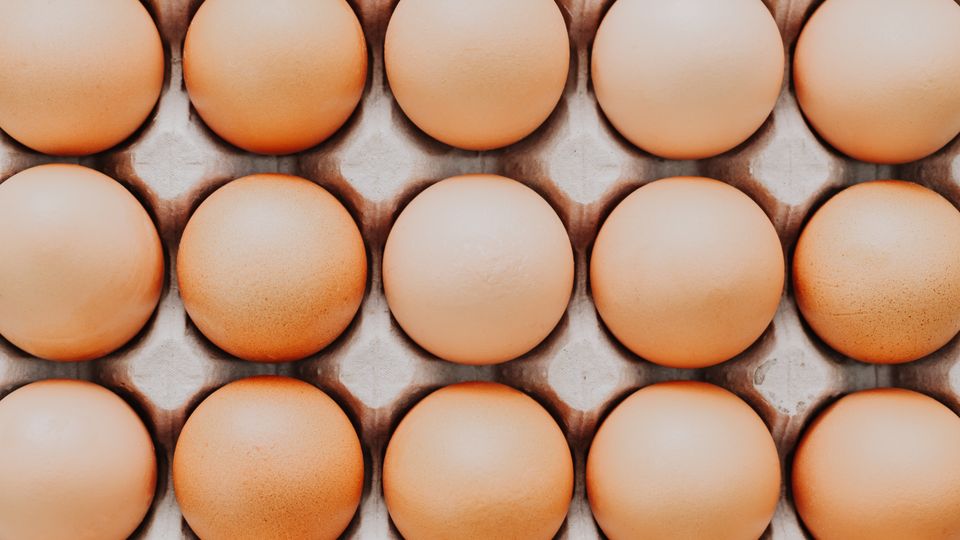
Rows of brown eggs in a tray.
Salty water
Borehole and well water in some areas, especially near the coast, carries enough dissolved salt to raise shell defects in a flock that is otherwise well fed, even when the water tastes acceptable and the hens drink it readily. If thin shells persist despite a correct ration, good intake and healthy birds, have the water tested at a laboratory and discuss the result with your vet or nutritionist. Sources and treatment are dealt with in our guide to water for poultry.
Weak shells or rough handling?
Before you change the feed, find out where the cracks are being made. In a dark room, hold a strong torch against a sample of 100 eggs at each of three points: in the nests or on the cage trays before anyone touches them, in the trays straight after collection, and after grading and packing. Hairline cracks show as bright lines.
If most are already cracked before collection, the trouble lies in the shell or the house: thin nest litter, too few nests, cage floors that are too steep or have sagging wire, eggs piling up and knocking each other because collection is late. If the number jumps after collection, the trouble is in people's hands: eggs gathered in buckets and basins, trays stacked crooked, soft or torn paper trays, big eggs standing proud of the tray and taking the weight of the stack. The routines that prevent this are set out in collecting, grading and storing table eggs.
For a measure of the shell itself, break ten eggs of known weight, rinse the shells, dry them for a day and weigh them. Sound shells are around a tenth of the weight of the egg. Repeat this monthly and compare the figure with your own earlier results. A falling share warns you weeks before the crack count does. Shell strength matters even more if you sell fertile hatching eggs, because thin shells lose moisture too fast in the incubator.
A fault-finding order when shells go wrong
Sort and count the rejects by type, and note how fast the problem appeared.
Sudden and widespread, with pale shells or a fall in production: call the vet.
Weigh feed intake per hen. If it is low, deal with heat, water and feeding times.
Check the ration: calcium level, coarse particles, premix age and mixing, any recent change of ingredients.
Add coarse oyster shell or limestone grit in the afternoon and let troughs be eaten clean daily.
Consider the age of the flock and whether a late-lay ration is due.
Look at stocking, disturbance and the lighting timetable.
Candle samples to separate handling damage from weak shells.
If nothing explains it, test the water.
Give any change two weeks before you judge it, since the bone store takes time to recover. If you would like to talk a shell problem through, or you are planning your next flock, call Halaal Farms Ghana on 024 915 1503 or send the order form with the age of your hens and what you are seeing. There is no charge for advice, whether or not you are ordering chicks.
Questions farmers ask
Can I feed crushed eggshells back to my layers?
You can, as a small part of their calcium. Use shells from your own farm only, bake or boil them to kill germs, dry them and crush them so that they no longer look like eggs. They return far less calcium than the flock needs, so they do not replace limestone or oyster shell. Never bring in shells from other farms or from food sellers.
Why is my hen laying eggs with no shell at all?
In pullets during the first two or three weeks of lay it is usually a timing fault that corrects itself. In an established flock, a few shell-less eggs after a fright are normal. Many of them, together with pale shells or a fall in production, suggest egg drop syndrome, infectious bronchitis or Newcastle disease and should be reported to a vet.
How much oyster shell should I give my layers?
If the layer feed is correctly formulated, oyster shell is a top-up and not the main source. A few grams for each hen, scattered on the feed in mid-afternoon or left in a separate hopper for the birds to take freely, is the usual approach. Hens in lay regulate their own intake well. Ask your feed supplier how much coarse calcium the ration already contains.
Are thin-shelled or cracked eggs safe to sell?
A clean, intact egg with a thin shell is safe but travels badly, so sell it close to the farm. A cracked egg has lost its barrier against bacteria. Keep cracked eggs cool, sell them the same day at a lower price to buyers who will cook them thoroughly at once, or use them at home. Discard any egg that is leaking or dirty and cracked.
Written by the Halaal Farms Ghana team. We hatch and import day-old chicks at Opeikuma, Kasoa, and deliver to all 16 regions. This article is general guidance for farmers. For diagnosis and treatment of sick birds, speak to a vet or your district veterinary office.
A side-by-side look at battery cages and deep litter for laying hens: what each costs per bird place, the work and disease problems each brings, and which kind of farmer each system suits.
A practical method for finding the hens that eat without laying: five physical checks you can do in seconds, a test pen for doubtful birds, the right time to cull and how to sell the culls.
Follow the egg from the nest to the buyer: a collection timetable, nest management, what to do with dirty eggs, grading by quality and size, storage in hot weather and transport without breakages.