
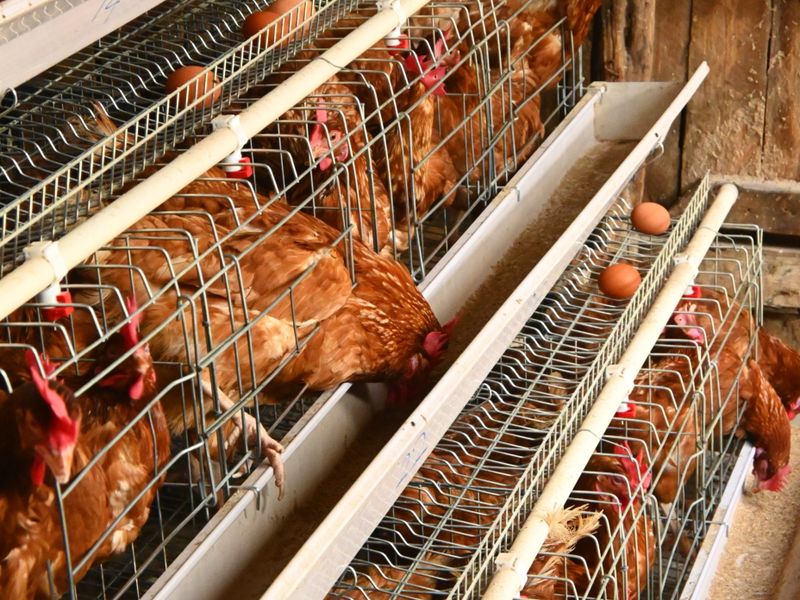
A cage advertised as a "96-bird set" is a piece of arithmetic: three tiers, two sides, four cells on each tier, four hens in each cell. Put three hens in a cell and the same steel is a 72-bird set. So the first thing to ask about any layer cage is not the price of a set but the size of one cell and how many hens the seller has counted into it. Everything else, including the house you must build, follows from that answer.
Halaal Farms Ghana supplies layer cages from the farm at Opeikuma, Kasoa. Prices are quoted on request, not printed here. This page shows how a cage system works, how to size it, where it is and is not the better choice, and what to inspect before any money moves.
How a cage set works, from feed trough to egg tray
The cage most often offered to small and medium farms in Ghana is the A-frame type. The tiers step outwards like a ladder leaning on both sides of a frame, so droppings from the upper hens fall past the lower ones to the floor. Larger automated farms use the upright H-type, where tiers stack directly above each other and belts carry the manure out. That is a different level of investment and needs dependable power.
In an A-frame set, each tier is a long wire cage divided into cells. Each cell has four working parts:
- a sloping wire floor, so that an egg rolls forward out of the hen's reach as soon as it is laid;
- an egg tray at the front, where the floor curls up to catch the egg;
- a feed trough running along the front, above the egg tray, filled by hand or from a trolley;
- a water line with nipple drinkers, fed from a small tank at the end of the row.
The hen stands on wire, eats through the front, drinks at the nipple and never touches her droppings or her eggs. That one design fact explains both the advantages and the complaints that follow.
Birds per cell and per set: do the sum yourself
| Set layout | At 4 hens per cell | At 3 hens per cell |
|---|---|---|
| 3 tiers, 4 cells per tier, 2 sides | 96 | 72 |
| 3 tiers, 5 cells per tier, 2 sides | 120 | 90 |
| 4 tiers, 4 cells per tier, 2 sides | 128 | 96 |
| 4 tiers, 5 cells per tier, 2 sides | 160 | 120 |
Now check the space. Ask for the width and depth of one cell and multiply them. A widely sold size is a tier about 1.87 m long and 37 cm deep, split into four cells. Each cell is then about 47 cm by 37 cm, roughly 1,730 square centimetres. With four hens that is about 430 square centimetres each. With three it is about 575.
Breeder management guides for brown layers give 490 to 750 square centimetres of cage floor per hen. Four hens in that cell fall below the range. Three sit well inside it. In an open-sided house in Ghana's heat, packed hens pant, eat less and lay smaller eggs, so three per cell is usually the sounder plan even though it means buying more sets. Do the same check on feeding space: the guides ask for about 8 cm of trough per hen, which a 47 cm cell gives to four birds with room to spare.
How big a house for 500, 1,000 or 2,000 layers
Set sizes differ between makers, so treat these as planning examples and confirm them on the supplier's drawing. They assume a three-tier set a little under 2 m long and about 2.2 m wide across the legs, walkways of about 1 m between rows and along each wall, and 1.5 m of working space at each end.
| Hens | Sets of 96 | Layout | Inside size of house |
|---|---|---|---|
| 500 | 6 (576 places) | 1 row of 6 | about 4.5 m by 15 m |
| 1,000 | 11 (1,056 places) | 2 rows, 6 and 5 | about 7.5 m by 15 m |
| 2,000 | 21 (2,016 places) | 2 rows, 11 and 10 | about 7.5 m by 25 m |
If you stock three hens per cell, each set holds 72, so 1,000 hens need 14 sets and the same house grows to about 17 m long.
Two rules keep the building right. First, add length, not width. An open-sided house depends on wind crossing it, and that stops working much beyond 9 or 10 m, so think hard before adding a third row. A longer house with two rows is the safer choice. Second, give the roof height. The top tier sits closest to hot roofing sheets, and those hens suffer first. The article on ventilation in open-sided houses explains the airflow. For comparison, 1,000 hens on deep litter at 5 to 7 birds per square metre need 145 to 200 square metres of floor, against roughly 110 in three-tier cages.
Cages or deep litter, in honest terms
| Cages | Deep litter | |
|---|---|---|
| Cost to start | High. Steel, fittings, water tanks and a concrete floor, all before the first egg. | Low. Litter, nest boxes, feeders and drinkers. |
| Eggs | Clean, easy to collect, few eaten or laid on the floor. | More dirty and floor eggs unless nests are well managed. |
| Labour | One person can feed, check and collect from more hens. | Litter must be turned and replaced. Collection is slower. |
| Health | Hens are off their droppings, so worms and coccidiosis are less of a problem. A hen that stops laying is easy to find. | Wet litter brings coccidiosis and worms. Poor layers hide in the crowd. |
| Welfare | Hens cannot scratch, dust-bathe, perch or use a nest. Little exercise weakens bones over a long laying period. | Hens move and behave naturally, but pecking and bullying spread more easily. |
| Heat | A hen cannot walk to a cooler spot. Ventilation and stocking must be right. | Birds spread out, though litter adds warmth and dust. |
| Manure | Collects wet under the cages. Flies and ammonia build up unless it is removed often. | Mixes with litter and comes out drier, usually at the end of the flock. |
| Flexibility | The house holds layers only. | The same house can take broilers, cockerels or pullets. |
On welfare, be aware that some countries no longer allow this type of cage (the European Union banned the conventional battery cage in 2012), and some hotel and food chains ask their suppliers for cage-free eggs. If you hope to sell to buyers like that, ask them before you invest.
Cages do not raise what a hen can lay. They make it easier to collect what she lays and to see what each bird is doing. The cages or deep litter comparison on our blog takes the money side further, and the poultry profit calculator lets you test your own figures.
Seven things to check on the steel before you pay
- Galvanising. Ask whether the wire and frame are hot-dip galvanised or cold (electro) galvanised. Hot-dip leaves a much thicker zinc coat, looks duller and rougher, and resists rust far longer. Cold galvanised wire is bright, smooth and cheaper, and in humid or coastal air it rusts early. Look closely at the welds, where rust begins.
- Wire thickness. Ask the wire diameter in millimetres for the floor, front and partitions, and compare offers on that figure, not on appearance. The floor carries the hens for years. Press it with your hand. If it sags, eggs will stop rolling and feet will suffer.
- Floor slope and egg tray. Place an egg at the back of a cell. It should roll gently to the tray and stop without a knock. Too flat, and eggs stay under the hens to be soiled and pecked. Too steep, and they crack.
- Nipple drinkers. Every hen should be able to reach two nipples, so a blocked one does not leave a cell dry. Ask whether the tank, pressure regulator, pipes and connectors are in the price. Have the line filled and watch for drips.
- Feed troughs. Check the depth and the inward lip that stops hens flicking feed out. Look at how lengths join, because feed leaks at bad joints.
- Doors. Each door should open wide enough to lift a hen out with one hand and should latch firmly.
- Completeness. Get a written parts list: frames, legs, cage sections, troughs, hooks, clips, pipes, nipples, tanks, regulators. Count against it on collection. A missing bag of clips can hold up a whole installation.
Installing the sets and moving the birds in
Cages need a hard, level floor. Concrete with a slight fall to a drain is the standard, because nipples drip and manure must be scraped out. Assemble the frames first, level them along the row, then hang the cage sections, troughs and water line. A water pipe that is not level leaves the far cells short or the near ones leaking. Fill the system and run it for a day before any bird goes in.
Layer cages are for birds near laying age. Whether you rear layer day-old chicks yourself on the floor or buy point-of-lay pullets, plan to cage them by about 16 weeks, before the first eggs. Pullets that grew up on bell drinkers or founts must learn the nipple. Watch them closely for the first days and tap the nipples so that drops show. For the brooding and rearing stage you still need ordinary feeders, drinkers and brooders.
Plan the manure before the hens arrive: where it is scraped to, how often, and who takes it. In many areas vegetable and crop farmers buy dried poultry manure. See handling and selling poultry manure.
Before you build: get the cage drawing first and design the house around it. A house built half a metre too narrow turns a two-row plan into one row, and no supplier can fix that afterwards.
Asking us for a cage quote
Use the order form on this page, choose equipment or cages, and tell us:
- how many hens you plan to keep, now and later;
- the inside length, width and wall height of your house, or that it is not built yet;
- whether you want three or four hens per cell;
- your water source and whether you have a raised tank;
- whether you want help with layout and installation. That can be discussed under our poultry farm setup service, where scope and fee are agreed first.
We reply with the number of sets, what is included and the price. A cage quote depends on the tiers, the number of sets, the fittings and the cost of steel at the time, so it is worked out for each order. The figure is confirmed before you pay, no payment is taken on the website, and you can pay by cash, mobile money or bank transfer. Collection is at Opeikuma by appointment. Cages are heavy and bulky, so if you are outside Kasoa, ask us about transport and its cost when you request the quote. Our number is 024 915 1503.
Questions buyers ask
How many birds does one battery cage set hold?
It depends on the tiers, the cells in each tier and the hens you put in each cell. A common A-frame set with three tiers on two sides and four cells per tier holds 96 hens at four to a cell, or 72 at three. Five cells per tier gives 120 or 90. Always ask the seller which sum the number comes from.
What size of house do I need for 1,000 layers in cages?
As a planning example, 1,000 hens need 11 three-tier sets of 96. In two rows with walkways of about a metre between rows and along the walls, that fits a house roughly 7.5 metres wide and 15 metres long inside. Confirm it against the supplier's drawing, because set sizes differ between makers.
Should I put three or four hens in each cell?
Work out the floor area per hen from the cell measurements. Breeder guides for brown layers give 490 to 750 square centimetres per hen. Many cells sold for four hens give less than that with four and comfortably more with three. In a hot open-sided house, three per cell is kinder to the birds and to the egg count.
At what age do pullets go into the cages?
Layer cages are for pullets close to laying, not for chicks. Breeder guides advise moving the flock by about 16 weeks, before the first eggs, so the birds settle and learn the drinkers in time. Pullets reared on nipple drinkers adapt fastest. Rear them on the floor or in rearing cages until then.
Are cages better than deep litter for layers in Ghana?
Neither is better for everyone. Cages give cleaner eggs, fit more hens on the same floor, cut worm and coccidiosis problems and make each hen easy to see. They cost much more to start, restrict the birds' movement and need regular manure removal to control flies and smell. Deep litter is cheaper to start and gives a house you can use for other birds.