
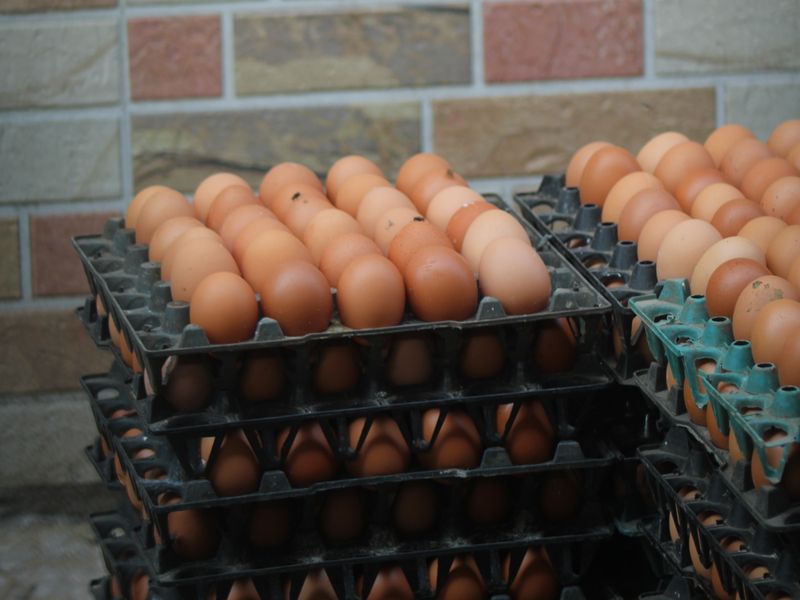
A crate of table eggs is 30 eggs on a moulded tray, and that is the unit we sell by at Halaal Farms Ghana in Opeikuma, Kasoa. Whether you want two crates for the house, twenty for a provisions shop or a regular supply for a school kitchen or a bakery, the questions are the same: how many, what size, how fresh, and how they will get home in one piece. This page answers those, including the part most sellers leave out, which is how to keep eggs good in Ghana's heat once they are yours.
There is no egg price printed here, and the reason is explained near the end. Send the order form on this page with your number of crates and your town, and we reply with the price for the day.
A crate is 30 eggs: work out your number before you ask
Buyers who guess usually end up either short by Thursday or holding eggs that are two weeks old. A short sum avoids both. Count how many eggs you use or sell in a day, multiply by the number of days until you next buy, and divide by 30. Round up to a whole crate.
| Example buyer | Eggs in a week | Sum | Crates to order |
|---|---|---|---|
| Household of six, one egg each a day | 42 | 42 ÷ 30 = 1.4 | 2 |
| Boiled-egg seller, 90 eggs a day, six days | 540 | 540 ÷ 30 = 18 | 18 |
| Bakery, 8 eggs a batch, 25 batches a day, six days | 1,200 | 1,200 ÷ 30 = 40 | 40 |
| School, 300 pupils, one egg each twice a week | 600 | 600 ÷ 30 = 20 | 20 |
The figures in the table are examples to show the sum, not typical quantities. Put in your own. If the eggs are travelling a long way, add a little for breakage. If you have no cold room or fridge space, buy for one week at a time and not for a month, for the reason given in the storage section below.
Small, medium or large: what the size names mean
Egg size follows the age of the hen. A flock that has just started to lay gives small eggs, often sold as pullet eggs. Size climbs over the first months of lay, and old hens lay the largest eggs, though with thinner shells. So the mix of sizes a farm has on any day depends on the age of its flocks, which is why it helps to ask what is available before you fix your menu or your selling price around one size.
Size names are not used the same way by every seller in Ghana. One weight guide given in FAO's egg marketing manual for African markets puts small eggs at about 45 to 55 g, medium at 55 to 65 g and large at 65 g and above. A commercial brown hen in full lay produces eggs of roughly 60 g, so medium covers most of what a laying flock gives. When size matters to you, ask what the seller's "large" weighs, or ask for the weight of egg in a crate. Thirty eggs of 60 g carry 1,800 g of egg, before the tray.
Which size suits which buyer:
- Bakeries and pastry makers. You use egg by weight, whatever the recipe says. Divide the crate price by the weight of egg in the crate and take the cheapest kilo. Small eggs are often good value for baking.
- Boiled-egg, fried-egg and waakye sellers. You sell by the piece, so customers judge each egg with their eyes. Even, medium eggs avoid arguments over one egg looking smaller than the next.
- Hotels and restaurants. A breakfast plate looks wrong with one large and one small egg. Ask for crates of one size.
- Homes. Any size cooks the same. Very large eggs have thinner shells and break more easily on a rough road.
Brown or white shell makes no difference to food value. Shell colour comes from the breed of hen, and yolk colour comes from her feed.
Five freshness checks that take a minute
You do not need equipment to judge a crate. Do these on two or three eggs taken from different trays.
- Look at the shell. It should be clean, dry, whole and slightly dull. A scrubbed, shiny shell has probably been washed, which removes the natural coating that keeps bacteria out.
- Find the cracks. Hold the egg against your phone torch in a dim corner. Hairline cracks show as bright lines. Tapping two eggs lightly together helps too: sound shells give a clear note and a cracked one sounds dull.
- Use a bowl of water. A fresh egg sinks and lies on its side. An older egg stands on its point, because the air pocket at the blunt end grows as the egg loses moisture. An egg that floats is old. Break it into a separate cup and smell it before you decide, and do not sell it. Use the tested eggs first, since they are now wet.
- Break one on a flat plate. In a fresh egg the yolk sits up round and the thick white holds close around it. In a stale egg the yolk is flat and the white runs thin across the plate.
- Smell it. A good raw egg has almost no smell.
A small red spot on the yolk is a blood spot from the hen and does no harm. Our article on thin, soft and misshapen egg shells explains what causes weak shells on the farm side.
Keeping eggs good in Ghana's heat
Heat ages an egg far faster than time does. FAO's guide puts it plainly: the change in an egg kept for a week to ten days at 27 to 29°C is comparable to several months in cold storage. Daytime temperatures in Kasoa, Accra and most of the south are in that range or above for much of the year. So without cooling, treat about a week as your working limit for selling an egg as fresh. In a fridge at around 4°C, eggs keep for three to five weeks.
- Choose the coolest, shadiest spot with moving air, on a shelf and not on the floor. Never in the sun, beside a coal pot, on top of a fridge or in a parked car.
- Keep eggs blunt end up, the way they sit on the tray. The air pocket stays at the top and the yolk stays centred.
- Do not wash them. Wipe dirt off with a dry cloth, and rinse only just before cooking if you must.
- Store them away from kerosene, petrol, paint, onions and smoked fish. Shells are porous and eggs take up smells.
- Once chilled, keep them chilled. A cold egg carried into warm air sweats, and that film of water helps bacteria through the shell. Take out only what you will use.
- Write the buying date on the edge of each tray and sell the oldest first.
Shopkeepers can put one or two trays on display and keep the rest inside in the shade. For the farm side of the same subject, read collecting, grading and storing table eggs.
Standing orders for shops, schools, hotels and bakeries
If you will be buying eggs regularly, say so in your first message. Hens lay daily, but demand does not stay level. It tends to rise around Christmas and Easter, when more baking is done, and while schools are in session, and regular buyers are easier to plan for than buyers who appear on the day. Tell us:
- how many crates you need each week or each month;
- the size you want, or what the eggs are for;
- the day you prefer to collect;
- whether you need a receipt or invoice for your accounts.
We will tell you plainly what quantity we can supply on that rhythm. The price is still confirmed each time, because it moves with feed cost. If you run a kitchen, try the arrangement for two or three weeks before you print a menu around it. Farmers who supply institutions themselves may find our notes on what shops, schools and hotels expect from an egg supplier useful from the other side of the counter.
Collecting at Opeikuma, or sending crates by transport
Collection at the farm is by appointment, so that your crates are counted and ready. Bring something flat to stand them on. Tie each stack with twine, with an empty tray on top as a lid, and keep stacks to five or six trays. In a car, put them on the seat or the floor of the cabin, not in a hot boot. On a motorbike, use a padded carton or basket and take the rough stretches slowly.
For buyers outside Kasoa, crates can go by bus or cargo transport to a station in your town, where you collect them. The station and the transport cost are agreed with you before anything leaves. Eggs are not chicks, though, and the risks differ. Breakage rises with distance, rough roads and the number of hands that lift the cartons. Agree with us before dispatch how breakages will be handled. At the station, open the cartons, count the broken eggs, take a photo and tell us straight away. Do not leave eggs sitting in the sun at a station.
Cracked, dirty and leaking eggs
However carefully eggs are carried, some trays will have a casualty. A hairline crack with the inner skin unbroken is safe to use the same day in food that is cooked through, such as cake or a well-cooked stew, but it should not be sold as a fresh table egg. A leaking egg should be thrown away and its tray replaced, since raw egg on a tray smells within hours and brings flies to the whole stack. For small children, pregnant women, the elderly and anyone who is ill, cook eggs until both the white and the yolk are firm.
Why the crate price is given when you ask
Feed is the largest cost in producing an egg. A hen eats roughly 110 to 120 g of feed a day whether maize is cheap or dear, so when maize and soya prices move, the cost of each crate moves with them. Size and quantity change the figure as well. That is why we quote on the day. The price is confirmed before you pay, no payment is taken on this website, and you can pay by cash, mobile money or bank transfer. If you set egg prices yourself, see how to price eggs and broilers.
To order, fill in the form below, choose table eggs and tell us the number of crates, the size, whether it is a single purchase or a regular one, your town, and whether you will collect or want transport. You can also call 024 915 1503. If you would sooner produce your own eggs, we sell point-of-lay pullets and layer day-old chicks, and the farm page lists everything else we supply. Cooks buying for an event may also want dressed chicken on the same trip.
Questions buyers ask
How long will a crate of eggs keep without a fridge in Ghana?
Plan on about a week. FAO's egg marketing guide notes that a week to ten days at 27 to 29°C ages an egg as much as several months in cold storage, and much of southern Ghana sits in or above that range by day. Keep trays shaded, off the floor and away from strong smells, and buy weekly. In a fridge, eggs keep three to five weeks.
Is there any difference between brown eggs and white eggs?
Only the shell. Shell colour comes from the breed of hen, and the food value, taste and keeping time are the same. Yolk colour is not a sign of freshness either. It follows what the hen eats, with yellow maize and green leaves giving a deeper yolk. If your customers prefer one shell colour, say so when you order.
Can you send crates of eggs to a town outside Kasoa?
Tell us the town and the number of crates and we will say what is possible. Eggs can travel by bus or cargo transport to a station where you collect them, but breakage and freight both rise with distance. For a few crates going far, a layer farm nearer to you may be the sensible choice, and we will tell you so.
What egg size should a bakery or a boiled-egg seller buy?
A bakery uses egg by weight, so compare the crate price with the weight of egg in the crate and take whichever size gives the cheapest kilo. A seller of boiled or fried eggs sells by the piece, so even, medium eggs usually serve better than a mixed crate. Tell us what you do with the eggs and we will suggest a size.
Why is there no egg price on this page?
Egg prices follow feed prices, and feed cost moves with the maize and soya markets through the year. A figure printed here would soon be wrong. Send the form or call 024 915 1503 with your number of crates and we give the price for that day. It is confirmed before you pay anything.