Work out your true cost per broiler and per crate of eggs, set a margin, compare it with the market price, and handle volume discounts and credit sales safely.
Halaal Farms Ghana team4 October 2026 · 13 min read
Key points
Divide total batch cost by birds sold, never by chicks placed, so that dead birds are paid for by the survivors.
The feed cost of a crate depends heavily on laying rate: the same hens cost far more per crate at 60 percent production than at 90 percent.
Margin is profit as a share of the selling price and markup is profit as a share of cost, and mixing them up leaves you short.
A discount is only safe if the price stays above your floor price and the buyer gives you something back, such as cash on delivery or a firm weekly order.
One crate that is never paid for can wipe out the profit on seven or eight crates sold, so limit credit and record every debt.
A selling price has to answer to two numbers. The first is what the bird or the crate cost you to produce. The second is what buyers in your area are paying this week. You have far more control over the first than the second, and most pricing mistakes come from knowing only one of them. A farmer who knows only the market price can sell at a loss for a year without noticing. One who knows only the cost can name a fair price and find that nobody buys.
The method is the same for 100 birds or 10,000: find your full cost, decide the lowest price you can accept, find out what the market pays, then set rules for discounts and credit, the two things that quietly reduce the price you actually receive. All cedi figures below are examples chosen to make the arithmetic clear. Replace them with your own.
Start with the full cost of a broiler
The cost of a broiler is everything the batch consumed, divided by the number of birds you were paid for. The division matters. Chicks that died in week one still cost the chick price, and birds that died in week five also ate four weeks of feed. The birds you sell must carry those costs.
Here is an example batch of 300 broilers, with 5% mortality and an average live weight of 2.2 kg at sale.
Cost item
Example amount (GH₵)
Notes
Chicks
6,000
300 at an example price of GH₵ 20
Feed
9,350
1,100 kg at an example GH₵ 8.50 per kg
Vaccines, medicines, litter, brooding heat
900
From your expense book
Labour
1,200
Include a wage for your own time
Transport and selling costs
500
Chick delivery, trips to market, airtime
Wear on house and equipment
450
A share of what the building, feeders and drinkers cost
Total
18,400
Birds sold: 285. Cost per bird sold is 18,400 ÷ 285 = GH₵ 64.56. Total live weight is 285 × 2.2 = 627 kg, so cost per kilo of live weight is 18,400 ÷ 627 = GH₵ 29.35.
Three lines in that table are the ones farmers most often leave out. Your own labour is a cost even if you pay yourself nothing, because the farm should be able to hire someone to do the work if you fall ill. Wear on the house and equipment is real money: if a set of feeders and drinkers lasts about five years and you raise five batches a year, each batch should carry one twenty-fifth of what they cost, and the house the same way over its expected life. Selling costs include every trip to market and every call to a buyer.
Eggs are harder to cost than broilers because the hen is not sold with her eggs. You paid for her over about 18 weeks of rearing, and that cost has to be spread across every crate she lays. A crate (30 eggs) has three layers of cost.
Feed per crate
This is the biggest part and it moves with the laying rate. A hen eats nearly the same amount whether she lays or not. Suppose each hen eats 115 grams a day, so 30 hen-days of feed is 3.45 kg. Divide that by the production rate to get the feed behind one crate. The table uses an example layer feed price of GH₵ 8.00 per kg.
Hen-day production
Feed per crate (kg)
Feed cost per crate (GH₵, example)
90%
3.83
30.67
80%
4.31
34.50
70%
4.93
39.43
60%
5.75
46.00
The gap between the top and bottom rows is more than GH₵ 15 a crate with no change in feed price at all. This is why an old or poorly performing flock can lose money at a price that pays a young flock well, and why cost per crate must be recalculated every month.
The hen's own cost
Take what a pullet cost you by the time she laid her first egg (chick, rearing feed, vaccines, labour, and the cost of those that died during rearing). Subtract what you expect to receive for her as a spent hen. Spread the difference over the crates she will lay. As an example, a pullet that cost GH₵ 110 to rear and will sell for GH₵ 50 at the end has a net cost of GH₵ 60. If she lays 280 eggs in her laying life, that is 9.3 crates, so each crate carries 60 ÷ 9.3 = GH₵ 6.45. If you bought point-of-lay pullets, which Halaal Farms Ghana also supplies, the purchase price plus delivery takes the place of the rearing cost.
Everything else
Labour, vaccines and medicines during lay, water, electricity, paper trays, transport and repairs. Add up a month's spending on these and divide by the crates produced that month. Assume GH₵ 4.00 a crate for this example.
At 80% production the example crate therefore costs 34.50 + 6.45 + 4.00 = GH₵ 44.95. Finally, allow for eggs you cannot sell at full price. If 2 eggs in every 100 are cracked or badly soiled, divide by 0.98: the cost per saleable crate becomes GH₵ 45.87. Careful handling reduces that loss, as explained in our article on egg collection, grading and storage.
Margin and markup are different sums
These two words are often used as if they meant the same thing. They do not.
Markup is profit as a percentage of cost. A 15% markup on a bird that cost GH₵ 64.56 gives a price of 64.56 × 1.15 = GH₵ 74.24.
Margin is profit as a percentage of the selling price. For a 15% margin, divide the cost by 0.85: 64.56 ÷ 0.85 = GH₵ 75.95.
The gap is GH₵ 1.71 a bird, or nearly GH₵ 490 across 285 birds. If your business plan talks about margin and you price with markup, you fall short on every sale. Pick one and use it every time.
Whichever you use, the profit has to build a reserve for the batch that goes wrong and fund the next chicks and feed at prices that may be higher than the last.
Write down one more number: your floor price. This is your cost plus the smallest profit you are willing to work for. Any offer, discount or credit deal that takes you below the floor is a sale you should be ready to refuse.
Finding the real market price in your area
Most poultry farmers are price takers. Buyers can compare your eggs with the next farm's and your broiler with frozen chicken in the cold store, so you cannot simply announce a price. You can, however, know the market better than the buyer expects.
Check three levels. The farm-gate price paid to farmers, the price wholesalers and egg sellers charge retailers, and the price households pay at the market or roadside. The gaps show what you might gain by selling one step closer to the consumer.
Check by size and form. Eggs are priced by size of crate (small, medium, large, extra large). Broilers are priced live per bird, live per kilo, or dressed per kilo. Compare like with like.
Check weekly. Call two or three buyers and one fellow farmer on the same day each week and write the prices in your book. After a few months you will have your own price history.
Know the season. Demand for live birds rises sharply before Christmas, Easter and the two Eid festivals, and prices follow. Egg sales to schools and food vendors slow when schools are on vacation. Feed ingredients, especially maize, are usually cheapest just after harvest and dearest in the lean months before it.
Where a local farmers' association suggests a farm-gate price, treat it as a reference and still do your own sum. For a fuller look at where to sell, see marketing broilers and eggs in Ghana.
When the market pays less than your cost
Sooner or later your cost and the market price will be on the wrong side of each other. What you should do depends on whether the birds are already grown.
If the broilers are ready now, the money spent on them is gone whatever you decide. The only question is whether keeping them another week will bring in more than it costs. A finished broiler eats more feed every day while its growth slows, so holding out for a better price is expensive. If no firm buyer at a higher price is in sight, sell at the best price available and record the loss. The sums are set out in our guide on when to sell broilers.
Before you stock the next batch, you have real choices:
Lower the cost. Feed conversion and mortality are the two figures that move cost per bird the most. Bringing mortality from 8% down to 4%, or saving 200 grams of feed per kilo of gain, can be worth more than any price increase.
Change the customer. Selling dressed birds to households, caterers or chop bars usually pays more per bird than selling live to a trader, in exchange for more work.
Change the timing. Plan batches to finish when demand is strongest.
Change the size. Some buyers pay best for smaller birds sold younger, which also saves the most expensive last days of feed.
For layers, the equivalent decision is culling. A flock whose production has fallen to the point where feed cost per crate is close to the selling price is costing you money every day it stays.
Live, dressed, by the kilo: keeping your prices consistent
If you sell in more than one form, the prices must agree with each other, or buyers will simply pick the form where you made a mistake.
A dressed broiler weighs much less than the live bird. Carcass yield is usually in the region of 70 to 75% of live weight, depending on bird size and whether the giblets, neck and feet are included. A 2.2 kg live bird therefore gives roughly 1.6 kg dressed. If that bird cost GH₵ 64.56 alive and dressing adds an example GH₵ 5 for labour, water, gas, ice and packaging, the dressed bird has cost GH₵ 69.56, which is GH₵ 43.48 per dressed kilo against GH₵ 29.35 per live kilo. A dressed price that is only a little above your live price per kilo loses money on every bird.
When you sell live per bird, weigh a sample before the buyer arrives. A batch that averages 2.4 kg, sold at a per-bird price based on 2.0 kg, gives away feed you paid for.
For eggs, set a price ladder by size and keep the steps sensible. Small pullet eggs, large eggs from an older flock, and cracked eggs sold cheaply for immediate use each need their own price.
Volume discounts that do not eat your profit
A buyer who takes 50 crates at once saves you real costs: one delivery where there would have been many, one payment to collect, less time on the phone, fewer eggs ageing in the store. It is reasonable to share part of that saving, but not to hand over most of your profit.
Do this sum before you offer anything. Suppose your crate costs GH₵ 45.87 and sells at GH₵ 52, a profit of GH₵ 6.13. A discount of GH₵ 2 leaves GH₵ 4.13. To earn the same total profit as before, you now have to sell 6.13 ÷ 4.13 = 1.48 times as many crates, nearly half as many again. A discount that looks small in cedis is large as a share of profit.
Rules that keep discounts under control:
Publish a simple ladder and apply it to everyone, for example full price for 1 to 9 crates, a small reduction for 10 to 49 and a slightly larger one for 50 and above.
Never go below your floor price, however large the order.
Ask for something in return: payment in cash or mobile money on delivery, collection from the farm with the buyer's own transport, or a standing order for the same quantity every week.
Give the discount on the quantity actually taken. A buyer who promises 50 crates and collects 15 pays the 15-crate price.
The same thinking applies to broilers. A caterer or cold store taking the whole batch on one day saves you the feed the birds would have eaten while you sold them a few at a time, and that saving can be measured.
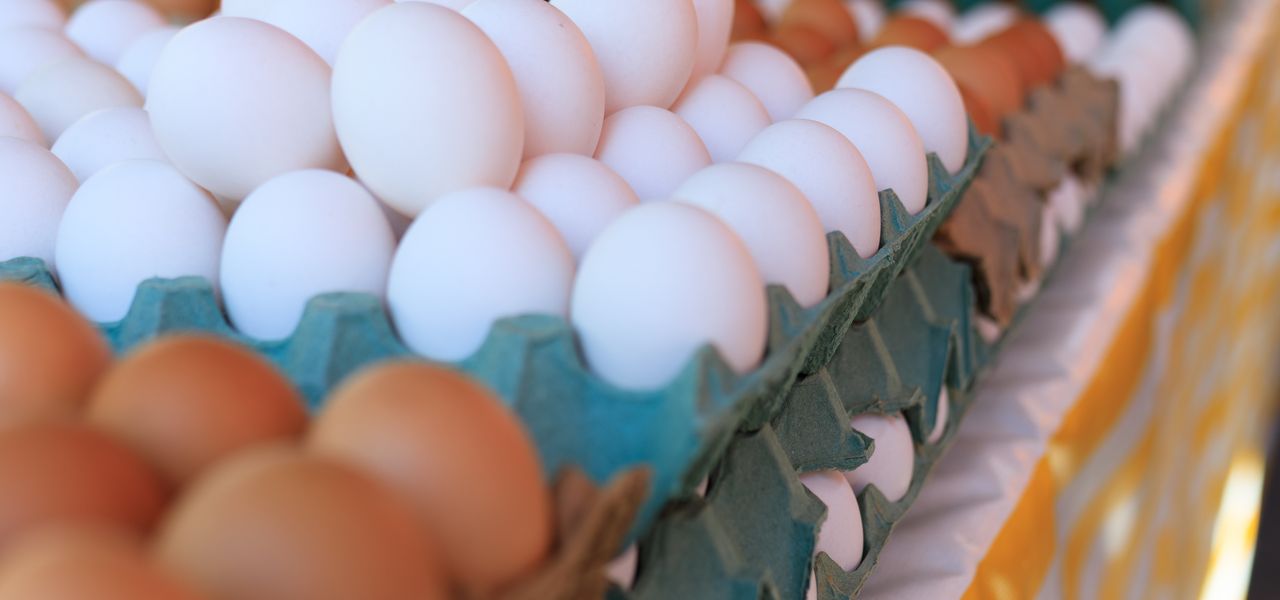
Farm eggs for sale at a market stall.
Credit: the price of selling without cash
Credit feels like a sale, but until the money arrives it is a loan from you to the buyer, made with your feed money. It carries two costs.
The first is delay. Your feed supplier wants payment now. If a buyer pays three weeks late, you must find three weeks of working capital elsewhere, and if you borrow it, the interest is a cost of the sale.
The second is default. When a crate is never paid for, you do not lose only the profit. You lose the full cost of producing it. In the example above, one unpaid crate costs GH₵ 45.87, and at GH₵ 6.13 profit a crate it takes 45.87 ÷ 6.13, about seven and a half paid crates, to get that money back. A retailer who disappears owing for 20 crates has cancelled the profit on roughly 150.
Before any goods leave on credit: agree the amount and the payment date, write it in the debtors page with the buyer's phone number, and decide the limit beyond which you will not supply. If a payment is missed, stop supplying until it is cleared. Do this politely and without exception.
Other ways to cut credit risk: quote a cash price and a slightly higher credit price, so that the buyer pays for the delay. Take a deposit on pre-orders for festive broilers. Use mobile money so there is a record of every payment. Give credit only to buyers with a fixed place of business who have first bought from you for cash. Institutions such as schools and hotels nearly always pay in arrears, and their terms need separate handling, covered in supplying eggs to shops, schools and hotels.
When to change your price, and how to tell buyers
Recalculate your cost whenever one of the big inputs moves: a new feed price, a new chick price, a change in mortality or laying rate. Feed is the trigger most often. A rise of GH₵ 20 on a 50 kg bag adds GH₵ 0.40 a kilo, which in the examples above is about GH₵ 1.50 on a broiler and GH₵ 1.70 on a crate at 80% production.
When you must raise a price, tell regular buyers a few days before, state the new price plainly and give the reason in one sentence. Apply it to everyone from the same date. Buyers accept an explained increase far more readily than one that appears without warning. Avoid changing prices every few days, which invites bargaining on every sale.
When market prices fall, resist the urge to be the cheapest. Clean, graded eggs delivered on the agreed day and birds of the promised weight hold customers better than the lowest price.
A pricing sheet to fill in before every batch
Keep one page at the front of your record book. Update it at each stocking, or monthly for layers:
Cost per bird sold, per live kilo and per dressed kilo, or cost per saleable crate.
Floor price: the lowest figure you will accept.
Target price: cost plus your chosen margin.
Market price this week at farm gate, wholesale and retail.
Discount ladder and what the buyer must give in return.
Credit limit for each named customer, and total credit you can afford to have outstanding.
The chick price is one of the few costs you can fix before a batch begins. Halaal Farms Ghana confirms the price, hatch date and delivery cost before you pay, so a firm figure goes into your cost sum. Starting prices for broiler day-old chicks and layer day-old chicks are on the price list. They change, so check before you budget. If you would like help working through the cost of your next batch, call 024 915 1503 or send the order form. We give free advice to farmers before and after an order.
Questions farmers ask
How do I calculate the cost of producing one crate of eggs?
Add three things. First, feed per crate: daily feed in kilos divided by crates collected, multiplied by your feed price per kilo. Second, the hen's own cost: what the pullet cost to reach point of lay, less what you will get for her as a spent hen, spread over the crates she lays. Third, a share of labour, medicines, water, power and transport. Then add a small allowance for cracked eggs.
Should I sell broilers per bird or per kilo?
Selling by weight is fairer to both sides and protects you when birds are heavier than the buyer assumes. Many live-bird buyers in Ghana prefer to judge by eye and pay per bird, so know your average weight and cost per kilo before you bargain. A hanging scale at the farm gate lets you show the weight and defend your price even when the deal is struck per bird.
What profit margin should a poultry farmer aim for?
There is no single correct figure. The margin has to pay you for your time, cover the risk of a bad batch and leave something to reinvest. Work out your cost first, find the going market price, and see what margin that leaves. If it is thin, look for savings in feed conversion and mortality, or sell closer to the final consumer, before you try to push the price above the market.
Is it safe to sell eggs or chickens on credit?
Credit is safe only in small, controlled amounts with buyers who have a record of paying. Set a limit for each customer, agree the payment date before goods leave the farm, write every debt down and stop supplying when a payment is missed. Remember that an unpaid crate costs you its full production cost, so it takes the profit from several paid crates to recover the loss.
Written by the Halaal Farms Ghana team. We hatch and import day-old chicks at Opeikuma, Kasoa, and deliver to all 16 regions. This article is general guidance for farmers. For diagnosis and treatment of sick birds, speak to a vet or your district veterinary office.
The main ways Ghanaian farmers pay for chicks, feed and housing, what each one really costs, what lenders want to see, and how to match the type of money to broilers or layers.
How to win and keep institutional egg buyers: working out what you can promise, grading and packing, delivery routines, the paperwork they expect, and keeping credit from draining your feed money.
A practical way to list the threats to your flock and your cash, cut the odds of each, build a reserve, ask the right questions about insurance and write a one-page emergency plan.