
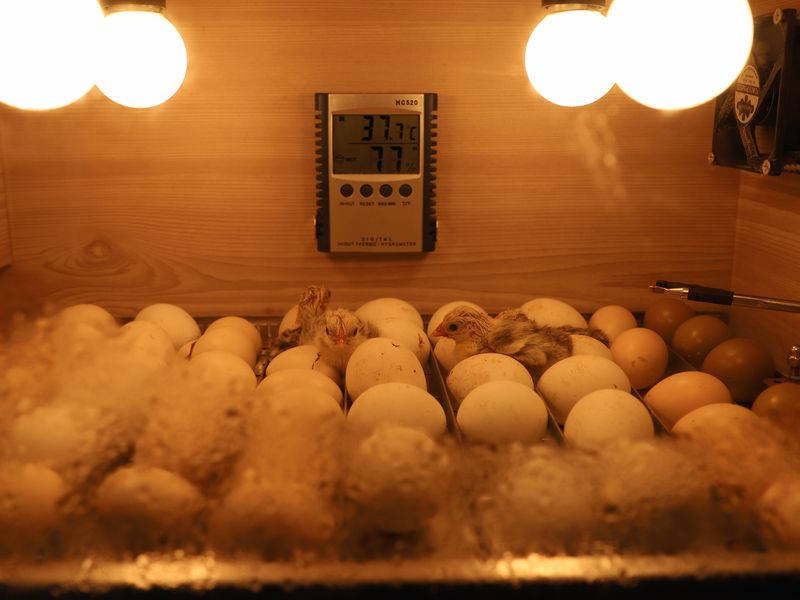
If you keep cocks with your hens, you already own the raw material for your next flock. What you may not own is an incubator, steady power for three weeks, or enough broody hens. That is the gap this service fills. You bring fertile eggs from your own birds to our hatchery at Opeikuma, Kasoa, we hatch them in our incubators for a fee, and you collect the chicks. This page tells you which eggs are worth bringing, how to keep and carry them, what happens while they are with us, and why the hatch you get is decided largely before the eggs leave your farm.
Who this service suits, and who should buy chicks instead
It suits farmers who breed their own birds: local chickens, a line of dual-purpose birds you have selected over the years, or a flock you want more of. A broody hen covers about a dozen eggs and stops laying while she sits and rears. A hatchery sets all your eggs together, so the chicks come out on one day at one age, which makes brooding, vaccination and selling far easier to manage.
It does not suit everyone. If you have no cocks, you have no fertile eggs, and what you need is fertile hatching eggs or day-old chicks. If you want to hatch small batches all year, compare the fee with the cost of running an incubator of your own. And if your hens are commercial hybrids such as layers or Sasso, their eggs will hatch when a cock is present, but the chicks are a second-generation cross and will not grow or lay like their parents. For hybrid performance, buy hybrid chicks.
A good hatch starts in the breeding flock
An incubator adds nothing to an egg. It can only keep alive what the hen and cock put there. Three things on your farm decide that.
- Enough cocks. A common guide for chickens is one active cock to about eight to ten hens. Too few cocks and many eggs are clear. Too many and they fight instead of mating.
- Time together. Cocks should have been running with the hens for about two weeks before you start saving eggs.
- Health and feed. Hens that are sick, wormy, very old or fed on maize alone lay eggs with weak embryos and thin shells. Hens in their first weeks of lay give small eggs that hatch poorly.
Our article on keeping a breeder flock for fertile eggs goes further into mating ratios and feeding.
Which eggs to set and which to eat
Sort your eggs before they travel. Every egg that should not have been set takes a space you pay for and can spoil the eggs around it.
| Check | Set it | Eat it or sell it |
|---|---|---|
| Age | Laid within the last seven days | Older than about ten days, or age unknown |
| Size | Average for your flock | Very small, very large or double-yolked |
| Shape | Normal egg shape, one end clearly blunter | Round, long and narrow, ridged or lopsided |
| Shell | Smooth, sound, no cracks when two eggs are tapped gently together | Cracked, thin, rough, chalky or wrinkled |
| Cleanliness | Clean from the nest, or with a speck that brushes off dry | Smeared with droppings, mud or broken egg |
Do not wash hatching eggs or wipe them with a wet cloth. Water takes off the shell's natural coating and can carry dirt through the pores. A dirty egg can rot in the warmth of an incubator, burst and contaminate the eggs beside it, which is why a hatchery may turn dirty eggs away. Clean eggs come from clean nests and from collecting several times a day, not from scrubbing. There is more on this in selecting and storing hatching eggs.
Keeping eggs alive in Ghana's heat until setting day
A fertile egg holds a living embryo that is resting. It stays at rest in cool conditions, and breeder farms store eggs at roughly 15 to 18 °C for that reason. An ordinary room in Ghana is ten degrees or more above that. In such warmth the embryo starts and stops and grows weaker by the day, so the single most useful thing you can do here is to keep storage short.
- Keep the eggs in the coolest, shadiest room you have, away from the kitchen, a zinc roof and direct sun.
- Do not put them in a household fridge. It is far colder than the storage range and can kill the embryo.
- Stand them in clean egg trays with the pointed end down.
- If they will wait more than three or four days, prop one end of the tray up and change the side daily.
- Write the laying date on each egg in pencil. Do not use a marker pen.
- Agree the setting date with us first, then save eggs for the week before it, not the other way round.
Carrying eggs to Opeikuma without shaking them
Rough handling does damage you cannot see: hairline cracks, and a loosened air cell inside the blunt end. Pack the eggs in trays, pointed end down, stack the trays in a carton with padding so nothing slides, and label the carton with your name, phone number and the number of eggs. Carry it in the cabin of the vehicle, level and shaded, never in a hot boot or in the sun on a pickup. Go slowly over rough ground. A motorbike on a broken feeder road is the hardest ride an egg can have, so if that is your only way to the main road, hold the carton instead of tying it to the carrier.
Travel in the cool of the morning and come by appointment, so the eggs are received as you arrive. Eggs that have been on the road should rest for some hours before they are set, so plan to bring them ahead of setting day as agreed. If you live too far from Kasoa to bring eggs yourself, call us before you send them by any other means.
What happens during the 21 days
| Stage | What is done | What it tells you |
|---|---|---|
| Setting day | Eggs go into the setter on trays, blunt end up, at about 37.5 °C | The 21-day count begins |
| Days 1 to 18 | Steady heat and humidity. The eggs are turned many times a day so the embryo does not stick to the shell | Nothing to see from outside |
| About day 7 to 10 | Candling: a bright light is held against each egg | Developing eggs show veins and a dark spot. Clear eggs were infertile or died very early |
| Day 18 | Turning stops. Eggs move to hatching baskets and humidity is raised | Eggs with dead embryos can be taken out |
| Days 20 to 21 | Chicks break the shell, hatch and dry | Your hatch is counted |
Candling is the point where you learn the truth about your flock. If many eggs are clear after a week, the fault lies with fertility or storage on the farm, not with the last days in the machine. Ask us for the candling count for your batch, and use it: a high number of clears is a reason to look at your cocks, your feed and how long you are keeping eggs. Our guide to candling eggs shows what a live egg looks like at each stage, and the hatchery page explains what happens to chicks after they come out.
Why nobody can promise that every egg will hatch
Even on professional breeder farms, with selected birds, cool stores and eggs set within days, a share of the eggs set gives no chick. Eggs from a backyard or village flock, saved over a week in a warm room and carried over a rough road, will do less well than that, sometimes much less. Be wary of anyone who guarantees you a full hatch from eggs they have not seen.
The things that decide your result, roughly in the order they happen, are these: fertility in the flock, the age and feeding of the hens, shell quality, the age of the egg and how it was stored, how it travelled, and then the incubation itself. Most of that list belongs to you, which is good news, because it means a poor first hatch can usually be improved. When you book, ask us how the fee works if the hatch is low, so there are no surprises. The article on why eggs fail to hatch helps you trace a disappointing result back to its cause.
Collection day, and booking your space ahead
Chicks should go from the hatchery to a warm brooder without delay, so collect on the day agreed. Have the brooder lit, with litter, water and starter feed in place, before you leave home. The chick brooding guide has the temperatures. Ask us in advance whether to bring your own ventilated boxes, and ask what vaccination can be given to your chicks before they leave. Count them when you collect. Remember that eggs hatch as they come, so about half of your chicks will be male. Plan for cockerels as well as pullets.
Book before you save eggs. Incubator space is planned around setting dates. If you turn up with eggs and there is no space for several days, the eggs age while they wait. Contact us first, get a setting date, and then collect your eggs in the seven days before it.
For guinea fowl, turkey and quail eggs, ask first. They need different incubation times from chicken eggs (in general about 26 to 28 days for guinea fowl, about 28 for turkey and about 17 to 18 for quail), so we need to know the species and number before we can say yes. If you would sooner buy than hatch, we also sell guinea keets, turkey poults and quail chicks.
To book, send the form on this page or call 024 915 1503. Tell us the species, roughly how many eggs, how many cocks and hens they come from, and where you are. We confirm the fee and the setting date before you bring the eggs or pay anything.
Questions buyers ask
Can you hatch eggs I bought in the market or from an egg seller?
Almost certainly not. Table eggs come from commercial layers kept without cocks, so they are not fertile and will never hatch, however long they are incubated. Even eggs sold as fertile in a market are of unknown age and have usually stood in the heat. Bring eggs from a flock where cocks run with the hens, collected by you.
How many of my eggs will hatch?
Nobody can tell you in advance, and nobody honest promises 100 percent. The result depends on how many eggs were fertile, how old they were, how they were stored and carried, and the health and feeding of your hens and cocks. Candling after about a week shows how many eggs are developing, which is the first real answer.
How old can my eggs be when I bring them?
Aim for eggs no more than seven days old on the day they are set, counted from the day each was laid. Hatchability falls with every day of storage and falls faster after the first week, more so in a warm room. Eggs older than about ten days are rarely worth the fee. Mark the laying date on each egg in pencil.
Do you hatch guinea fowl, turkey and quail eggs?
Ask us first, before you start saving eggs. Other species need different incubation times, in general about 26 to 28 days for guinea fowl, about 28 for turkey and about 17 to 18 for quail, and they cannot always share a machine with chicken eggs. Tell us the species and the number and we will say what is possible.
How much does the hatching service cost?
The fee is quoted when you ask, because it depends on the species and the number of eggs you want set. Tell us both and we confirm the fee, what it covers and the setting date before you bring anything. No payment is taken on the website. You pay by cash, mobile money or bank transfer.
What should I have ready on the day I collect my chicks?
A brooder that is already warm, with dry litter, water and starter feed in place, and a way to carry the chicks home with moving air and no direct sun. Ask us beforehand whether you need to bring your own ventilated boxes. Count the chicks when you collect them and ask about vaccination for that hatch.