Cages or deep litter for your layers? Compare capital per bird, labour, egg cleanliness, disease pattern, heat, welfare and manure before you build in Ghana.
Halaal Farms Ghana team4 October 2026 · 13 min read
Key points
A naturally ventilated house holds roughly two to two and a half times as many layers in three-tier cages as on deep litter at 5 to 7 hens per square metre.
Compare systems by cost per bird place, building included, and remember that a fuller house also needs more pullets and more feed money.
Cages reduce coccidiosis, worms, dirty eggs and floor eggs, but bring wet manure, flies, brittle bones and less escape from heat.
Deep litter costs less to start and lets hens behave naturally, but only works while the litter stays dry and nests are well managed.
Move pullets into cages at about 16 to 17 weeks, before they lay, and make sure they find the nipple drinkers in the first days.
Take a naturally ventilated house 10 metres wide and 30 metres long. On deep litter, at six hens to the square metre, it holds about 1,800 layers. Fitted with three rows of three-tier cages, the same building holds somewhere between 3,700 and 4,700, depending on the cage model. That single difference drives most of the argument between the two systems, but it does not settle it. Cages cost more to install, change the diseases you fight, turn manure from a dry by-product into a daily chore and raise a welfare question that some buyers now ask about.
Neither system is the right answer for every farm. What follows compares them on the points that decide the matter in practice, then matches each to the kind of farmer it suits.
The two systems as they are built in Ghana
Deep litter means hens loose on a concrete or rammed floor covered with 8 to 10 cm of wood shavings or a similar dry material, in an open-sided house with a dwarf wall and wire mesh. The birds share tube feeders or troughs and bell or nipple drinkers, lay in nest boxes and, ideally, roost on perches. Brown layers are normally stocked at about 5 to 7 hens per square metre in our climate. The reasoning behind those figures is in our stocking density guide.
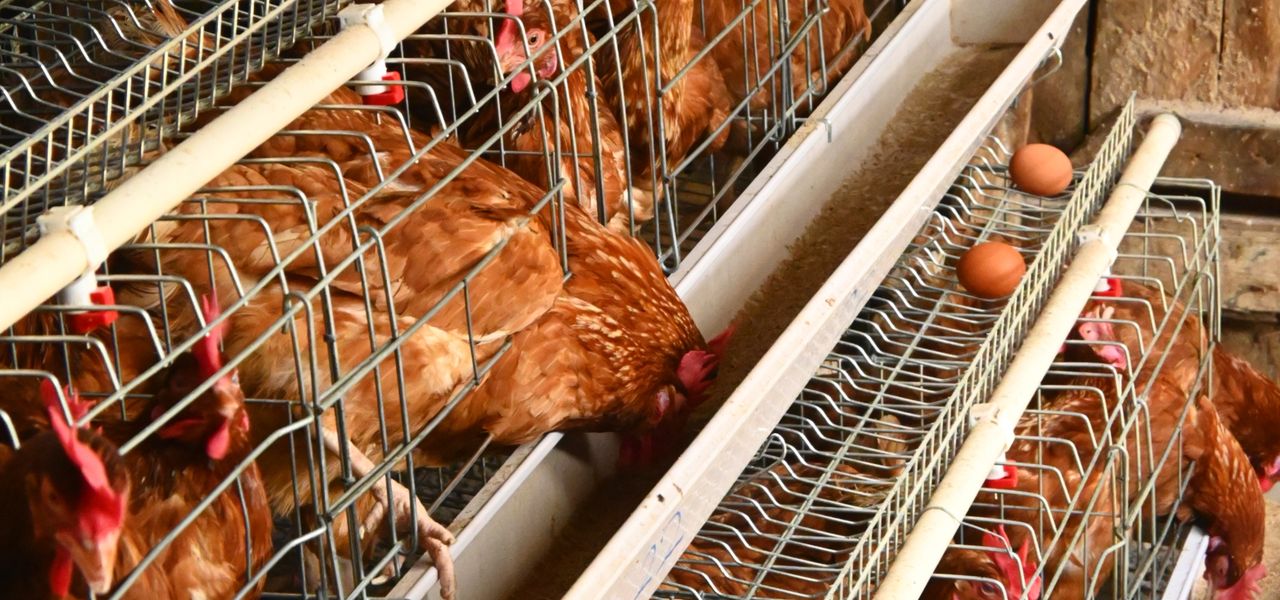
Battery cages on small and medium farms are usually A-frame sets of three tiers, stepped so that droppings from the upper tiers fall clear of the birds below. Each cell holds three or four hens on a sloping wire floor. Eggs roll forward to a tray outside the cell, a feed trough runs along the front and a nipple line runs through the cage, fed by gravity from a small tank. Sets are commonly sold to hold between about 90 and 130 hens. These simple cages need no electricity, which matters where the supply is unreliable.
The comparison at a glance
Point
Deep litter
Battery cages
Birds in a given house
5 to 7 per square metre
Roughly two to two and a half times as many
Starting outlay
Lower: feeders, drinkers, nests, litter
Higher: cages are the largest item after the building
Labour
More walking, litter work, nest and floor egg collection
One worker handles more hens; collection from front trays
Egg cleanliness
Depends on nests and litter; floor eggs are dirty
Cleaner, as eggs roll away from droppings
Main health problems
Coccidiosis, worms, wet litter and ammonia, pecking, smothering
Flies, red mites in cage joints, brittle bones, heat stress, foot and feather wear
Feed use
Slightly higher, as hens are active and can scratch feed out
Slightly lower if troughs are not overfilled
Checking and counting birds
Hard to count; non-layers hide in the flock
Easy to count; a cell with few eggs is seen at once
Manure
Dry, mixed with litter, removed at the end of the flock
Farmers often say that cages are expensive and litter is cheap. That is true of the equipment bill and often untrue of the whole project, because the building is the bigger cost and cages spread it over more hens. The fair comparison is the cost of one bird place, building included.
Here is the method, with example figures only. Replace every number with your own quotations.
Example building: 300 square metres at a total of GH₵ 180,000.
Deep litter: 1,800 hens. Building share is GH₵ 100 per bird place. Add feeders, drinkers, nests, perches and the first litter, say GH₵ 15 per bird as an example. Total about GH₵ 115 per bird place, and GH₵ 207,000 for the house.
Cages: 39 sets of 120 birds, 4,680 hens. Building share is about GH₵ 38 per bird place. If a complete set with troughs and nipple line cost GH₵ 7,200, that is GH₵ 60 per bird. Total about GH₵ 98 per bird place, and close to GH₵ 461,000 for the house.
In this example the cage house is slightly cheaper per bird and more than twice as expensive in total. Both statements matter. Where land and building are costly, as on small plots around Accra, Kasoa and Kumasi, cages make good use of every square metre. Where you have space and can build simply, litter gets you into production for far less money.
Do not stop at the equipment. A house that holds 4,680 hens needs 4,680 pullets reared or bought, and feed for all of them through the weeks before egg income covers the bill. Many cage projects stall with half the cells empty because the owner budgeted for the steel and not for the birds. Test both versions in the poultry profit calculator before you order anything. Remember too that litter is a running cost. Each new flock needs fresh shavings, and in some districts they are no longer cheap.
Labour and the daily routine
On deep litter, the day involves walking the whole floor: filling and shaking feeders, washing drinkers, turning damp patches, topping up nest material and collecting from the nests three or four times, with a search for floor eggs in the corners. Catching birds for vaccination or culling means driving and penning them.
In cages the worker walks the aisles. Feed goes into the trough from a scoop or trolley, eggs are lifted from the front trays, and every bird is at eye level or within reach. One person can care for considerably more hens, and an owner who cannot be on the farm every day finds control easier. Four birds per cell multiplied by the number of cells gives a stock count in minutes, and missing birds are obvious.
Cages add their own tasks. Manure must be scraped out regularly, nipples checked along every line each day, and the top tier, where it is hottest, and the bottom tier, where it is darkest, inspected deliberately because problems hide there.
Clean eggs, cracked eggs and lost eggs
An egg laid in a cage rolls away from the hen within seconds. It does not sit in droppings, cannot be trodden on and is hard for the hen to reach, so dirty eggs, floor eggs and egg eating are far less common. For a farmer selling to shops and hotels that want clean, uniform trays, this is a strong point for cages.
On litter, clean eggs are possible but have to be earned. You need one nest for every four or five hens, nests open before the first egg is laid, dry nesting material topped up weekly, dry litter so that feet are clean when hens enter the nest, and frequent collection. Where those are missing, a tenth or more of the eggs can end up soiled.
Cages can lose eggs in a different way. A floor with too steep a slope, sagging or rusty wire, or a tray with no cushioning cracks eggs as they roll, and thin shells from older hens suffer most. Check a few trays with a torch before you blame the feed.
Each system has its own disease pattern
On deep litter
Hens live in contact with their droppings, so everything passed in droppings circulates. Coccidiosis and worms are the classic litter problems, and both flare when the litter is wet. Damp litter also releases ammonia, which irritates the airways and opens the way to respiratory infection. Keeping the floor dry is the central skill of the system, and it is covered in detail in our guide to litter management.
Loose birds can also harm each other. Pecking spreads through a floor flock because a victim cannot get away from the whole group, and frightened birds can pile in a corner and smother. Good beak trimming, moderate light and enough feeder space keep this in check. The triggers are set out in feather pecking and cannibalism.
In cages
Separation from droppings almost removes coccidiosis and greatly reduces worms. In their place come problems of confinement. Hens that take little exercise have weaker bones, and high producers can develop cage layer fatigue, going down on their hocks unless calcium, phosphorus and vitamin D3 in the feed are right. Inactive, well-fed hens in hot houses are also prone to fatty liver. Claws overgrow, and feathers wear against the wire.
Red mites are a risk in both systems, but cage joints and trough brackets give them thousands of hiding places and they are hard to clear once established. Flies breed in the wet droppings under the cages, especially below a leaking nipple. Airborne viral diseases such as Newcastle disease and infectious bronchitis take no notice of the housing system. Vaccination and biosecurity matter equally in both.
Rearing history matters when birds change system. Pullets reared on litter move into cages without trouble if they are transferred at about 16 to 17 weeks and shown the nipples. Pullets reared in cages and then put on litter have met few coccidia, have never used a perch or a nest, and often suffer coccidiosis and lay on the floor. Ask how point-of-lay birds were reared before you buy.
Moving pullets into cages
Transfer the flock at about 16 to 17 weeks, so that the birds have a week or two to settle before the first eggs. Catch them in the cool of the evening or early morning and carry them by both legs with the breast supported. Fill each cell with birds of similar size, so that small pullets are not kept off the trough by heavier ones, and take out undersized and unthrifty birds at this point instead of giving them a cage place.
Water is the danger in the first days. Press the nipples by hand so that a drop hangs on each one, and leave the lights on for the first few hours so that the birds explore. For the next two days walk every row looking for pullets that sit hunched with an empty crop, because they have not found the drinker. Birds raised on bell drinkers take longest to learn. Keep them on the feed they were eating in the rearing house for the first days. A new house and a new feed together put pullets off eating just when their body weight should still be rising.
Heat, space and the welfare question
A hen on litter that feels hot can move to the windward side, find a cooler spot away from the others and spread her wings. A caged hen stays where she is, shoulder to shoulder with three others, and the top tier sits in the warm air under the roof. In hot inland areas this is a real production risk. If you choose cages, do not build the house wider than natural ventilation can cope with, keep the roof high with a generous overhang, leave both long sides open to the prevailing wind and stock three hens to a cell where the maker allows four. The principles are in our article on poultry house design for Ghana's climate.
Then there is welfare in the wider sense. A conventional cage gives each hen a space smaller than a sheet of A4 paper and prevents walking, wing stretching, dust bathing, perching and nesting. The European Union banned this type of cage in 2012, while still allowing larger furnished cages, and a number of international hotel and food companies have announced that they will buy only cage-free eggs. If you hope to supply buyers of that kind, ask them now what they will require in five years.
Deep litter is not automatically kind to hens. A crowded floor with wet, ammonia-laden litter, pecked birds and heavy worm burdens is poor welfare too. The honest position is that litter allows natural behaviour and demands good management to deliver it, while cages protect hens from some diseases and from each other at the cost of nearly all movement.
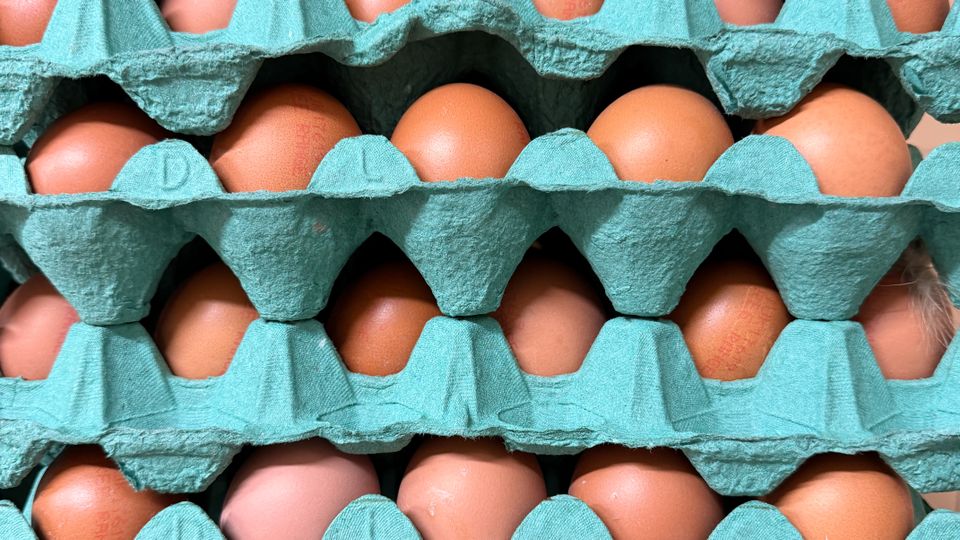
Cardboard trays of brown eggs at a market.
Manure: dry and bagged, or wet and daily
A laying hen passes roughly 100 grams or more of fresh droppings a day, about three-quarters of it water. A thousand hens therefore produce over 100 kg daily, around three tonnes a month.
On deep litter, that moisture evaporates as the hens scratch and turn the bedding. What you remove at the end of the flock is a dry, crumbly mix of droppings and shavings that can be bagged and sold to vegetable growers with little smell.
Under cages, pure droppings pile up wet. Left for weeks in the rainy season they become a slurry that breeds flies and brings complaints from neighbours. Plan from the start for a concrete floor with a slight fall, a routine of scraping out every few days, a covered place to dry or compost the manure and a buyer or a field to take it. Spreading dry shavings or lime under the cages helps. Our guide to handling, composting and selling poultry manure explains the options.
What to inspect before you buy cages
Galvanising. Hot-dip galvanised wire lasts far longer than thinly plated wire, particularly in humid coastal air. Ask which it is and look at the cut ends and welds for early rust.
Floor. The wire should be smooth, firm under the hand and sloped enough for eggs to roll gently without racing into the tray.
Trough. A deep trough with an inward lip wastes less feed. Fill it only a third full.
Drinkers. Check that nipples and regulators are of a make for which spares are sold locally, and that each cell has access to two nipples.
Layout. Ask for a drawing of your house showing rows, aisle widths of roughly a metre and working space at both ends.
Second-hand sets. Rusty floors crack eggs and injure feet. Wash, disinfect and treat used cages for mites before any bird goes in.
Which system suits which farmer
Your first flock, a few hundred hens, on your own land. Start on deep litter. The outlay is small, you learn to read birds by walking among them, and if layers turn out not to be your business the house can be used for broilers or cockerels the following month.
A small plot in or near a city. Cages let a modest building carry a flock large enough to pay a worker. Give manure removal and flies serious thought, because neighbours are close.
An owner with a full-time job elsewhere. Cages make counting birds and eggs simple and make it obvious when hens are not laying, which helps when you depend on a caretaker.
A farmer with crops or vegetable-growing customers. Either system supplies manure, but dry litter manure is easier to store, bag and transport.
A site that is hot and still. Favour litter at a moderate density, or cages at three per cell in a narrow, high house. Dense cages in a low, wide building are the worst combination.
Buyers who ask for cage-free eggs. Deep litter with good nests, or litter with access to an outside run, is the only option.
Many farms combine the two: chicks and growers are reared on litter, then moved into cages a week or two before lay. Whichever you choose, the result still depends on the pullet you put in it. Halaal Farms Ghana delivers layer day-old chicks (Hy-Line Brown, Hy-Line White, Lohmann Brown and Bovans Brown) and point-of-lay pullets to all 16 regions, and the chicks are vaccinated at the hatchery before they leave. Starting prices are on the day-old chick price list.
If you are still deciding between the two, call us on 024 915 1503 or send the order form with your house measurements and budget. We give advice free of charge, and we confirm price, hatch date and delivery cost before you pay anything.
Questions farmers ask
How many layers does one battery cage hold?
Cage sets sold for small and medium farms in West Africa commonly hold between about 90 and 130 hens. They are built in three tiers, with each cell taking three or four birds. Ask the seller for the number of cells, the cell size and the space per hen, and stock at the lower number in hot areas so that birds can lose heat.
Do layers in cages lay more eggs than layers on deep litter?
The genetics are the same, so a well-managed flock lays at a similar rate in either system. The difference is in what reaches the crate and what it costs. Caged hens usually eat slightly less, and fewer eggs are lost as floor eggs, dirty eggs or eaten eggs. Poorly ventilated cages in hot weather can reverse that advantage.
Can I move hens from deep litter into cages after they have started laying?
You can, but expect a fall in production for one to three weeks because of the stress of catching, a new feeder and a new drinker. It is far better to move pullets at 16 to 17 weeks, before the first eggs. If you must move laying hens, do it in the cool of the evening and check that every bird finds water.
Are wooden or bamboo cages a good way to save money?
They can work for a small flock, but they have real drawbacks. Wood soaks up droppings, is hard to disinfect and gives red mites countless cracks to hide in. The floor must still be smooth wire set at the right slope or eggs will crack or stay under the hens. Compare the cost over several flocks and not just the first one.
Written by the Halaal Farms Ghana team. We hatch and import day-old chicks at Opeikuma, Kasoa, and deliver to all 16 regions. This article is general guidance for farmers. For diagnosis and treatment of sick birds, speak to a vet or your district veterinary office.
A practical method for finding the hens that eat without laying: five physical checks you can do in seconds, a test pen for doubtful birds, the right time to cull and how to sell the culls.
Follow the egg from the nest to the buyer: a collection timetable, nest management, what to do with dirty eggs, grading by quality and size, storage in hot weather and transport without breakages.
Feathers on the floor and fewer eggs in the trays usually mean an older flock is moulting. Here is how to confirm it, feed through it and decide whether a second laying cycle pays.