Coughing, Sneezing and Swollen Faces: Respiratory Disease in Chickens
Sneezing, rattling and swollen faces have several causes. How CRD, coryza and infectious bronchitis differ, what dust and ammonia do, and when to call a vet.
Halaal Farms Ghana team4 October 2026 · 12 min read
Key points
Listen to the flock at night with the lights off; sneezing, rattling or coughing in resting birds is the earliest sign of respiratory trouble.
Ammonia you can smell at bird height and dust from dry litter damage the lining of the windpipe and let germs in, so fix the air before anything else.
CRD spreads slowly and lingers, coryza swells the face within days, and infectious bronchitis sweeps the house in two days and spoils egg shells.
Antibiotics do nothing against infectious bronchitis, and birds that recover from CRD or coryza stay carriers, so get a diagnosis before you buy medicine.
Sudden heavy deaths with breathing signs may be Newcastle disease or avian influenza and must be reported to the veterinary office at once.
Stand inside the poultry house at nine at night, with the lights off and nobody talking, and listen for two minutes. A healthy flock at rest is close to silent. A flock with a breathing problem gives itself away: short, sharp sneezes (farmers call them snicks), a wet rattle like water in a pipe, or a repeated cough from one corner. Night is the best time to hear it because the birds are still and the daytime noise of feeding has stopped. What you hear, how many birds are doing it and how fast it spreads over the next two days are your first clues.
Respiratory disease on a poultry farm is seldom one germ acting alone. More often it is a germ plus bad air, or two germs together. The three names you will hear most are chronic respiratory disease (CRD), infectious coryza and infectious bronchitis. They overlap enough that guessing is expensive, and differ enough that the right response to one is useless for another.
What to look and listen for
Walk the house slowly and pick up a few birds. Hold a bird's chest close to your ear to hear rattling that is too soft to notice from a distance.
Snicking and sneezing: irritation of the nose and upper airway.
Rattling or gurgling: mucus in the windpipe.
Gasping with the beak open and neck stretched: the windpipe is partly blocked. This is an emergency sign.
Head shaking: the bird is trying to clear its nostrils or throat.
Wet or crusted nostrils, often with feed stuck to them, and dirty feathers on the shoulder where the bird wipes its face.
Foamy or watery eyes, eyelids stuck together.
Swelling of the face below and in front of the eye, or swollen wattles.
A sour or rotten smell around the birds' heads.
Then write down the facts a vet will ask for: the age of the flock, roughly how many birds in a hundred are affected, the day you first noticed it, feed and water intake compared with last week, egg numbers and shell quality, deaths, and anything that changed in the past ten days such as a vaccination, new birds, a storm or wet litter.
Start with the air: ammonia, dust and chilling
The windpipe is lined with microscopic hairs and a film of mucus that sweep dust and germs up and out of the airway. A chicken depends heavily on this cleaning system, because its lungs connect to thin-walled air sacs that run through the body cavity. Anything that gets past the windpipe can spread a long way.
Ammonia is the gas released when droppings break down in damp litter. It paralyses and then strips the cleaning lining, and at higher levels it burns the eyes. Test for it with your own nose, crouching at bird height, first thing in the morning before the curtains are raised. If you can smell ammonia clearly, it is already around the level that most guides treat as the upper limit for poultry, roughly 20 to 25 parts per million. If your eyes sting, it is far above that, and the birds have been breathing it all night.
Dust overloads the same lining and carries bacteria on its particles. The harmattan is the worst time, especially in the north, but fine dry sawdust, mash feed and sweeping a house with birds inside all add to it. Coarser wood shavings make less dust than fine sawdust.
Chilling does not cause infection, but a cold draught at bird level on a harmattan night or during a storm stresses the flock and lets a quiet infection flare. The usual mistake is to close every curtain tight to keep birds warm, which traps ammonia. A gap along the top of the curtain on the sheltered side lets foul air out without a draught on the birds.
Whatever the germ, signs often ease within a few days of removing wet litter and correcting curtain use. Our article on ventilation in open-sided poultry houses explains curtain management through the day.
Chronic respiratory disease (CRD): the slow one
CRD is caused by Mycoplasma gallisepticum, a very small bacterium that has no cell wall. It creeps through a flock over weeks instead of days, and it can sit unnoticed until a stress brings it out: a live vaccine, a spell of ammonia, cold nights, or a second infection.
The signs are snicking, rattling, wet nostrils and foamy eyes in a share of the birds, with reduced appetite and slow growth. Layers lay fewer eggs, often by a margin small enough to miss unless you keep records. On its own CRD kills few birds. The serious form comes when E. coli bacteria and dusty, ammonia-laden air join in. The air sacs, normally as clear as cling film, turn cloudy and fill with yellow cheesy material, and a pale film covers the heart and liver. Broilers of four to seven weeks are the usual victims. Deaths rise, birds stop growing and carcasses are spoiled.
Three facts about the organism decide how you manage it:
It passes through the hatching egg. Chicks from infected breeder flocks can hatch already carrying it. It also spreads bird to bird and on hands, clothes and equipment.
An infected bird stays infected for life, even when it looks well.
It is fragile outside the bird and dies within days. An emptied, cleaned and rested house is safe. The disease returns with birds, not with the building.
Certain antibiotic families reduce the signs and the losses, and a vet will prescribe one where it is worthwhile. None of them clears the infection, so signs can return after the course ends. Penicillin-type antibiotics do not work at all, because they attack a cell wall this organism does not have.
Infectious coryza: the swollen face
Coryza is a bacterial disease (the organism is Avibacterium paragallinarum) and it moves quickly. Signs appear one to three days after exposure and pass through a house within days.
The mark of coryza is swelling of the face under and around one or both eyes, caused by the sinuses filling with discharge. The nostrils run, first clear and then thick and sticky, and the discharge often develops a foul smell. Eyes close. Wattles swell, most obviously in cocks. Birds eat and drink less, and layers can lose anything from a tenth to almost half of their production. Few birds die from coryza alone, but it can drag on for weeks when other infections join it.
It is mainly a disease of growers and adult birds, and of farms that keep several ages together. Recovered birds remain carriers. Each new group of pullets brought near the older hens, or sharing their drinkers, catches it in turn. The organism is spread in nasal discharge, through drinking water and by close contact. It is not passed through the egg, and like mycoplasma it dies within a few days outside the bird.
Coryza responds to treatment prescribed by a vet, but relapses are common once treatment stops, and the carriers remain. Where coryza is an established problem, a killed vaccine is given by injection to pullets during rearing, commonly as two doses some weeks apart before lay. Your vet will know whether it is needed in your area.
Infectious bronchitis: the fast one that also damages eggs
Infectious bronchitis (IB) is caused by a virus that infects chickens only. It is one of the most contagious diseases of poultry. Signs begin within a day or two of infection, and nearly every bird in the house is affected within about 48 hours.
In chicks, you see gasping, coughing, rattling, wet eyes and nostrils, and birds huddling under the heat and leaving their feed. Deaths are usually modest but can be heavy in very young chicks or where E. coli follows. Some strains attack the kidneys. Those flocks drink more, pass wet droppings and may show few breathing signs at all.
In layers, the breathing signs may be mild and gone in a week. The eggs tell the story. Production falls, sometimes slightly and sometimes by half, and the eggs that are laid have thin, rough, wrinkled or misshapen shells, with brown eggs turning pale and the white turning watery. Recovery takes several weeks and the flock may never return to its earlier level.
In baby pullets, infection in the first two or three weeks of life can damage the developing oviduct for good. Those birds grow up looking like normal hens and never lay.
No drug acts on the virus. Care means warmth for young birds, fresh air, and a vet's decision on whether secondary bacterial infection needs treatment. Prevention is by vaccination. Live IB vaccine is commonly given in the first days or weeks of life, often combined with Newcastle vaccine, and layers usually receive a killed vaccine by injection before lay. The virus exists in many variants, so protection is good but not always complete.
The three side by side
Feature
CRD
Infectious coryza
Infectious bronchitis
Cause
Mycoplasma (bacterium without a cell wall)
Bacterium
Virus
Speed of spread
Slow, over weeks
Fast, over days
Very fast, one to two days
Age most affected
Broilers from four weeks, layers at any age
Growers and adults
All ages, worst in young chicks
Leading signs
Snicking, rattling, foamy eyes, slow growth
Swollen face and wattles, smelly nasal discharge
Gasping and coughing in chicks, wet droppings with kidney strains
Effect on eggs
Fewer eggs, shells normal
Sharp fall in numbers
Fall in numbers plus thin, wrinkled, pale shells and watery whites
Passed through hatching eggs
Yes
No
No
Carriers after recovery
Yes, for life
Yes
Virus shed for some weeks
Do antibiotics act on it
Some families, without clearing it
Yes, with relapses
No
Use the table to describe what you see, not to make a diagnosis. Real outbreaks often combine two columns.
Avian influenza: sudden, very heavy deaths, swollen heads, blue-purple combs and wattles. This must be reported immediately. Our article on what to do about avian influenza gives the steps.
The wet form of fowl pox: yellow cheesy patches in the mouth and throat that make birds gasp, usually with scabs on combs somewhere in the flock. It is covered in fowl pox and Marek's disease.
Brooder pneumonia (aspergillosis): silent gasping in chicks in their first weeks, caused by breathing mould spores from damp litter or mouldy feed. It does not spread from bird to bird and has no practical treatment. Remove the mouldy material.
Infectious laryngotracheitis: violent coughing and gasping in older birds, sometimes with blood-stained mucus.
Gapeworm: gaping and stretching the neck in free-ranging and village birds that pick up the worm from the soil.
Heat: panting with wings held away from the body on a hot afternoon is silent, affects the whole flock and stops in the evening. It is not disease.
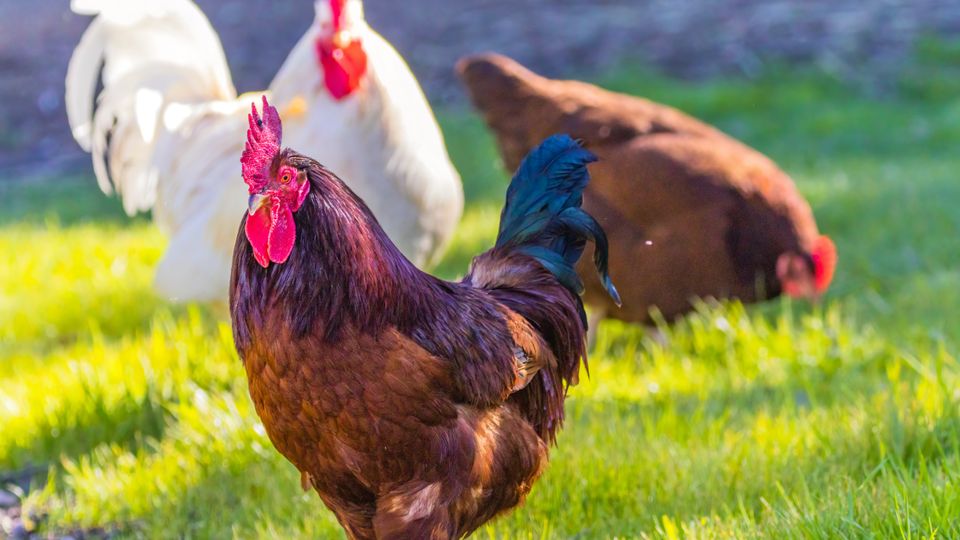
Three chickens on a grassy farm.
Why the diagnosis comes before the medicine
When a flock starts coughing, the common reaction is to buy an antibiotic the same afternoon. Consider what can go wrong.
If the cause is infectious bronchitis or Newcastle disease, the antibiotic does nothing to the virus, and the money is spent while the real problem runs on. If the cause is mycoplasma and the product belongs to a family that needs a cell wall to work, the result is the same. If the product is right but the course is stopped as soon as the noise fades, the infection returns, and each half-finished course helps bacteria on the farm become resistant. And every course carries a withdrawal period during which eggs and meat must not be sold. Our article on using antibiotics responsibly goes through this in detail.
There is a safety point too. The antibiotic tiamulin, widely used against mycoplasma, reacts dangerously with some anticoccidial drugs found in broiler feed. Always tell the person prescribing what feed the birds are eating.
A vet, or the district veterinary office, will open several birds and look at the windpipe, air sacs, sinuses and kidneys. Where a laboratory is within reach, swabs or blood samples can confirm which organisms are present, and the result guides the vaccination programme for the next flock as much as the treatment of this one. Bring live birds in the early stage of illness if you can, along with your vaccination dates and egg or weight records.
What to do in the first two days
Record the starting point: birds affected, deaths, feed, water and eggs. You will need these to judge whether things are improving.
Fix the air today. Take out wet and caked litter, add dry litter, open the sheltered-side curtains from the top, and stop dry sweeping.
Treat the house as a unit. Give it its own boots and tools, and attend to it last. You cannot isolate your way out of a disease that is already through the house, but a few badly affected birds do better in a sick pen where they can reach feed and water.
Call the vet and take birds for post-mortem.
Empty, scrub and refill drinkers daily. Nasal discharge in the water spreads infection.
Hold off other vaccinations until the vet advises, and do not move birds off the farm or bring new ones on.
If deaths are sudden and heavy, stop all movement of birds, eggs and manure and report to the veterinary office before doing anything else.
Watch the eggs. On a layer farm, a fall in egg numbers together with pale, rough or wrinkled shells a few days after a mild cough points strongly towards infectious bronchitis. Keep a tray of the abnormal eggs to show the vet.
Keeping respiratory disease off the farm
Because CRD and coryza live in carrier birds and die quickly outside them, most of the prevention is about which birds you bring in and which birds they meet.
Start with healthy chicks. Mycoplasma travels through the hatching egg, so the health of the breeder flock matters. Ask any hatchery about its breeder stock and what vaccines the chicks receive. Layer chicks and broiler chicks from Halaal Farms Ghana are vaccinated at the hatchery before they leave, and we will tell you what a batch has had.
Be careful with started birds. Growers, point-of-lay pullets and spent hens from farms you do not know are the commonest way coryza and CRD arrive. If you must buy them, keep them well apart from your own flock at first.
Keep one age in a house, and where a farm has several ages, work from the youngest to the oldest each day.
Empty, clean and rest each house between batches. A fortnight of downtime ends the life of both mycoplasma and the coryza organism in that building.
Follow a vaccination programme set by your vet that includes infectious bronchitis and, where the farm history calls for it, coryza.
Brood well. Chicks that are chilled or kept in stale air in the first two weeks carry airway damage forward. The chick brooding guide covers heat and fresh air together.
Keep village chickens, ducks and pigeons out of the poultry area and away from feed and water.
If you are restocking after a respiratory problem, tell us when you call Halaal Farms Ghana on 024 915 1503 or send the order form. We can talk through the timing of the new batch against your clean-out, and what to ask your vet about the vaccination programme, before you commit to a hatch date.
Questions farmers ask
Why are my chickens sneezing a few days after vaccination?
A mild sneeze or snick that starts three to five days after a live Newcastle or infectious bronchitis vaccine and fades within a few days is a normal reaction. The vaccine virus multiplies briefly in the airways. If the reaction is heavy, lasts more than a week or turns into rattling and swollen eyes, poor air quality or an underlying infection such as mycoplasma is usually involved. Call a vet.
Can I eat eggs from hens that are coughing or have swollen faces?
CRD, infectious coryza and infectious bronchitis do not infect people, and eggs from affected hens are safe when cooked. Two cautions apply. If the flock has been given antibiotics, the eggs must not be sold or eaten until the withdrawal period on the label has passed. And if birds are dying suddenly in numbers, stop all sales and report to the veterinary office.
Will respiratory disease in chickens clear up without treatment?
It depends on the cause. Infectious bronchitis runs its course in one to two weeks, although egg production may take much longer to recover. CRD and coryza seldom clear completely. Signs fade, but many birds remain carriers and the disease returns when the flock is stressed. Improving air quality helps in every case, and a vet can tell you whether treatment is worth giving.
Is it safe to mix recovered birds with a new batch?
No. Birds that have recovered from CRD or infectious coryza can carry the organism for the rest of their lives while looking healthy. Placing new pullets beside them, or in a house they have just left without cleaning and resting it, is the usual way these diseases pass from batch to batch. Keep ages apart and care for the youngest birds first.
Which antibiotic is best for coughing chickens?
There is no single best one, and often none is needed. Antibiotics act only on bacteria, so they do nothing against viral causes such as infectious bronchitis or Newcastle disease, and some antibiotic families have no effect on mycoplasma. The right choice depends on a diagnosis. A vet will choose the drug, the course and the withdrawal period for meat or eggs.
Written by the Halaal Farms Ghana team. We hatch and import day-old chicks at Opeikuma, Kasoa, and deliver to all 16 regions. This article is general guidance for farmers. For diagnosis and treatment of sick birds, speak to a vet or your district veterinary office.
Fowl pox scabs combs and blocks throats; Marek's paralyses legs and grows tumours. See how each spreads, when and how the vaccines are given, and what you must still do on the farm.
Bird flu kills poultry fast and can infect people who handle sick birds. Learn the signs, the steps to take in the first hour, what happens after you report, and how to keep the virus off your farm.
Disease is carried onto a farm by boots, crates, birds and vehicles. These twenty measures, ordered from the gate to the bird, block those routes with a padlock, spare boots, a brush and a notebook.