Aflatoxin and Mouldy Feed: The Hidden Thief of Poultry Profit
How aflatoxin gets into maize and groundnut cake, what it does to chickens, how to spot and test risky grain, what binders can do and when to reject a batch.
Halaal Farms Ghana team4 October 2026 · 12 min read
Key points
Aflatoxin has no smell or colour, survives milling and pelleting, and can be present in grain that looks clean.
Low doses do the most damage to profit: slower growth, worse feed conversion, fewer eggs and weaker response to vaccines, with no obvious sickness.
Ducklings and turkey poults are far more sensitive than chickens, and young birds more than adults, so starter feeds need the cleanest grain.
Mould needs moisture, so maize dried to 13 per cent and kept dry is your main protection.
A toxin binder reduces the harm from low-level contamination but never makes a visibly mouldy batch safe to feed.
Aflatoxin has no smell, no taste and no colour. A bag of maize can pass every check your eyes and nose can make and still carry enough of it to slow a broiler flock, thin out egg production and blunt the vaccines you paid for. It rarely kills chickens outright. What it does is take a little from every bird, every day, and leave nothing on the post-mortem table that points clearly back to the feed. That is why farmers lose money to it for months without naming the cause.
The toxin was discovered through poultry. In 1960 more than 100,000 turkey poults died in England from an unknown illness that was eventually traced to groundnut meal contaminated by a mould. The poison that mould produced was named aflatoxin. Ghana grows and stores maize and groundnuts in exactly the warm, humid conditions the same mould likes, so this is a subject every farmer who buys grain or mixes feed needs to understand.
What mycotoxins are, and which ones matter in poultry feed
Mycotoxins are poisons made by moulds growing on crops and stored feed. The mould is a living fungus. The toxin is a chemical it leaves behind. This distinction matters because you can kill or remove the mould (by drying, sieving or heating) and the toxin stays in the grain. Equally, grain can be mouldy without containing much toxin, and grain with no visible mould can contain a great deal.
Aflatoxin is the most important mycotoxin in West African poultry feed, but it is not the only one. Several often occur together, and their effects add up.
Kidney damage, wet droppings, poor growth and shell quality
Fumonisins
Fusarium species
Maize, very commonly
Chickens tolerate moderate levels, but gut health and immunity suffer at high levels
T-2 and related toxins
Fusarium species
Cereals and cereal by-products
Sores in the mouth, feed refusal, poor feathering
Aflatoxin is also a human health matter. It is a recognised cause of liver cancer in people, which is why grain that fails for poultry must never be diverted to the kitchen.
How maize and groundnut cake become contaminated
The mould that makes aflatoxin lives in soil and on crop residues all over Ghana. Its spores are on almost every cob. Whether they grow and produce toxin depends on moisture, warmth and damage to the grain, and there are four stages at which things go wrong.
In the field
Maize plants stressed by drought and heat while the grain is filling are far more easily infected. So are cobs bored by insects or pecked by birds, because the wounds let the mould past the kernel's skin. Cobs left standing long after maturity, or lodged and touching the soil, pick up more. Groundnuts are at special risk because the pods form in the soil itself. This means some grain is already contaminated on the day it is harvested, however carefully it is handled afterwards.
At harvest and drying
A great deal of the damage is done here. Freshly harvested maize is far too wet to store. If it is heaped in a damp pile, left in sacks before drying, covered with a tarpaulin so that it sweats, or dried on bare ground, the mould grows quickly. In warm, moist grain, toxin can build up within a few days. The southern major-season harvest, which comes in during rainy weather, is the riskiest of the year for this reason.
In storage
The mould cannot grow in maize held at 13 per cent moisture or below. Above about 14 per cent it can. Dry grain becomes wet again from a leaking roof, from bags standing on a concrete floor or against a wall, and from weevils and borers, whose activity produces heat and moisture inside the bag. A small wet pocket is enough: the toxin from a few kilos of spoiled grain ends up mixed through the whole batch at the mill. How to dry, bag and stack grain so that this does not happen is covered in our guide to buying and storing maize and soya.
On your own farm
Clean feed can go mouldy after it reaches you. Look for the damp bottom layer of a stack of bags, the crust of old feed stuck inside tube feeders and bins, feed wetted by rain blown through the side mesh, and feed spilt around leaking drinkers. Milled feed spoils faster than whole grain because every particle is broken open.
What aflatoxin does inside the bird
Aflatoxin is absorbed from the gut and carried to the liver, which tries to break it down and is damaged in the process. Almost everything else follows from a liver that no longer works properly.
Growth and feed conversion. The damaged liver makes less bile and fewer of the proteins the body needs, so fat and protein in the feed are digested less well. Birds eat the same or slightly less and grow more slowly. The feed needed for each kilo of gain goes up.
Immunity. Aflatoxin suppresses the immune system. The organs that produce immune cells shrink, and birds make fewer antibodies after vaccination. A flock on contaminated feed can be vaccinated correctly and still break with Newcastle disease or Gumboro, and it suffers more from coccidiosis and bacterial infections.
Bruising and paleness. Blood clots more slowly and small blood vessels become fragile, so carcasses show bruises and blood spots. Pigment is poorly absorbed, giving pale shanks, combs and yolks.
Eggs. In layers, production and egg size fall, often a week or two after the contaminated feed was first given, and recovery after clean feed is restored takes a similar time or longer. In breeders, hatchability drops.
Bones. Because fat digestion is impaired, the fat-soluble vitamins, including vitamin D, are absorbed poorly, which can show as leg weakness in growing birds.
Sensitivity varies widely between species and ages. Ducklings are the most sensitive of all farm birds, followed by turkey poults. Chickens are more resistant, and adult birds more than chicks. If you keep ducks, turkey poults or guinea keets as well as chickens, do not assume that grain your broilers appear to tolerate is safe for the others. Where grain quality is in any doubt, the cleanest lots should go into starter feed and feed for young turkeys and ducks.
Why it is so hard to see on the farm
High doses cause obvious illness: depressed birds, drooping wings, deaths, and at post-mortem a pale, yellow, swollen liver, sometimes with small bleeds. That is unusual. The common situation is a low dose eaten for weeks, and its signs are the signs of a dozen other problems.
The flock is behind target weight and uneven, although brooding and feeding were done properly.
Combs, shanks and yolks are pale.
Droppings are loose or greasy, and litter is wetter than usual.
Diseases you vaccinated against appear anyway.
Egg production dips with no change in lighting, water or weather.
Dressed birds show bruising that the catching team did not cause.
None of these proves anything by itself. Take them as a reason to look at the feed alongside the other causes set out in our guide to why broilers are not growing. If several appear together shortly after a new batch of maize or feed came in, the feed moves to the top of the list. Ask your vet to open a few birds, and send a feed sample for testing.
The cost is easy to underestimate. As an example, suppose contaminated feed worsens feed conversion on a batch of 1,000 broilers from 1.8 to 1.9. At a sale weight of 2.3 kg that is 230 kg of extra feed. If feed costs GH₵ 8 a kilo (an example price), GH₵ 1,840 has gone, before counting slower growth, extra deaths or a failed vaccination. You can test the effect of a shift like this on your own figures with the poultry profit calculator.
Spotting risky grain before you buy it
You cannot see aflatoxin, but you can see the conditions that produce it. Open several bags, push your hand deep inside, and take handfuls from different depths. Reject or treat as high risk any lot that shows the following.
Visible mould. Powdery yellow-green, grey-green or black growth on kernels or at the tip where the kernel joined the cob. Pink or white mould points to Fusarium.
A musty, sour or earthy smell, or dust that catches the throat.
Caking. Kernels stuck together in clumps have been wet.
Warmth. Grain that feels warm deep in the bag is heating from mould or insects.
High moisture. Anything above 13 per cent on a meter is a storage risk, and grain that has clearly been wet and re-dried is suspect.
Damage. Many broken, shrivelled, discoloured or insect-bored kernels. The toxin is concentrated in these, and in the dust and fine material at the bottom of the bag.
Buyers sometimes use an ultraviolet lamp. Kernels infected by the aflatoxin mould often glow a bright greenish yellow under it. The glow comes from another substance the mould makes, not from the toxin, so it is a warning sign and not a measurement.
Be most careful with groundnut cake, maize bran, mill sweepings and "screenings" sold cheaply as feed. They are cheap because they are what was sorted out of better grain.
Testing: strips, laboratories and the sampling problem
Aflatoxin is measured in parts per billion (ppb). One part per billion is one milligram of toxin in a whole tonne of grain. Many countries set the limit for aflatoxin in poultry feed at around 20 ppb, with tighter limits for young birds in some. Ask the Ghana Standards Authority or your feed mill which limit currently applies here.
Two kinds of test are available. Rapid test strips give a result on the spot in a few minutes after a ground sample is mixed with an extraction liquid, and larger feed mills and grain aggregators use them at the gate. Laboratory methods are slower and more exact. Ask your feed supplier, the Ghana Standards Authority, the CSIR Food Research Institute or a university food science or animal science department where samples can currently be sent, and what the test costs.
The weak point of every test is the sample. Aflatoxin is spread very unevenly. A handful of badly contaminated kernels can carry most of the toxin in a bag while the kernels beside them carry none, so one scoop from one bag tells you almost nothing. Sample like this:
Take small amounts from at least ten bags, or one bag in every ten for a large load, from the top, middle and bottom of each.
Combine them into one sample of 3 to 5 kg.
Mill the whole sample and mix it thoroughly.
Take the portion for testing from the milled, mixed sample.
Keep a second labelled portion, dry and sealed, in case the result is disputed.
If you mix your own feed, a tested maize supply is one of the main quality controls you need, as our article on mixing your own poultry feed explains.
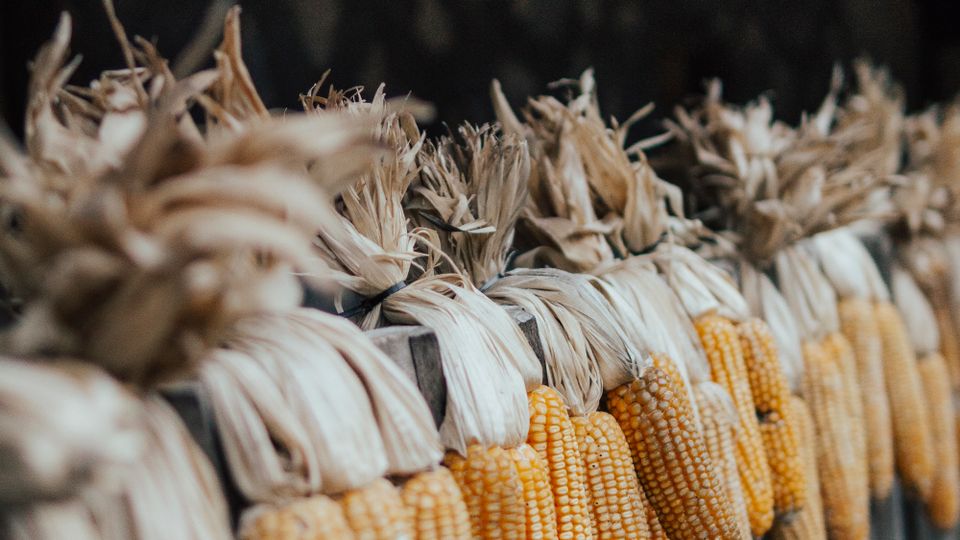
Dried maize cobs hanging to cure.
Binders and mould inhibitors: what they can and cannot do
Two different kinds of product are sold, and they are often confused.
Toxin binders are mixed into feed to hold toxin in the gut so that it passes out in the droppings instead of being absorbed. The best proven are certain clays (bentonites and related aluminosilicates), which bind aflatoxin well. They do much less against ochratoxin, fumonisins and T-2. Products based on yeast cell walls or enzymes are sold for those wider toxins, and their quality varies between brands. Ordinary charcoal is sometimes added on farms. Trials with activated charcoal have given inconsistent results, so do not depend on it.
Mould inhibitors, usually based on propionic acid or its salts, stop mould growing in feed and grain during storage. They do nothing to toxin that is already there.
A binder is insurance against low-level contamination you cannot detect. It makes most sense in the wet season, in the lean months when grain has been in store a long time, and in starter and breeder feeds. Use a product from a known manufacturer at the rate on its label. It is not a licence to buy bad grain. No binder catches all the toxin, and a visibly mouldy batch with binder added is still a mouldy batch. For how to weigh up this and other feed additives, see our buyer's guide to vitamins, probiotics and feed additives.
When to reject a batch, and what to do with doubtful grain
What you find
What to do
Visible mould, caking or a musty smell through the lot
Reject. Do not accept a discount.
Test result above the limit your mill or vet advises
Reject.
Sound appearance but moisture above 13 per cent
Buy only if you can dry it the same day, and pay for dry weight.
A few mouldy or caked bags in an otherwise sound load
Reject those bags. Sample and test the rest before milling.
Dry, sweet-smelling grain with many broken and bored kernels
Sieve and winnow out dust and broken pieces, discard them, use a binder, and keep it out of starter feed.
Groundnut cake of unknown origin
Test it or leave it.
Cleaning helps because the toxin sits mainly in damaged kernels and fines. Sieving, winnowing and hand-picking discoloured grain can remove a large share of it. The material you remove is the most contaminated part. Do not feed it to any bird, and do not sweep it back into the mill.
Rejected grain should not be sold on cheaply to another farmer, and must not go to people for food. Bury it or compost it away from wells and streams. When handling mouldy grain, wear a dust mask and wash afterwards, because the dust is harmful to breathe.
If you think your birds are already eating contaminated feed: remove it and replace it with feed from a different, sound batch. Empty and scrape out feeders and bins. Keep a 2 kg sample of the suspect feed in a sealed, labelled bag. Call your vet or the district veterinary office for a post-mortem and advice on supportive care. There is no drug that reverses aflatoxin damage. Recovery depends on clean feed and time.
Clean feed and the first weeks of a new flock
Young birds are the most easily harmed, and the first weeks are when the immune system and the vaccination programme are being built. Chicks from Halaal Farms Ghana are vaccinated at the hatchery before they leave, and you should ask what your batch has had. Those vaccines, and the ones your vet schedules afterwards, work properly only in birds whose immune system is not being suppressed by their feed. Our article on vaccination schedules for broilers and layers sets out the usual pattern, and the chick brooding guide covers the rest of the early care.
Have your starter feed bought, checked and stored dry before the chicks arrive, and keep the best grain you have for it. If you would like to talk through feed and brooding preparations for a new batch, advice is free before and after an order. Call 024 915 1503 or send the order form.
Questions farmers ask
Can I dry mouldy maize in the sun and then feed it to chickens?
Drying stops the mould from growing any further, but it does not remove toxin the mould has already produced. Ordinary sun-drying does not reliably break aflatoxin down, and it survives milling, cooking and pelleting. Sun-dried mouldy maize is therefore dry mouldy maize. Sort out and discard caked and discoloured grain, have the rest tested if the quantity is large, and never use doubtful grain in chick or starter feed.
How do I know if my chickens have aflatoxin poisoning?
You cannot tell from the birds alone. The usual picture is vague: slow growth, uneven sizes, pale combs and shanks, poor feathering, a fall in egg production, more disease than expected and vaccines that seem not to work. A vet may find a pale, yellowish, enlarged liver at post-mortem. Confirmation needs a laboratory test on the feed or grain the birds were eating, so keep a sample of every batch.
Is weevil-damaged maize safe for poultry?
Lightly weevilled maize that is dry and smells sweet can be fed, although each kilo carries less energy because the insects have eaten starch. Heavily bored grain is a different matter. Insect holes let mould into the kernel, and insect activity raises heat and moisture inside the bag, so badly damaged lots are much more likely to carry aflatoxin. Sieve out the dust and broken pieces and treat such grain as high risk.
Does aflatoxin in feed get into eggs and chicken meat?
A small fraction of the aflatoxin a bird eats can pass into the liver, and a much smaller fraction into eggs and muscle. Levels fall quickly once clean feed is given. The amounts are far lower than in the feed itself, but they are one more reason not to feed contaminated grain, and a good reason to tell your vet if you suspect a problem in a laying flock.
Which feed ingredients in Ghana carry the highest aflatoxin risk?
Maize and groundnut products are the main ones. Groundnut cake is the riskiest common ingredient, because groundnuts grow in the soil where the mould lives and rejected nuts often end up in cake. Maize harvested in wet weather and stored damp comes next. Maize bran, mill sweepings and screenings concentrate whatever toxin was in the grain. Copra and cottonseed cakes can also be affected. Soya bean meal is usually a lower risk.
Written by the Halaal Farms Ghana team. We hatch and import day-old chicks at Opeikuma, Kasoa, and deliver to all 16 regions. This article is general guidance for farmers. For diagnosis and treatment of sick birds, speak to a vet or your district veterinary office.
Work out how much water your flock needs each day, what each water source in Ghana can carry, how to clean tanks and drinkers, the basics of chlorination and simple ways to keep water cool.
FCR is kilos of feed divided by kilos of live weight. See it worked through for a 500-bird broiler batch, turned into cedis per kilo, checked mid-batch and adapted for layers as feed per crate of eggs.
Find out how much feed your farm is losing and where it goes. Covers feeder fill level and height, stale feed, beak condition, rats, wild birds and store losses, with simple tests to measure each one.