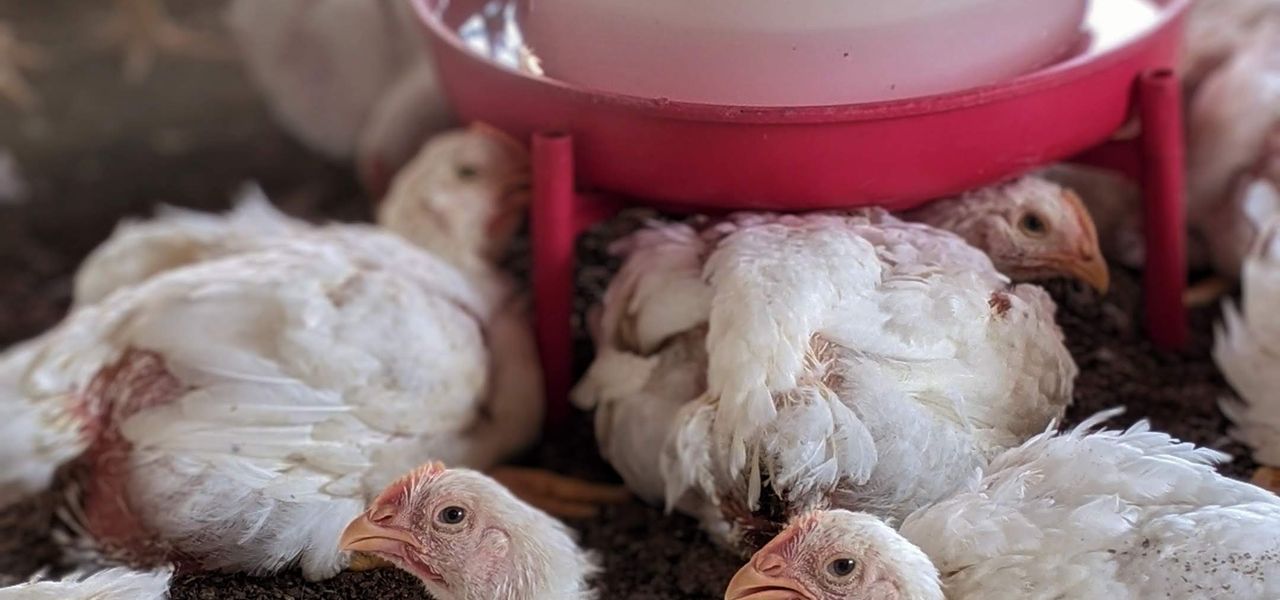
Why Your Broilers Are Not Growing: A Troubleshooting Guide
A step-by-step way to find out why broilers are small for their age: chick quality, brooding, feed, feeder space, water, disease, parasites, crowding and heat.
Halaal Farms Ghana team4 October 2026 · 13 min read
Key points
Before changing anything, collect three facts: average weight for age, whether all birds or only some are small, and feed eaten per bird so far.
Low feed intake with low weight means something is stopping the birds from eating, most often heat, too few feeders, poor water or too few lit hours.
Normal feed intake with low weight means feed is being wasted, is poorer than it should be, or is not being absorbed by a diseased gut.
A flock that was small at day 7 and has grown steadily since was set back by chick quality or brooding, and the fix is in the next batch.
Worms are rarely the cause in a six-week broiler on fresh litter, so do not make a dewormer or a tonic your first purchase.
Before you change the feed, buy a tonic or blame the hatchery, collect three facts: how heavy the birds are for their age, whether they are all small or only some of them, and how much feed each bird has eaten so far. Slow growth in broilers has about a dozen common causes, and those three facts, which take an hour to gather, rule out most of them. What remains is usually something you can see with your own eyes on one careful walk through the house.
Three facts to collect first
1. Weight for age
Weigh a proper sample, not a few birds picked up near the door. Pen a group in three parts of the house and weigh every bird in the pen, at least 50 for a flock of a few hundred. Count age from the day the chicks arrived as day 0. Our article on broiler weight targets gives the method and the weekly figures to compare against. As a rough marker, a flock more than 10 to 15 per cent under target has a real problem and is not simply showing the effect of an open-sided house.
2. Evenness
Look down your list of weights. If nearly every bird is small by a similar amount, the cause is something that reaches the whole flock: the feed, the heat, the water, the hours of eating. If there is a group of normal birds and a tail of small ones, the cause is something that divides birds: competition for feeders, a mixed lot of chicks, or a disease that hit some harder than others.
3. Feed eaten per bird
Count the bags opened since day 0, multiply by the bag weight and divide by the number of birds alive. For comparison, the breeder standards show a broiler having eaten roughly 1.2 to 1.3 kg by 21 days, 2.0 to 2.4 kg by 28 days and 3.2 to 3.6 kg by 35 days. You do not need to match these. You need to know whether your birds have eaten much less than this, or about this much.
Note two more things: when the birds first fell behind, and the daily deaths for the last two weeks.
The decision path
Take your findings to this table. Start at the top and stop at the first row that fits.
What you found
What it points to
Slim, upright, active birds that never looked like broilers at any age
The wrong type of bird
Birds became dull, droppings changed or deaths rose in the last few days, and growth stopped at the same time
Disease. Go to the vet first, then read the rest
Small since the first week, growing steadily but always behind
Chick quality or brooding
Even flock, low weight, low feed eaten
Something is stopping the birds from eating
Even flock, low weight, normal feed eaten
Feed is being wasted, is poor, or is not being absorbed
Uneven flock with a tail of small birds
Competition, mixed chicks or gut disease
More than one row can apply. Hot weather and too few feeders often arrive together. Work on the first that fits, then come back.
The wrong bird, or the wrong age
A broiler is a specific product of breeding. Ross 308 and Cobb 500 are broad across the breast by two to three weeks, thick in the leg, and heavy enough that they sit for much of the day. A layer-type cockerel is a different animal: slim, upright, quick on long legs, well feathered early, and a fraction of a broiler's weight at the same age. So are slow-growing dual-purpose birds, which are bred to take far longer than six weeks.
The price gap is the reason substitution happens. On the Halaal Farms price list, checked on 2 October 2026, white cockerels start from GH₵ 3 and broiler chicks from GH₵ 20 (prices change, so confirm on the day). A seller who passes one off as the other makes a large profit, and the buyer only discovers it weeks later when the birds will not grow. If the whole flock fits the description above, no feed or medicine will make it perform as a broiler. Sell the birds for what they are and buy the next batch from a hatchery you can question and visit. You can compare the two types on our pages for broiler chicks and for Sasso, Kuroiler, Noiler and cockerels.
Check the age too. Chicks sold as day-old that were in fact held for two or three days without feed start weak and behind. And if your own count of days is out by a week, the birds are not behind at all.
Behind since the first week
If the birds were under about four times their arrival weight at day 7 and have grown at a normal rate since, the damage was done in the first days. There are two places to look.
The chick
Small chicks from young parent flocks start with less and need better brooding to make it up. Chicks that travelled long hours arrive dehydrated. Chicks with unhealed or infected navels die between days two and five, and the survivors of that group often stay stunted. A box of obviously different sizes gives an uneven flock from the first day.
The brooder
A cold chick huddles under the heat and does not walk to feed. An overheated chick pants, drinks and does not eat. Either way it misses the first meals that open up its gut. The test is the crop: 24 hours after placing, pick up 30 or 40 chicks and feel the crop at the base of the neck. Nearly all should be full and soft, with feed and water together. Chicks with empty crops at that point become the runts you are looking at now, or die around day four to six once the yolk reserve is used up.
Nothing done in week four repairs week one. Give the flock every advantage from here on, and correct the brooding for the next batch using our chick brooding guide and the diagnostic article on why chicks die in the first week.
Eating too little: what stops a broiler from eating
A healthy broiler with feed in front of it eats to appetite. When intake is low, find what stands between the bird and the feed. Visit the house at three times in one day, because each visit shows something different.
At six in the morning
Are the feeders empty? Birds whose feeders ran out at midnight have gone hungry for hours. Are there enough of them? A sound working figure in an open-sided house is one 40 cm tube feeder for every 30 to 35 finishing birds. Is the lip of each feeder level with the birds' backs? Feeders left low are fouled with litter, and feeders set for the biggest birds are out of reach of the smallest.
Take a breath at bird height. If your eyes sting or you smell ammonia sharply, the air is damaging the birds' airways and suppressing appetite. The cause is wet litter and poor air movement, and both need attention.
At two in the afternoon
If the birds are spread out, panting with open beaks and ignoring the feeders, heat is taking five or six hours out of their eating day. In weeks five and six of a hot-season batch this is the most likely single cause of weights falling away, and heat stress in broilers sets out what to change.
Check the water at the same visit. A broiler drinks nearly twice the weight of the feed it eats, and more in heat. If water is short, feed intake falls the same day. Put your hand in a drinker: is it hot? Is it dirty, or slimy to the touch? Do the nipples run when pressed? Are birds queuing? Water from some boreholes is salty or heavy with iron, and birds drink less of it. If you would not drink it yourself, question it.
Count the birds against the floor. For open-sided houses in hot conditions, breeder guidance is about 20 to 25 kg of live weight per square metre at the heaviest point. That is 8 to 10 birds per square metre at 2.5 kg. Above that, the weaker birds cannot reach feed and water, the litter turns wet and the house runs hotter.
At nine at night
Is the house dark? The breeder weights assume about 18 to 20 hours of light a day. Ghana gives roughly 12 hours of daylight all year, and birds do not eat in the dark. If the hot afternoon removes another five hours, your birds have seven good eating hours against the book's eighteen. A few hours of evening light, with full feeders, is often the cheapest improvement on the farm. Then switch off, since birds need a dark rest as well.
Night is also when to listen. Stand still for two minutes. Rattling, sneezing or a wet clicking sound that you cannot hear over the daytime noise is the sign of respiratory disease, which is dealt with below.
Eating well but not gaining: where the feed is going
Onto the floor or out of the store
Look for a ring of spilt feed around each feeder, rat droppings in the store, and bags that do not match your records. Feed raked into the litter, eaten by rats or carried out through the gate is all counted as "eaten" in your sum.
The feed is not what the bird needs
Wrong type. Read the tag. Broiler starter is typically around 21 to 23 per cent crude protein and finisher around 18 to 20 per cent. Layer mash and pullet grower are far lower in protein and energy, and layer mash carries a high level of calcium that is harmful to young broilers. Finisher fed from day one is another version of the same error.
Diluted. Complete feed stretched with extra maize or wheat bran has less protein in every mouthful.
Home-mix errors. The wrong ratio of concentrate to maize, premix left out, shovel mixing that leaves some bags rich and others poor, or soya beans that were not properly heat-treated. Raw or under-roasted soya contains substances that block protein digestion, and birds on it grow poorly however much they eat.
Old or badly stored. Vitamins fade and fat turns rancid in feed kept for many weeks in a hot store.
Mould toxins
Maize and groundnut cake that were stored damp can carry aflatoxin and other toxins produced by moulds. They damage the liver and weaken immunity, and the typical picture is a flock that eats but stays pale, grows slowly and catches every infection going. The feed does not always look or smell mouldy. If you suspect it, stop that batch of feed and read aflatoxin and mouldy feed.
A gut that is not absorbing
Feed that passes through a damaged gut is paid for and lost. Look at the droppings on clean paper or a board. Loose, foamy or orange-tinged droppings, mucus, blood, or visible undigested feed particles all point to the intestine. This is a disease question, covered next.
Diseases that show up as slow growth
Some diseases kill quickly and are obvious. Others mainly cost growth, and these are the ones that puzzle farmers.
Coccidiosis. The mild form causes few deaths. Birds look ruffled and pale, the litter gets wetter, droppings are loose and may show mucus or blood, and weight gain stalls, most often between three and five weeks. Wet litter and crowding drive it. See coccidiosis in chickens.
Bacterial enteritis. Wet, sticky litter, foamy droppings, undigested feed. It often follows coccidiosis or a sudden change of feed.
Gumboro (infectious bursal disease). Usually strikes between three and six weeks: sudden dullness, whitish watery droppings and a burst of deaths that eases after about a week. The lasting harm is to the immune system. Survivors grow poorly and respond badly to other vaccines.
Chronic respiratory disease. Sneezing, rattling at night, wet eyes, and a slow flock. Dust and ammonia make it much worse.
Runting and stunting. From one to three weeks of age, a proportion of chicks simply stop growing. They are pale in the legs and beak, their wing feathers stick out at odd angles, and their droppings contain undigested feed. Gut viruses are involved and there is no treatment.
Do not treat on a guess. These conditions need different responses, and several are caused by viruses or parasites that antibiotics do not touch. Take three or four fresh dead birds and a few live sick ones to a vet or the district veterinary office for a post-mortem. The diagnosis costs far less than a week of the wrong medicine, and medicines carry withdrawal periods before birds can be sold.
Whatever the diagnosis, remove true runts. A bird that is under half the average weight at three weeks will not catch up. It eats until sale day, is rejected by the buyer, and may be carrying the infection that stunted it.
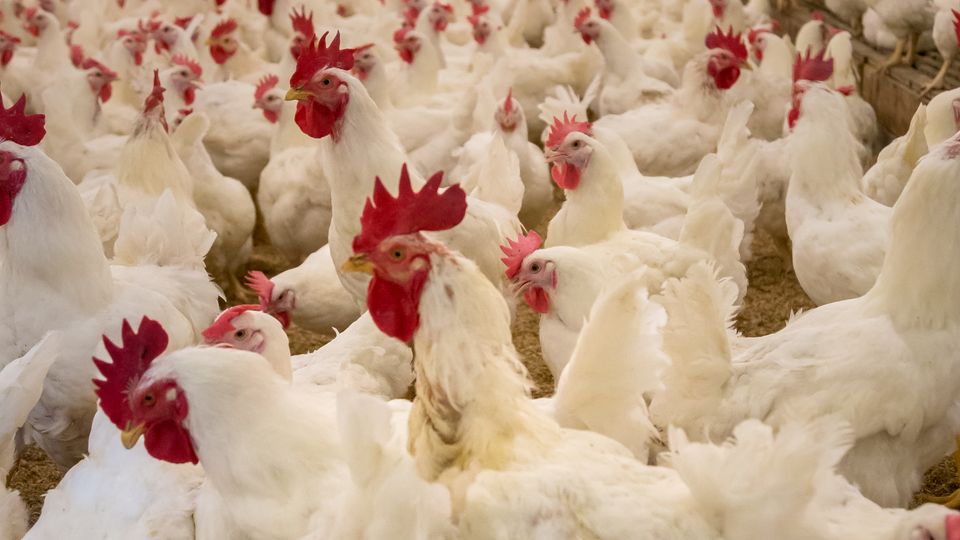
Large poultry house filled with white chickens.
Parasites: seldom the answer in a six-week bird
Many farmers reach for a dewormer first. In a broiler sold at six weeks from a cleaned house with fresh litter, worms are rarely the reason for poor growth, because the common roundworm needs five weeks or more inside the bird to reach maturity. Worms become a real possibility where litter is reused from the last batch, where birds are on an earth floor or have access to an outside run, and in birds kept longer, such as Sasso, cockerels and layers.
External parasites are also uncommon in short-cycle broilers, but check if the house is old, wooden, or close to layers. Take a torch at night, part the feathers around the vent and under the wings, and look in the cracks of posts and perches. Red mites hide in the woodwork by day and feed on the birds at night, leaving them restless and pale. If you find worms or mites, ask the vet for the right product and treat the house as well as the birds.
A one-week plan, then weigh again
Day 1. Weigh the sample, count the feed, make the three visits and write down what you find.
Day 1 to 2. Fix everything that costs little: add feeders and drinkers, set their heights, clean the drinkers, refresh the water at midday, open the curtains fully in the hot hours, give the birds the whole floor, add evening light, turn or replace wet litter.
Day 2. If there is any sign of disease, get birds to the vet and follow the advice given.
Day 2 to 3. If the feed is doubtful, change to a fresh, correctly labelled batch from a supplier you trust, blending over two or three days.
Day 3. Cull the hopeless runts humanely.
Day 8. Weigh again in the same way. Work out the daily gain for the week. If it has risen towards normal for the age, you found the cause. If it has not, go back to the table with the new figures and involve the vet if you have not already.
Then decide about the sale. Birds that are converting feed well again can be held until they reach the buyer's weight. Birds that are still eating without gaining cost you every day, and selling them lighter is sometimes the smaller loss.
Setting up the next batch so it does not happen again
Many slow batches are decided before day 7, so the prevention list is short. Clean out, disinfect and rest the house. Have fresh litter and enough feeders and drinkers for the full flock. Warm the brooder before the chicks arrive and check crops the next day. Start a weight chart on day 0 and keep it weekly, so that a slow week is caught in days.
Start with chicks you know the facts about: the breed, the hatch date and the vaccines given. Halaal Farms Ghana vaccinates chicks at the hatchery before they leave, so ask what your batch has had and pass that to your vet. Price, hatch date and delivery cost are confirmed before you pay, chicks that arrive dead are replaced free in the next hatch, and farm visits are welcome by appointment. If a batch is worrying you now, call 024 915 1503 with your three facts ready. Advice is free before and after an order, and you can book the next batch through the order form.
Questions farmers ask
Why are my broilers still small at 4 weeks?
The most common reasons are a poor first week (cold or late access to feed and water), too few feeders and drinkers, heat that stops birds eating in the afternoon, poor or diluted feed, and gut disease such as coccidiosis. Weigh a sample, work out feed eaten per bird and check whether all birds or only some are small. Those three facts narrow the cause quickly.
Can slow-growing broilers catch up before sale?
Partly. Once the cause is removed, birds return to a normal daily gain, but ground lost early is seldom fully recovered by the usual sale age. A flock well behind at four weeks will normally need extra days to reach the buyer's weight. Fix the cause, weigh again after a week, and then decide whether to hold the birds or sell lighter.
Will changing the feed brand make my broilers grow faster?
Only if feed is the real problem. Check the tag for the right type and protein level, smell the feed for mustiness and look at the manufacture date. If those are in order, look at feeders, water, heat and health first. Changing brand suddenly can itself reduce intake for a few days, so make any change over two or three days.
How can I tell if I was sold cockerels as broilers?
True broilers are broad and heavy by three weeks, with thick legs, and they spend much of the day sitting. Layer-type cockerels are slim, upright and active, with longer legs and quick feathering, and they weigh a fraction of a broiler at the same age. If the whole flock looks and behaves like this from the start, the birds are not broilers and no feed will change that.
Written by the Halaal Farms Ghana team. We hatch and import day-old chicks at Opeikuma, Kasoa, and deliver to all 16 regions. This article is general guidance for farmers. For diagnosis and treatment of sick birds, speak to a vet or your district veterinary office.
Lame birds, swollen bellies and healthy broilers found dead on their backs are all linked to very fast growth. Learn to tell them apart and which management changes reduce each one.
A practical method for choosing your broiler sale day: the daily feed-against-gain sum, how per-kilo and per-bird pricing change the answer, and what waiting for a better price really costs you.
How to turn live broilers into clean, well-chilled dressed chicken on a small farm, from the last feed to the freezer, with the temperatures, timings and hygiene habits that keep the meat safe and saleable.