How to weigh a sample of broilers properly, the weekly weights to aim for with Ross 308 and Cobb 500, and how to work out average, uniformity and next steps.
Halaal Farms Ghana team4 October 2026 · 14 min read
Key points
Weigh on the same weekday and at the same hour every week, counting the day the chicks arrived as day 0.
Pen a group of birds in at least three parts of the house and weigh every bird in the pen, never birds picked by hand.
For flocks of 100 to 500 birds weigh about 50, and for bigger houses weigh at least 100 or one per cent of the house.
Uniformity is the share of the sample within 10 per cent of the average, and around 70 per cent or better is a sound mixed-sex flock.
A flock more than 10 per cent under its target, or slipping further for two weeks running, needs a full check of feed, water, space, heat and health.
From the door of the house, a flock averaging 1.7 kg at 35 days looks almost the same as one averaging 2.1 kg. The gap is 400 grams a bird. On 500 birds that is 200 kg of live weight missing from your sale, and without a scale you only find out when the buyer hangs the birds on his. A weekly weighing takes about forty minutes and gives you the same news weeks earlier, while there is still time to act on it.
Most farms that do weigh get a flattering answer: a worker picks up ten birds near the door, the ones that are easy to catch, and writes down a number. The method below gives a true one, with the weights to compare it against and the two sums that turn a page of figures into a decision.
The kit for weigh day
A scale that suits the age of the bird. For chicks up to two weeks, use a tabletop digital scale that reads to 1 or 2 grams. For older birds, a digital hanging scale that reads to 10 grams and carries at least 5 kg is enough.
A container. A light plastic bowl or small carton for chicks. For bigger birds, a bucket with a lid, a feed sack with the mouth held closed, or a weighing cone hung from the scale. An enclosed bird cannot flap and gives a steady reading. Zero the scale with the empty container on it.
A catching pen. Two or three light frames of wire mesh or plywood, about 60 to 75 cm high and a metre or more long, tied at the corners so they close around a group of birds.
A notebook kept for weights only, with the date, the age in days, the house or pen, and a column for each bird's weight.
Check the scale before you start by weighing a sealed 1 kg pack of sugar or rice. Cheap scales drift when the batteries are weak. Use the same scale every week, because two scales can disagree by more than the difference you are trying to measure.
Choosing a sample that cannot flatter you
How many birds
Large commercial farms weigh at least 100 birds per house, or one per cent of the house if that is more. Small farms can scale that down, but not as far as most people think. Broilers in one house commonly differ from each other by 10 to 12 per cent around the average. With that spread, a sample of 50 birds will normally land within about 3 per cent of the true flock average. A sample of 20 can be out by 5 per cent or more, which is as big as the problem you are trying to detect.
Birds in the house or pen
Birds to weigh
Up to 100
25 to 30
100 to 500
About 50
Over 500
At least 100, or one per cent of a very large house
If the house is divided into pens, sample each pen and record it separately. An average across pens can hide one pen that is in trouble.
How to pick them
Walk quietly to at least three places in the house: near the door, the middle and the far end, away from the walls. At each place, set the catching pen down around a group of birds and close it.
Then weigh every bird inside the pen, including the smallest and any that look unwell. If the pen holds 22 birds and you wanted 17, weigh all 22. Birds caught by hand are the slow ones, the tame ones or the ones the catcher liked the look of. A person choosing birds leaves out the runt without meaning to, and the runt is part of the flock you will sell.
Up to 14 days, count ten chicks into the bowl, read the total, and repeat until you have covered your sample. That gives the average only. From 21 days, weigh birds one at a time, because you now want to know how even the flock is as well as how heavy.
Same day, same hour, same hands
Count the day the chicks arrive as day 0. If they came on a Tuesday, every Tuesday is weigh day: day 7, 14, 21, 28, 35. A broiler in its fifth week puts on close to 100 grams a day, so weighing a day late makes the flock look better than it is.
Weigh at the same hour each week. A bird with a full crop and gut is noticeably heavier than the same bird a few hours after the feeders ran empty, so a morning weight and an afternoon weight cannot be compared. Early morning is best in Ghana for a second reason: handling birds at midday in March adds heat stress to a flock that is already panting.
Handle them calmly. Lift a bird with a hand under the breast and the other over the wings, or hold both legs together, never one leg. Heavy broilers bruise and can damage a hip joint when they hang and flap from a single leg. Write each weight down at once and do not round to the nearest 100 grams. You need the real figures for the uniformity sum.
Weekly targets for Ross 308 and Cobb 500
The companies that breed the two main broilers sold in Ghana publish the weights their birds reach under very good conditions. The table rounds the 2022 objectives for mixed-sex (as-hatched) flocks. They are updated from time to time, so treat them as a guide. Halaal Farms Ghana supplies both breeds as broiler day-old chicks, so ask which one is in your box.
Age
Ross 308 book weight
Cobb 500 book weight
Investigate below (85% of the Ross figure)
Day 0
about 44 g
about 42 g
n/a
Day 7
210 g
200 g
180 g
Day 14
530 g
570 g
450 g
Day 21
1,010 g
1,120 g
860 g
Day 28
1,620 g
1,780 g
1,370 g
Day 35
2,300 g
2,520 g
1,950 g
Day 42
3,000 g
3,280 g
2,550 g
How to read the table honestly
The book weights come from closed, climate-controlled houses, pelleted feed made to the breeder's specification and long light hours. An open-sided deep-litter house in Ghana gives the bird hot afternoons, about twelve hours of natural daylight, and feed that is often mash. Birds eat less in heat and cannot eat in the dark, so a well-managed flock here commonly runs a little under the book, with the gap widening in weeks five and six.
That is why the last column is there. It is our suggested working floor, not a breeder figure. A flock between the floor and the book is doing a sound job for the conditions. A flock under the floor has a problem worth finding.
The day 7 check
The first weighing matters more than any other. A long-standing rule is that chicks should weigh at least four times their arrival weight at seven days, and the current breeder books sit closer to four and three-quarter times. A 42 gram chick should therefore be past 170 grams at day 7 and ideally near 200. The breeders' own guides state that each gram missing at day 7 costs several grams at five weeks. If your day 7 weight is low, the cause is nearly always in brooding: temperature, or how quickly the chicks found feed and water. Our chick brooding guide covers that ground.
Cockerels and pullets
Most broiler chicks in Ghana are sold unsexed. Males grow faster, and by five weeks they are commonly 10 per cent or more heavier than the females in the same house. This is normal, and it means a healthy flock still shows a spread of weights.
The first sum: average weight and daily gain
Add up all the individual weights and divide by the number of birds weighed. Suppose that on day 28 you weighed 50 birds and the weights add up to 72,400 grams.
72,400 ÷ 50 = 1,448 grams average.
If the birds are Ross 308, the book says about 1,620 grams. Divide your figure by the book figure: 1,448 ÷ 1,620 = 0.89. The flock is at 89 per cent of book, inside the working band.
Next, work out daily gain. If last week's average was 905 grams, the flock gained 1,448 minus 905 = 543 grams in seven days, or about 78 grams a day. The book gain for that week is about 86 grams a day. A flock that is a little under the book but gaining at close to the book rate is holding its position. A flock whose daily gain has dropped well below it is falling further behind and needs attention this week.
Add feed to the picture
Count the bags emptied so far, multiply by the bag weight, and divide by the birds alive. If 488 birds have eaten 22 bags of 50 kg, that is 1,100 kg, or about 2.25 kg a bird. The breeder books show roughly 2.0 to 2.4 kg eaten by day 28, so in this example the birds have eaten a full ration yet weigh only 89 per cent of target. Feed is going somewhere other than into meat: onto the floor, into rats, or through a gut that is not absorbing it well. If both feed and weight had been low, the question would be different: what is stopping the birds from eating. The full sum is in our article on feed conversion ratio with worked examples.
The second sum: uniformity
Two flocks can share the same average and be very different. In one, nearly every bird is close to 1,450 grams. In the other, half are at 1,750 and half at 1,150. The second flock gives trouble at sale, because a buyer who wants 2 kg birds rejects the small ones and you feed them for another fortnight.
Uniformity is the percentage of the sample that falls within 10 per cent of the average, above or below. Using the example:
Ten per cent of 1,448 is about 145 grams.
The band is therefore 1,303 to 1,593 grams.
Go down your list and tick every bird inside the band. Say 36 of the 50 are inside.
36 ÷ 50 = 0.72, so uniformity is 72 per cent.
As a rough scale for mixed-sex broilers: around 80 per cent is a very even flock, around 70 per cent is average and acceptable, and 60 per cent or less means a good part of the flock is not getting what it needs. If you use a spreadsheet, the coefficient of variation (standard deviation divided by the average, times 100) says the same thing: a CV of 8 matches roughly 80 per cent uniformity, 10 about 68 per cent and 12 about 60 per cent.
Look also at where the birds outside the band sit. In the example, 9 were below the band and 5 above. A tail of light birds, with few heavy ones to balance them, points to birds being pushed off feed and water or held back by disease. A spread that is even on both sides is more likely to be the natural gap between males and females. The usual first fix for a tail of small birds is more eating and drinking places at the right height.
Put the line on paper
Take a sheet of squared paper, mark age in days along the bottom and weight up the side, and plot the book weights for your breed before the chicks arrive. Each weigh day, add your own point and join it to the last one. The shape of your line against the book line tells you things a single figure cannot:
Below the book but running parallel to it. The flock lost ground early, usually in the first week, and has grown normally since. Fix the brooding for the next batch.
On the book early, then bending away. Something began to limit the birds at the point where the line bends. In weeks three and four this is often crowding, a sudden change of feed, or a disease challenge such as coccidiosis or Gumboro. In weeks five and six in the hot months it is very often heat.
One flat week, then recovery. A short event: feed ran out, the water failed, a vaccination reaction, a few days of extreme weather. Check the diary for that week.
Keep the sheets. After three or four batches you will have your own farm's normal curve for the dry season and the rains, which is a better target than any book.
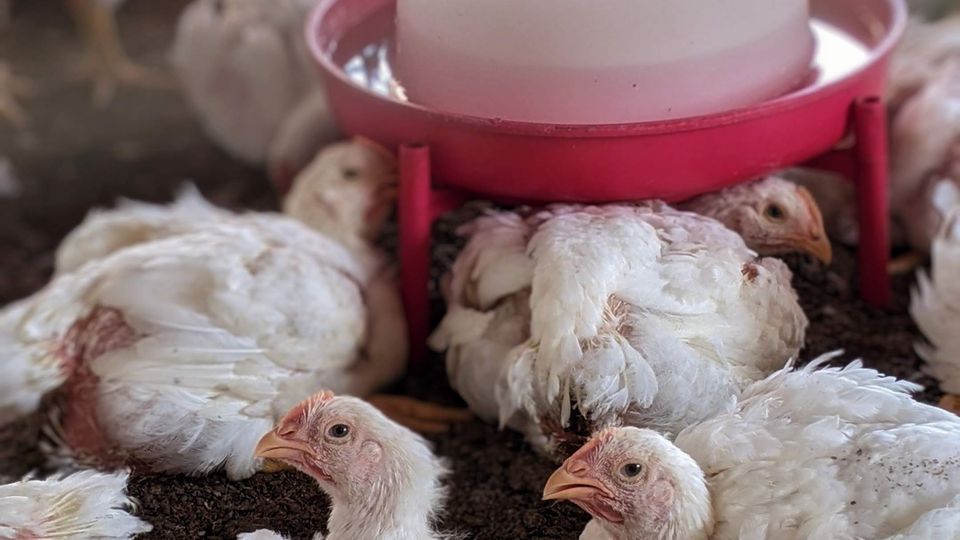
White chickens gathered at a feeder and drinker.
When the flock is behind target
First confirm that the number is real: same scale, zeroed with the container on, age counted from day 0, sample taken with the pen in three places. If any of that is doubtful, weigh a fresh sample the next morning before changing anything. Then size the gap against your target.
Gap below your target
What to do
Up to 5 per cent
Normal variation between weeks and samples. Record it and carry on.
5 to 10 per cent
Check the basics the same day: feed in the feeders at all hours, feeder and drinker height, water flow, afternoon house temperature, litter condition, bird numbers against floor space.
More than 10 per cent, or wider for two weeks running
Work through every possible cause in order and involve a vet if birds look unwell or deaths are rising.
Use the clues you already have. Low feed use with low weight says the birds cannot or will not eat: heat, too few feeders, poor water supply, dark hours with empty feeders, or feed they dislike. Normal feed use with low weight says the feed is being wasted, is poorer than the label claims, or is not being absorbed. Poor uniformity with a tail of small birds says competition or disease. A low day 7 weight says brooding. Each branch is followed to the end in our troubleshooting guide, why your broilers are not growing.
Do not buy a growth booster before you have found the cause. Tonics do not replace feeder space, cool water or a diagnosis. If birds are dull, droppings are abnormal or deaths are climbing, take fresh dead birds to a vet or the district veterinary office first.
Be realistic about catching up. A broiler that has been held back grows at a normal rate again once the problem is removed, but a flock 12 per cent behind at four weeks will not be on the book at six. Stop the gap widening, then re-plan the sale.
When the flock is running ahead
Being above target is usually good news, with one caution. Birds well ahead of the book in the second and third weeks, particularly males on dense pelleted feed under long light hours, are the ones most likely to suffer leg weakness, fluid in the belly and sudden heart failure later on. Do not starve a fast flock. Check instead that it has several hours of proper darkness each night after the first week and that the house air is fresh. The reasons are in our article on leg weakness, ascites and sudden death in broilers.
Turning weights into a sale date
With three or four weekly points you can predict when the flock will reach the weight your buyer wants. Take the latest average and add the expected daily gain for each day remaining. In the example, the flock was at 1,448 grams on day 28 and gaining 78 grams a day. Gain normally rises a little in the fifth week, so allow about 85 grams a day. To reach a 2.2 kg live bird, the flock needs another 752 grams, which is about nine days. Expect to sell around day 37.
Tell the buyer early. A caterer or cold store given ten days' notice of the date and the expected size is easier to deal with than one phoned the night before.
Farm weight is not buyer weight. Birds lose weight once feed is withdrawn and during the journey, so the buyer's scale will read lower than yours.
The last days cost the most. A bird in its sixth week eats about 200 grams of feed a day. Whether those days pay is the subject of when to sell broilers, and you can test your own figures in the poultry profit calculator.
File the weigh sheet with the batch's mortality, feed and sales records, so that you can compare batch with batch and season with season.
The chart starts on the day the chicks arrive. Halaal Farms Ghana confirms the price, hatch date and delivery cost before you pay, so you know your day 0 in advance. Weigh a full box on arrival, subtract the weight of the empty box and divide by the number of chicks. If a later weighing worries you, call 024 915 1503 with your numbers in front of you (age, average weight, feed used and deaths). Advice is free for farmers before and after an order, and it is far more useful when it starts from real figures. To book chicks, use the order form.
Questions farmers ask
What should a broiler weigh at 6 weeks in Ghana?
The breeder books for Ross 308 and Cobb 500 show about 3.0 to 3.3 kg at 42 days for mixed-sex flocks in ideal closed houses. In an open-sided house in Ghana's heat, a well-run flock usually finishes somewhat below that. Judge your flock against the book, treat anything within about 15 per cent as workable, and investigate anything further behind.
Can I weigh broilers without a proper poultry scale?
Yes. A digital hanging scale of the kind used for luggage or market produce works well if it reads to 10 grams and carries at least 5 kg. Hang a bucket or a sack from it, set it to zero, and weigh one bird at a time. Check the scale each week against a sealed 1 kg pack of sugar or rice before you start.
Why are some of my broilers much smaller than others?
A wide spread usually means some birds are not getting their share of feed or water, or a disease or poor chick start has held part of the flock back. Too few feeders, feeders set too high, crowding and gut infections such as coccidiosis are common causes. Mixed-sex flocks also spread naturally in the later weeks because the cockerels grow faster than the pullets.
How often should I weigh my broilers?
Weigh on the day the chicks arrive and then every seven days until sale: days 7, 14, 21, 28, 35 and again a day or two before the buyer comes. Weekly figures let you see daily gain, catch a slow week within days and predict the sale date. Weighing only at the end tells you what went wrong when it is too late to fix.
Written by the Halaal Farms Ghana team. We hatch and import day-old chicks at Opeikuma, Kasoa, and deliver to all 16 regions. This article is general guidance for farmers. For diagnosis and treatment of sick birds, speak to a vet or your district veterinary office.
Feed cost per kilo of broiler depends on how much feed each kilo takes and what you pay for it. These ten habits lower both without starving the birds or buying additives.
Heat kills the heaviest broilers in the last days before sale. This guide explains why, shows the signs in order, and sets out the house, stocking, water and feeding changes that prevent it, plus an afternoon emergency plan.
Slow-growing broilers have about a dozen common causes. This guide shows how three simple facts (weight, evenness and feed eaten) point to the right one, and what to check and fix in each case.