When to Order Chicks for Christmas, Easter and Eid Sales
Work back from your sale date to the right hatch day for broilers, Sasso, cockerels, turkeys and guinea fowl, and book before the festive hatches fill.
Halaal Farms Ghana team4 October 2026 · 13 min read
Key points
Start from the first day you will sell, subtract the growing time and a safety margin, and that gives the day chicks must be in your brooder.
Broilers for Christmas go in between late October and the first week of November, while turkeys, cockerels and guinea fowl must be placed between late May and August.
A hatchery sets eggs 21 days before chicks hatch, so festive hatches are decided weeks before most farmers call.
Book broiler chicks for a festive hatch four to six weeks ahead, and ask about turkey poults and guinea keets months ahead.
Two batches placed a week or more apart spread your risk and cover both the Christmas and New Year selling days.
A broiler you want to sell at seven weeks old on 19 December has to be in your brooder on 31 October. The egg it hatched from went into the incubator on 10 October. So when a farmer phones round in the first week of November looking for Christmas chicks, the chicks that could still make it were decided almost a month earlier, and most of them already have a name against them.
Festive poultry is a timing business. The birds are sold in a window of a few days, and a batch that is ten days late is worth a great deal less on 3 January than it was on 23 December. This guide shows how to count back from the sale day for each kind of bird, why the hatches fill up, and how early to put your name down.
The sum behind every festive batch
There are only two lines of arithmetic, and the mistake most farmers make is to start from the wrong end.
First sale day, minus growing time, minus a safety margin, gives the placement day. That is the day the chicks must arrive.
Placement day, minus the hatchery's booking lead, gives your ordering day. That is the day you must have booked and confirmed.
Notice that the starting point is the first day you will sell, not the festival. Households buy live birds in the last few days before Christmas, with a second, smaller wave before New Year. Caterers, chop bars and people who sell dressed birds want theirs earlier, because slaughtering, cleaning and freezing take time. Companies buying birds as staff gifts often want delivery by the middle of December. Ask each buyer for a delivery day and plan to the earliest one.
The safety margin is there because growth charts assume everything goes right. One cold week in the brooder, a feed change that arrives late or a bout of disease can each cost several days. A bird that is ready a few days early can be held or sold dressed. A bird that is too small on 23 December cannot be fixed.
How long each bird takes
These are typical ranges under reasonable management in Ghana. The shorter figure assumes good chicks, good feed given freely and few setbacks. Your own records from earlier batches are a better guide than any table, so use them where you have them.
Bird
Typical growing time to festive sale weight
Placement for a sale starting about 19 December
Broiler (Ross 308, Cobb 500)
6 to 8 weeks
Late October to the first week of November
Sasso
10 to 14 weeks on full feeding, longer if birds range for part of their feed
Mid-September to early October
Kuroiler and Noiler
16 to 20 weeks for a heavy cock
August
White cockerels
18 to 24 weeks
July to mid-August
Guinea fowl
4 to 6 months, depending on strain and feeding
Late June to August
Turkey
5 to 7 months, depending on type, sex and feeding
Late May to mid-July
Two things stand out. The slow birds have to be on the farm in the middle of the year, in the rainy season, long before anyone is thinking about Christmas. And the broiler window is narrow: about two weeks in which nearly every broiler farmer in the country wants chicks.
Christmas and New Year, bird by bird
Broilers
Christmas buyers at the live market like a big bird, so most farmers aim for seven to eight weeks, not six. Count eight weeks back from your first sale day and place then. If the flock grows on target you will have heavy birds a few days early, which at Christmas is rarely a problem. For New Year sales, a second batch placed about nine or ten days after the first is right. The article on finding the most profitable day to sell broilers shows how to weigh extra feed against extra weight once the birds are near market size.
Sasso, Kuroiler and Noiler
Coloured birds sell well at festivals to buyers who want firmer meat and a bird that looks like a local fowl but weighs more. Because they take three to five months, they tie up space and feed money for much longer than broilers. Decide by July whether you are raising them, and make sure the house they occupy is not the one you need for brooding broilers in late October. The breeds are described on our Sasso, Kuroiler and Noiler page.
White cockerels
Cockerels are cheap as chicks and slow to grow, so the whole plan depends on starting early and feeding economically. Chicks placed in July are a sensible target for December, and the same birds can be carried a little longer for buyers who want a mature cock. Feeding strategy and costs are covered in our guide to rearing cockerels for the festive market.
Turkeys and guinea fowl
These are the birds people most often order too late. A turkey for the Christmas table commonly needs five to seven months, so poults go in between late May and mid-July. Guinea fowl need four to six months. Supply is the other limit: turkey poults and guinea keets are hatched in far smaller numbers than broiler chicks, and guinea fowl lay mainly in the rainy season, so keets are not available evenly through the year. Ask about them early in the year, not a month before you want them. See our keets, poults and quail page, and the full timeline in turkey farming from poult to Christmas table.
Easter and the Eids: festivals that move
Christmas is the same date every year. The other three peaks are not, so each year's plan has to begin with a calendar.
Easter falls on a Sunday between 22 March and 25 April. Selling runs from the middle of Holy Week to Easter Saturday. In much of Ghana this is the hottest stretch of the year, and heavy broilers suffer in heat, so allow the full growing time and do not crowd the house to squeeze in extra birds.
Eid al-Fitr, at the end of Ramadan, and Eid al-Adha each move about ten or eleven days earlier every year, and the final day depends on the sighting of the moon. Get the expected date from your mosque and treat it as a window of two or three days. Chicken is widely bought for the Eid al-Fitr feast. At Eid al-Adha the sacrifice itself is a sheep, goat or cow, so the poultry peak is smaller, though households still buy birds for hosting. Many Muslim customers prefer to buy live so that slaughter is done the halal way by someone they trust.
As an example of how these dates interact, take 2027. Easter Sunday is 28 March. Eid al-Fitr is expected around 9 or 10 March and Eid al-Adha around 16 or 17 May, both subject to the moon. That puts two selling peaks less than three weeks apart in March. A farmer serving both would place one broiler batch in mid-January and another in early February, and would be brooding in the harmattan, when nights are cold and dry and chicks need more heat. Sasso for the same sales would have to be placed between early December and mid-January, which means booking them while the hatchery is busiest with Christmas. Cockerels for that Easter needed to be on the farm by October or early November.
Why the hatchery is full when you call
It helps to see the season from the hatchery's side, because it explains why money alone cannot produce chicks at short notice.
Chick numbers are fixed three weeks ahead. Chicken eggs take 21 days to hatch, turkey eggs about 28 and guinea fowl eggs about 26 to 28. Whatever was set on 10 October is what hatches on 31 October. Nothing can be added in between.
Egg supply is fixed even earlier. Hatching eggs come from parent flocks that take around six months to come into lay, or they are imported, which means orders placed with overseas suppliers well in advance. A hatchery cannot conjure extra fertile eggs in October.
Incubator space is finite. Each machine holds a set number of eggs. Demand in the festive hatch weeks is far above an ordinary week, but the machines are the same size.
Everyone wants the same two weeks. The same count-back applies to every farmer in Ghana, so the requests pile onto the same few hatch days.
The result is that festive hatches are allocated in the order farmers book and confirm. Those who call late are offered a later hatch, a different breed or nothing. That is also the moment when people turn to an unknown seller on social media who claims to have plenty of chicks in the one week nobody else does. Be careful: scarcity is when chick fraud does best.
How far ahead to book
As a working rule, we suggest the following.
Broilers for Christmas, Easter or Eid: book four to six weeks before the hatch date you need. For Christmas that means making contact in the second half of September.
Broilers at ordinary times: two to three weeks is usually enough, but ask.
Sasso, Kuroiler, Noiler and cockerels: book about a month ahead. Their festive placement falls outside the broiler rush, except in years when Easter planning collides with December.
Turkey poults and guinea keets: ask months ahead and be flexible about the exact hatch.
When you book, give the hatchery four facts: the bird, the number, your location and the first day you intend to sell. A hatchery that knows the sale day can tell you which hatch fits and whether your plan leaves a margin. At Halaal Farms Ghana the price, the hatch date and the delivery cost are confirmed before you pay, so you know exactly which day to have the brooder ready. Chick prices change, so check the current day-old chick price list and confirm the figure for your hatch when you book.
Staggering batches instead of betting on one date
One large batch aimed at one day is the riskiest way to do a festive season. If brooding goes badly, or disease arrives in week four, the whole season is gone. Two or three smaller batches change the odds.
Risk is divided. A problem in one batch leaves the others to sell.
The selling window is covered. One batch is at the right weight for 19 to 24 December and the next for 28 to 31 December, instead of one batch being right for three days and overweight after that.
Brooding is manageable. Your ring, heat and attention go to one group of chicks at a time.
Cash is spread. Broilers eat about half of all their feed in the last two weeks. With staggered batches, those heavy weeks do not all land together.
The cost is that you now have birds of different ages on one site, and older birds can pass disease to younger ones. Keep each age in its own house or a fully separated pen, with its own feeders and drinkers, and always attend to the youngest birds first. The reasoning is set out in our article on all-in, all-out batch planning. If you have a single small house, one batch with a generous margin is safer than two ages sharing the same air.
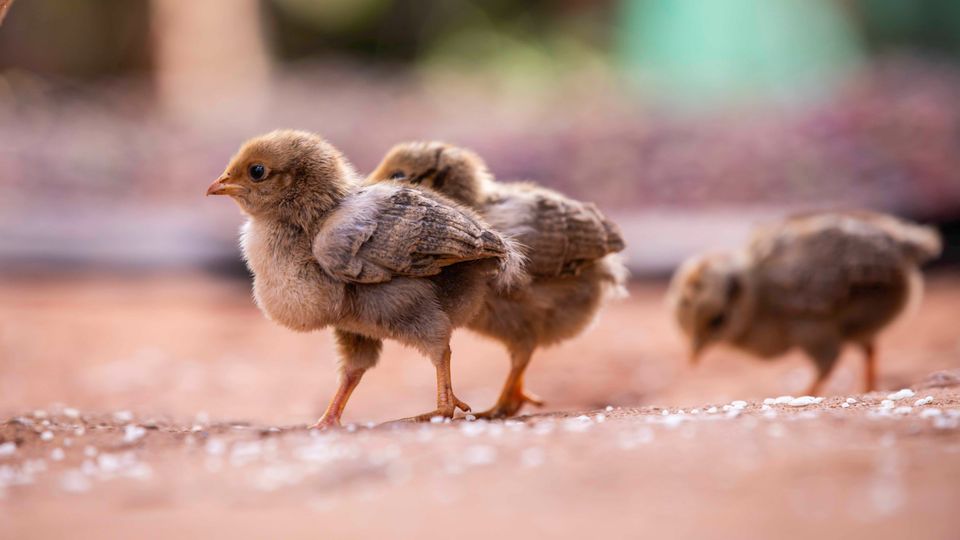
Young chicks walking on a soft floor.
A worked plan: two broiler batches for Christmas and New Year
Here is the sum written out for a farmer who wants to sell 400 broilers, split into two batches of 200. The dates are an example. Put your own sale days in and count the same way.
Step
Batch A (Christmas)
Batch B (New Year)
First sale day
19 December
28 December
Growing time allowed
7 weeks plus 1 week margin
7 weeks plus 1 week margin
Chicks in the brooder
24 October
2 November
Eggs set at the hatchery (21 days earlier)
3 October
12 October
Booking confirmed
Mid-September
Mid-September
Heaviest feed weeks
5 to 19 December
14 to 28 December
Now read the table for its consequences. The brooding area must be empty, cleaned and rested before 24 October. Batch B needs its own brooding space on 2 November, because batch A will still be only nine days old. Feed money must stretch through three straight heavy weeks in December. And the last feed purchase should be made before the shops and mills close for the holiday. You can test the whole plan against your own chick, feed and selling prices with the poultry profit calculator.
The margins that catch farmers out
Counting the weeks correctly is half the job. These are the other things that go wrong in a festive season.
Harmattan. From December into February, especially in the north, nights are cold and the air is dry and dusty. Chicks need more heat, birds use more feed to keep warm, and dust irritates the airways. Brooding for Easter and for an early Eid often falls in exactly this period.
Feed in the last fortnight. Demand for feed is at its highest when your birds are eating most. Buy or reserve the finishing feed early, and do not count on a delivery on 23 December.
Labour. Workers travel home for the holidays just when you need people to catch, weigh, slaughter and deliver. Agree who is staying, and what they will be paid for it, in November.
Transport. Roads, stations and cargo vehicles are crowded from mid-December. Chick deliveries and bird deliveries both take longer.
Processing and cold storage. If you sell dressed birds, arrange the slaughter team, the ice and the freezer space before the week arrives.
The last-day glut. Many farmers bring birds to market on the same two days, and late on the 24th sellers start cutting prices to avoid taking birds home. Orders taken in advance, with a deposit, protect you. Our guide to finding buyers for broilers and eggs covers how to line them up.
The week after. Demand drops sharply once the holiday is over, while an unsold broiler goes on eating. Plan to be sold out by 31 December, not to carry birds into January hoping for a better price.
If you are already late
Sometimes the count comes out wrong: the date has passed, or the hatch you needed is full. There are sensible options and some poor ones.
Aim for the next window. Chicks placed in mid-November miss Christmas but suit New Year. Chicks placed in late November are for the January trade, which is quieter, so stock fewer.
Sell a lighter bird, if your buyers accept one. Some grill and chop bar customers want a smaller bird at five and a half to six weeks. Ask them before you commit, because the household buyer at Christmas wants size.
Raise fewer and raise them well. A smaller batch with full feeder space will finish more evenly than a crowded house of birds that started late.
Buy finished birds to fill confirmed orders. If you trade as well as farm, ask whether market-ready broilers are available. Halaal Farms supplies them alongside chicks.
The poor options are buying from a seller you cannot verify because everyone reputable is sold out, crowding birds to make up numbers, and paying for products that promise faster growth. None of these recovers lost weeks.
Then fix next year now. Put two reminders in your phone: one in May to ask about turkey poults, keets and cockerels, and one on 1 September to book broilers. If you would like help with the count, send the order form or call 024 915 1503 with your sale date, and we will tell you which hatch of broiler chicks or other birds fits it.
Questions farmers ask
What is the latest date to place broiler chicks for Christmas?
For birds of about 2 kg or more, chicks placed in the first week of November reach a useful weight by 20 to 24 December if brooding and feeding go well. That leaves no margin for a slow week. Placing in the last week of October is safer. Chicks placed in mid-November are better aimed at New Year sales.
Why are hatcheries fully booked before Christmas?
Chick numbers are fixed three weeks before hatch day, when the eggs are set, and the incubators hold only so many eggs. Nearly every farmer wants chicks in the same two or three weeks of late October and early November. Hatcheries allocate those hatches in the order bookings come in, so farmers who call late get a later date or none.
Can I raise turkeys for Christmas if I buy poults in September?
It is too late for a full-sized bird. Turkeys commonly need five to seven months to reach festive weights, depending on type, sex and feeding, so Christmas poults are normally placed between late May and mid-July. Poults bought in September are better planned for Easter or for the following Christmas as larger, older birds.
How do I plan for Eid when the date is not fixed?
Eid dates move about ten or eleven days earlier each year and the final day depends on the sighting of the moon, so it can shift by a day. Ask your mosque for the expected date, plan to start selling three to five days before it, and count back from that first selling day instead of from the festival itself.
Written by the Halaal Farms Ghana team. We hatch and import day-old chicks at Opeikuma, Kasoa, and deliver to all 16 regions. This article is general guidance for farmers. For diagnosis and treatment of sick birds, speak to a vet or your district veterinary office.
Your starting number is the smallest of four limits: what the floor holds, what your feed money can finish, what your buyers will take and what you can manage. Here is how to work out each one.
Fake sellers, vanishing deposits, cockerels passed off as pullets and old chicks sold as day-olds all follow patterns. Learn the warning signs, how to verify a seller and how to pay without exposing yourself.
A ten-minute inspection you can do at the hatchery gate or the bus station: which chicks to pull from the box, what to look at on each one, and which faults are grounds to refuse the batch.