How to Judge the Quality of Day-Old Chicks Before You Pay
A hands-on inspection routine for day-old chicks: how to sample a box, check navel, legs, down, beak and weight, count properly and decide what to reject.
Halaal Farms Ghana team4 October 2026 · 13 min read
Key points
Sample at least 30 chicks drawn from several boxes and from the corners and middle of each box, never the first chicks that run to your hand.
A healthy chick laid on its back gets onto its feet within about three seconds, and its feet feel warm against your cheek.
The navel should be closed, dry and flat; open, wet, stringy or black-buttoned navels are the commonest route to deaths between day three and day five.
Weigh a full box, subtract the empty box and divide by the count: most broiler chicks fall between 38 and 45 grams, and evenness matters more than the average.
Judge the supplier finally at day seven, when deaths should be around one in a hundred or fewer and broilers should weigh at least four times their arrival weight.
Lay a day-old chick gently on its back in your open palm and let go. A good one twists over and is standing again in about three seconds. A poor one lies there paddling, or rolls onto its side and stays. That single test tells you more about what you are about to pay for than the breed name on the box.
Most farmers in Ghana receive chicks at a bus station, from a delivery van or at the hatchery gate, usually with a driver who wants to leave. You have perhaps ten minutes. This is a routine for using them properly: what to notice before you lift a lid, which chicks to pick out, what to check on each one, how to weigh and count, and which faults are grounds for refusing a box.
What a day-old chick is carrying when it reaches you
A chick in a box is the result of the previous three to four weeks: the age of the parent hens, the days the egg spent in storage, the temperature and humidity in the incubator, how long the chick sat in the hatcher after it dried, and the hours it has spent in the box since. Each of these leaves marks you can see and feel. A navel that has not closed tells you the chick was pulled before it was ready or had a difficult hatch. Dry, wrinkled shanks tell you it has been without water for too long. Red hocks tell you it struggled to get out of the shell. None of this needs a laboratory. It needs good light, clean hands and a method.
Inspection has limits. You cannot see whether the vaccines were given correctly, and you cannot see the genetics. Those you settle by asking, ideally before you order, which is the subject of our list of questions to put to a hatchery before buying.
Before you lift a lid: the boxes themselves
Start with your ears. Comfortable chicks make a soft, steady cheeping. A loud, sharp, continuous noise from the whole stack means distress: usually cold, hunger or thirst after a long wait. Then slide a hand into a ventilation hole near the middle of the stack. Warm is right. Hot and humid means the boxes were stacked too tightly or left in a closed vehicle.
Look at the cardboard. Wet bottoms and crushed corners reduce the air the chicks had. A box floor heavily stained with dark green droppings tells you the chicks have been in it a long time. Read the label or ask for the details in writing: type of bird, hatch date, number in the box and which vaccines were given at the hatchery, so that your own programme continues from the right point.
Now lift a lid and look before you touch. Chicks should be spread evenly across the compartments, standing or resting, heads up. A tight heap in one corner means cold. Chicks stretched out and panting means heat. Count any dead you can see and note which box they were in.
Which chicks to pick up, and how many
The mistake almost everyone makes is to open the top box, admire the three chicks that run to the hand and close it again. Those are the strongest chicks in the best-ventilated box. They tell you nothing about the rest.
Use this sampling routine instead:
Choose the boxes. For an order of up to ten boxes, open at least three: one from the top of a stack, one from the middle and one from the bottom. For bigger orders, open about one box in five. Middle and bottom boxes get the least air, so problems show there first.
Choose the chicks. From each box take ten chicks: two from each corner area and two from the centre. Take the chick your hand lands on, with your eyes on the corner and not on the chick. Do not choose.
Aim for 30 to 50 in total. Fewer than 30 and one unlucky chick distorts your picture. More than 50 keeps the rest waiting too long.
Write as you go. One notebook line for each chick, with a tick or a note against each check, gives you something to show the hatchery.
Bring a small digital kitchen scale that reads in grams, a torch or your phone light, and a notebook. Wash your hands before you start, particularly if you have handled older birds that morning.
Seven checks on each chick
Work in the same order every time. With practice each chick takes about fifteen seconds.
1. Alertness and the turn-over test
Put the chick on its back on your palm or on a flat surface. It should be on its feet within three seconds. Standing chicks should hold their heads up, react to a tap on the box and walk without wobbling. A chick that takes longer, or that stands with eyes closed and wings drooping, is weak.
2. Eyes
Both eyes open, round, bright and dry. A chick with a cloudy eye, a swollen lid or a missing eye is a reject.
3. Beak and nostrils
The beak should be straight, with the upper and lower halves meeting, and the nostrils clean. Crossed or parrot-shaped beaks are deformities and those chicks will not eat properly. A red spot at the tip of the beak or blood around the nostrils is damage from the hatcher, often a sign that the chicks were too hot and pushing against the tray. One chick with it means little. Many means the whole hatch was stressed.
4. Navel
This is the check that predicts first-week deaths best. Turn the chick over, part the down below the belly and shine your light. A good navel is closed, dry and flat, and you may struggle to find it at all. Faults to look for:
Open navel: a visible hole, sometimes wet or with yolk or membrane showing. Bacteria enter directly into the yolk sac.
String: a dry thread of membrane hanging from the navel. It works like a wick and can catch on the box.
Black button: a hard dark scab over the navel, larger than a pinhead. The navel closed around tissue that should have been drawn inside.
Wet or smelly navel area: infection has already started.
Chicks with navel infection typically look acceptable on arrival and die between about day two and day five with a swollen, bad-smelling belly, however well you brood. Our article on why chicks die in the first week explains how to tell navel deaths from brooding deaths.
5. Belly
Press the abdomen lightly between finger and thumb. It should feel soft and give a little. A hard, tight, enlarged belly means a large yolk sac that was not absorbed properly. These chicks are sluggish, slow to start eating and more likely to develop infection.
6. Legs, hocks and toes
Shanks should be plump, smooth and waxy, with a clean yellow or flesh colour depending on the breed. Thin, dry, dark shanks with wrinkled skin and a vein standing out along the side are the clearest sign of dehydration. Look at the hock joints: redness or swelling there comes from a hard hatch, and those chicks often sit instead of walking to feed. Toes should be straight and the chick should stand with its legs under its body, not sliding out sideways. Hold the feet against your cheek or the side of your neck. Warm feet mean a warm chick. Cold feet mean the chick is chilled and will not go looking for feed until it has been warmed.
7. Down and vent
The down should be dry, clean and fluffy all over. Down that is matted with dried yolk or egg white, or stained green or brown, tells you about a problem in the hatcher or a long time in a dirty box. The vent should be clean with no droppings pasted over it. A few sticky vents after a long journey can be managed, as described in our guide to pasty vent and other early chick problems, but many in a fresh delivery is a warning.
While the chick is in your hand, glance at the wing. A true day-old shows only short feather tips beyond the down. Wing feathers reaching well down the side of the body mean the chick is several days old, one of the tricks covered in our article on avoiding being cheated when buying chicks.
Weight and evenness
Weight is the easiest thing to measure and the easiest to misread. A chick weighs about two thirds of the egg it came from. Hens that have just started laying produce small eggs and therefore small chicks, and hens late in lay produce large ones. Most day-old broiler chicks fall between 38 and 45 grams. Layer chicks are commonly 35 to 40 grams. Coloured dual-purpose types, cockerels, keets and poults each have their own normal range, so for those compare chicks with each other.
The quick method: weigh the box
Weigh a full box. Weigh an identical empty box or ask the hatchery for its weight. Subtract, then divide by the number of chicks. As an example, if a full box weighs 2,520 grams, the empty box weighs 420 grams and there are 50 chicks inside, the average is (2,520 minus 420) divided by 50, which is 42 grams. If your scale does not go high enough, weigh ten chicks at a time in a small bowl.
The better method: weigh your sample one by one
Weigh each of your 30 to 50 sampled chicks and write the figures down. Work out the average. Then count how many fall within 10 percent of it. With an average of 42 grams that means between about 38 and 46 grams. In a good batch, three quarters or more of the chicks will fall inside that band.
Evenness matters because the small chicks in a mixed box lose the competition at the feeder from the first day, and at week six some birds are ready for sale while others need another ten days of feed. A box of evenly small chicks from a young parent flock is a different matter. They are healthy. They need a slightly warmer brooder, feed and water placed very close, and their own ring away from larger chicks. Brown layer pullets, which are sexed by down colour at hatch, should also look alike in colour, and a number of pale yellow chicks among the brown deserves a question. Many hatcheries grade out broiler chicks lighter than about 34 to 36 grams, and a chick that is both small and weak is not worth placing.
Counting what you were sold
The number written on the box is a claim. Check it. Count two or three boxes fully into an empty box, or straight into the brooder if you are at the farm, moving chicks in fives and saying the count aloud. If those boxes are correct, accept the rest. If one is short, count them all.
Some hatcheries add a few extra chicks to each box to cover losses on the road, and some do not. Know which applies to your order before delivery day, so that 48 in a box of 50 is not excused as normal. Record three numbers for every delivery: chicks paid for, chicks received alive and chicks dead on arrival. Halaal Farms Ghana replaces chicks that arrive dead free of charge in the next hatch, and a count made on the spot with photos is what makes that simple for both sides.
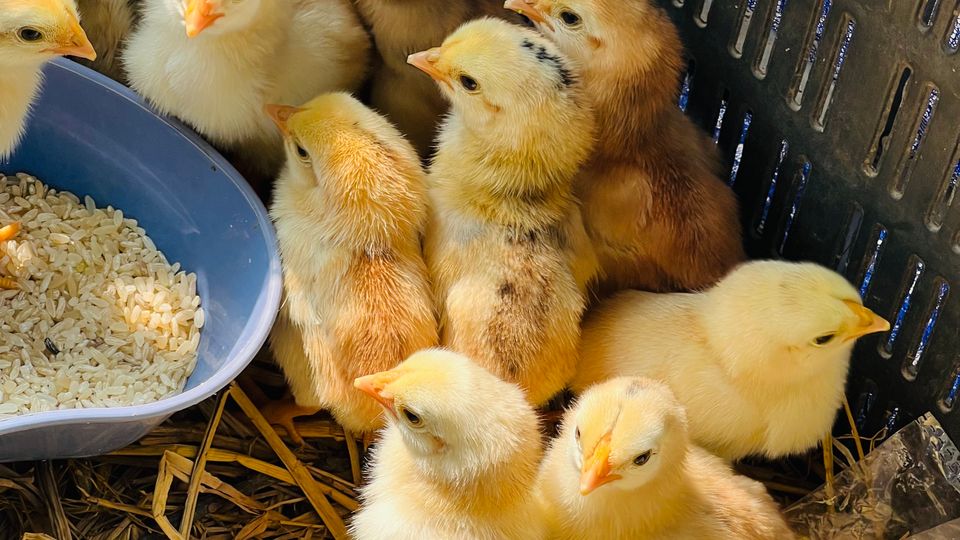
Yellow chicks gathered around a feeder.
Reject, second grade or acceptable
Not every imperfect chick is a reason to send a consignment back. Sort what you find into three groups.
What you find
How to treat it
Why
Open, wet or infected navel
Reject
Yolk sac infection and death in days two to five are likely
Crossed beak, missing or blind eye, twisted neck, legs splayed sideways, extra or deformed limbs
Reject
Cannot eat, drink or walk normally and will not recover
Cannot stand or fails the turn-over test completely
Reject
Too weak to find feed and water
Wet, sticky chick matted with yolk or egg white
Reject
Chills quickly and usually has an unhealed navel as well
Small black button or short dry string on the navel, chick otherwise lively
Second grade
Many survive with clean, warm brooding, but losses are higher
Red hocks, red spot on the beak
Second grade
Signs of a stressful hatch; watch that these chicks reach feed
Dry shanks, noisy, light for size
Second grade, urgent
Dehydrated; recovers if given water and warmth quickly
Slightly small but alert, clean navel, warm feet
Acceptable
Normal from young parent flocks
Now turn your notes into a decision. As a working rule, a batch is good when at least nine in ten of the sampled chicks have no fault at all. One reject in a sample of 40 is ordinary. If one chick in ten is a reject, or a third of the sample is second grade, the batch has a problem and you should say so before money changes hands. Hatcheries score their own chicks in a similar way. One widely used system, the Pasgar score, takes a point off a chick for each fault in reflex, navel, hocks, beak and belly.
Do not keep chicks waiting while you inspect. Sample three boxes, not thirty. If the weather is cold or the wait has been long, do the turn-over, navel and feet checks first and leave the weighing until the chicks are in a brooder that was warmed before they arrived.
If the sample is poor
Stay factual. Show the driver or the hatchery staff the chicks you have set aside. Photograph the faults close up, with the box label in at least one picture. Phone the hatchery there and then, give the numbers from your notebook and ask what they propose: replacing the affected boxes, adding chicks to cover expected losses, adjusting the price or taking the consignment back.
How much power you have depends on what was agreed before delivery. If you paid everything in advance to someone you have never met, you have very little. If the price, the hatch date and the replacement terms were confirmed before you paid, the conversation is simple. Settle them at the time you order, starting from a published reference such as our day-old chick price list.
If you accept a batch with some second-grade chicks, put the weak ones in a separate small ring closest to the heat, with their own feeder and drinker, so that they are not pushed aside. The hour-by-hour detail of what to do next is in our plan for receiving chicks in the first 24 hours and in the chick brooding guide.
The verdict that counts comes at day seven
Your gate inspection is a forecast. The first week tells you whether it was right. Keep two records for every batch.
Deaths to day seven. Write down every dead chick each morning. With good chicks and a properly prepared brooder, losses in the first seven days are commonly about one percent or less, which is five chicks in 500. Losses of three or four percent mean something went wrong. Deaths bunched between day three and day five, with swollen, smelly bellies, point to navels and chick quality. Deaths from the first night, with chicks piled near the heat, point to your brooding. A veterinary officer can open a few dead chicks and tell you which it was.
Weight at day seven. Weigh a sample of 30 to 50 again. Broilers should weigh at least four times what they weighed on arrival, so a 42 gram chick should be around 170 grams or more. A flock well short of that either started poorly or was brooded poorly, and your arrival notes help you see which.
Keep the arrival sheet with the batch record: hatch date, source, number received, dead on arrival, average weight and how many of the sample were faultless. After three or four batches you will be able to tell a hatchery exactly what you saw, with dates, and tell yourself honestly whether a bad result began at the hatchery or in your own brooder.
Chicks from Halaal Farms Ghana are vaccinated at the hatchery before they leave, so ask what your batch has had, and ask anything else you want to know about a type of bird before you buy. Advice is free before and after an order: send the order form or call 024 915 1503.
Questions farmers ask
How much should a day-old broiler chick weigh?
Most day-old broiler chicks weigh between 38 and 45 grams, roughly two thirds of the weight of the egg they hatched from. Chicks from young parent flocks can be in the mid-30s and still be healthy, but they need warmer, more careful brooding. Worry more about a box with very large and very small chicks mixed together than about an average that is a gram or two low.
Can I refuse chicks at delivery if they look weak?
You can and should raise it before the chicks leave the driver's hands. Sample three or more boxes, write down what you find, take clear photos of faults and of any dead chicks with the box label visible, and call the hatchery on the spot. Agree what happens next before you sign or pay any balance. A complaint made days later, with no count and no photos, is hard for anyone to settle fairly.
Are small chicks always bad chicks?
No. Chick size follows egg size, and young breeder hens lay small eggs. A box of evenly small, lively chicks with clean navels can perform well if you give them a warm brooder, feed and water close by, and avoid mixing them with bigger chicks that will push them off the feeders. The chicks to reject are the odd tiny ones in a box of normal chicks, and any small chick that is also weak or dehydrated.
How can I tell if chicks are older than one day?
Look at the wings and the navel area. A true day-old has only short wing feather tips showing past the down. Chicks held for several days have wing feathers that reach well down the body, sometimes tail feathers starting, and they are thinner in the leg with wrinkled, dry shanks if they have not been fed. They are usually noisier and lighter than they look.
How many dead chicks in a box is normal?
On a short, well-managed journey most boxes arrive with none. One or two dead in a consignment of several hundred can happen without it meaning the batch is poor. Several dead in one box, or deaths spread across every box, points to overheating, chilling, a long delay or weak chicks. Count them with the driver present, photograph them and report the number to the hatchery the same day.
Written by the Halaal Farms Ghana team. We hatch and import day-old chicks at Opeikuma, Kasoa, and deliver to all 16 regions. This article is general guidance for farmers. For diagnosis and treatment of sick birds, speak to a vet or your district veterinary office.
Twelve questions to put to any hatchery or chick seller before you send money, why each one matters to your flock, and how to tell a solid answer from one that should make you cautious.
Imported and locally hatched chicks usually share the same genetics. What differs is the journey, the price drivers, the supply through the year and the antibodies they carry. Here is how to weigh them.
The two best-known broiler breeds are closer than the arguments about them suggest. See where they are said to differ, what changes results on an open-sided Ghanaian farm, and how to test both yourself.