Pasty Vent, Splayed Legs and Other Early Chick Problems
How to recognise and deal with pasted vents, splayed legs, curled toes, navel and yolk problems, sore eyes and runts in the first two weeks of brooding.
Halaal Farms Ghana team4 October 2026 · 14 min read
Key points
Soften a pasted vent with lukewarm water and ease the plug off; never pull it dry, and dry the chick before it goes back under the heat.
Splayed legs respond to a soft hobble only if it is fitted in the first day or two and the chick is kept on a rough, non-slip surface.
Toes curled under like a fist, with chicks resting on their hocks, point to a vitamin problem in the feed and need a vet's advice quickly.
A swollen, smelly belly with a wet or scabbed navel cannot be cured on the farm; cull the chick humanely, record it and tell the hatchery.
One or two affected chicks are individual cases; the same sign in many chicks means the temperature, floor, air, feed or water needs correcting.
Pick up the chick that is standing alone at the edge of the brooder ring and turn it over. In the next ten seconds you can check four things: the vent under the tail, the navel on the belly, the legs and toes, and the crop at the base of the neck. Most of the small problems of the first two weeks show in one of those four places, and most of them have a simple first response if you catch them on the day they appear.
These are not the big killer diseases. They are the everyday faults found on the morning round: a chick with droppings stuck to its backside, one that cannot stand, one with its eyes shut. Each is easy to recognise. The harder skill is judging whether you have one unlucky chick or a warning about the whole house.
First question: one chick or the whole brooder?
Before treating anything, count. Walk the brooder, pick out every chick showing the same sign and work out how many there are per hundred.
One or two per hundred: individual cases. Treat or cull the chick and carry on.
Three or more per hundred, or more today than yesterday: something in the environment is causing it. Treating chicks one by one will not keep up. Find the cause.
Problems present when the box was opened: these began at the hatchery or on the road. Count them at unloading and report them the same day. Halaal Farms Ghana replaces chicks that arrive dead free in the next hatch, and the order form or a phone call is the quickest way to report.
The table gives a quick sort. The sections after it explain each problem.
What you see
Usual age
Commonest cause
First response
Droppings caked over the vent
Day 2 to 10
Chilling, overheating, travel stress
Soften with warm water, clean, dry, correct the heat
Legs sliding out sideways
Day 1 to 4
Slippery surface, hatch faults
Hobble the legs, rough flooring
Toes bent to one side, chick walks normally
Any age
Incubation, inherited
Usually none needed
Toes curled under, chick on its hocks
Week 1 to 3
Vitamin B2 shortage in feed
Vet advice, check the feed
Big soft belly, wet or scabbed navel, bad smell
Day 1 to 7
Navel and yolk sac infection
Cull, record, tell the hatchery
Eyes closed, watery or stuck
Any age
Ammonia, smoke, dust, injury
Clean the eye, check air at chick height
Small, light chick with an empty crop
Day 3 to 7
Never started eating or drinking
Hospital corner, easy feed and water
Pasted vent: droppings blocking the exit
The vent is the single opening under the tail through which a chick passes droppings. With pasting, droppings stick to the down around it, dry into a hard grey or white cap and seal the opening. The chick strains, stops eating, and can die within a day or two.
Do not confuse the vent with the navel, which is further forward on the belly, between the legs, and may carry a small dry scab in a healthy day-old. Leave that scab alone. A brown, soft, strong-smelling dropping passed a few times a day is also normal. It comes from the blind guts and only matters if it stays glued to the chick.
Cleaning a pasted chick
Hold the chick in one hand with its back in your palm and its tail towards you.
Press cotton wool or a soft cloth soaked in lukewarm water against the plug for a minute or two until it softens.
Ease the softened droppings away. Never pull a dry plug. The down and skin come away with it and the vent is left raw and bleeding, which invites other chicks to peck.
Check that the vent itself is open and clean, then pat the area dry. A wet chick loses heat quickly, so dry it properly before it goes back.
A thin smear of petroleum jelly or cooking oil on the down helps stop the next dropping from sticking.
Look at the same chick again for the next two or three days. Pasting often returns.
What pasting says about the brooder
A handful of pasted chicks after a long journey is common. More than that points to stress, and the commonest stress is temperature. Chilled chicks huddle and paste. Overheated chicks pant, dry out and paste. Read the brooder with a thermometer at chick height and with your eyes: chicks spread evenly are comfortable, chicks piled together are cold, chicks pressed to the edge of the ring are hot. Check that every chick found water in the first hours, since a dehydrated chick passes thick, sticky droppings.
If many chicks have white, chalky droppings, are dull and are dying, stop cleaning and call a vet. That picture can mean a bacterial infection of the gut, which needs a diagnosis.
Splayed legs: the chick that cannot get up
A chick with splay leg, also called spraddle leg, sits on its belly with one or both legs stretched out to the side. It tries to rise, the legs slide apart again, and it rows itself along with its wings. Left alone, it cannot reach feed or water and dies within a few days.
The usual cause is a slippery surface in the first hours of life, when the legs are still soft: a smooth hatcher tray, a box with no rough liner, or a brooder floor of bare cement, polythene, glossy paper or woven plastic feed sacks. Faults in incubation make it more likely.
Fitting a hobble
Treatment works if it starts within the first day or two. Cut a narrow strip of soft sticking plaster. Wrap one end loosely around one leg just above the foot, leave a bridge between the legs, and wrap the other end around the second leg. Set the legs at the width they would have if the chick were standing naturally, roughly two to three centimetres apart for a day-old. Soft wool tied in a loose figure of eight does the same job.
The loops must be loose enough to turn on the leg. A foot that swells or darkens means the hobble is too tight.
Stand the chick on rough paper or litter, never on a smooth surface.
Put shallow water and feed within a few centimetres, and dip its beak in the water to start it drinking.
Check daily and reset the hobble as the chick grows. Most chicks that are going to recover stand firmly within two to four days.
If there is no progress after four or five days, cull the chick.
Prevention is easier. Lay rough, absorbent paper over litter, never over bare concrete. Flooring and litter depth are covered in our guide to setting up a brooder ring. If several chicks in a box are already splayed on arrival, the fault is not in your brooder, and the hatchery should hear about it.
Crooked toes and curled toes are two different things
Crooked toes bend sideways, sometimes on one foot, sometimes on both. The chick stands on the flat of its foot, walks, eats and grows like the others. Causes include incubation temperature, inheritance and smooth or wire floors. In broilers and commercial layers it is mostly cosmetic and needs no treatment. Breeders should not keep such birds as parent stock.
Curled-toe paralysis is a different matter. The toes curl inwards and under, like a closing fist. The chick is reluctant to move, rests on its hocks, and walks on them with its wings out for balance when pushed. It grows poorly although it may still try to eat. The usual age is from the end of the first week into the third.
This is the classic sign of a shortage of riboflavin (vitamin B2), which damages the nerves to the legs. It happens when feed has been stored too long or in heat and sunlight, when home-mixed feed is made without a proper vitamin premix, or when the premix was old. If several chicks of the same age show it, suspect the feed before anything else.
Tell your vet what you are seeing. A vitamin supplement in the drinking water, used as the vet or the label directs, brings early cases back within days.
Check the manufacture date on the feed bag and how the feed has been stored. Replace suspect feed.
Chicks that have been down for a long time may stay crippled because the nerve damage is permanent. Cull those.
Swollen belly and unhealed navel
Just before hatching, a chick draws the remaining yolk into its abdomen through the navel, and the navel closes behind it. That yolk feeds the chick for its first days and is largely used up within about five days. A healthy day-old has a flat, clean, dry navel that you can barely find and a soft but not bloated belly.
When the navel fails to close properly, bacteria get in and infect the yolk sac. Vets call it omphalitis, and farmers know it as navel ill or mushy chick disease. Look for these signs:
A navel that is open, wet or covered by a black scab the size of a button, sometimes with a dried string hanging from it.
A swollen, heavy, watery-feeling abdomen. The skin around the navel may look bluish or dark.
A sour, rotten smell when you hold the chick near your face.
A drowsy chick that stands near the heat with its head down and does not eat. The vent is often pasted as well.
Deaths usually begin in the first day or two, peak before the end of the first week and tail off in the second. The infection starts at the hatchery or before it, through dirty hatching eggs, contaminated equipment or incubation faults that delay closing of the navel. Poor brooding makes the outcome worse. A chilled, overheated or unfed chick absorbs its yolk slowly, and the yolk is exactly where the bacteria grow.
Do not squeeze the belly, pick at the scab or pull the string. The yolk sac lies just under the skin and tears easily. There is no worthwhile farm treatment for an individual chick with an infected yolk sac. Humane culling is the kind course.
What you can do is protect the rest. Hold the brooder temperature steady, get every chick drinking and eating, remove dead chicks at each round and write down the daily count. If losses pass one chick in a hundred within the first few days, or keep climbing, ask a vet to open some of the dead chicks. Our article on why chicks die in the first week shows how to tell the causes apart, and navel checks at collection are in our guide to judging chick quality before you pay.
Closed, watery or sticky eyes
Start by asking how many chicks are affected and whether it is one eye or both.
One chick, one eye. This is usually a peck, a scratch or a speck of litter. Bathe the eye with boiled water that has been allowed to cool, on clean cotton wool, wiping from the inner corner outwards. Use a fresh piece for each wipe. Keep the chick in the hospital corner for a day or two so that others do not peck at the sore eye. Do not use eye drops or ointments made for people unless a vet tells you to.
Many chicks, both eyes, blinking and watering. The air is at fault. Kneel down and put your face at chick height for a full minute. If your own eyes sting, the chicks' eyes are burning. The usual culprits are ammonia from wet litter under closed curtains, smoke from a charcoal pot, and fine dust from sawdust litter or harmattan winds. Open the top of the curtain on the side away from the wind, replace wet litter around the drinkers and move any smoking heat source. Smoke in a closed brooder also means carbon monoxide, which kills chicks and can harm the person sleeping beside them. Keeping the floor dry is covered in our guide to litter management.
Eye trouble with gasping. Chicks under two weeks that breathe with open beaks and stretch their necks, some with swollen or cloudy eyes, may have brooder pneumonia, a fungal infection picked up from mouldy litter, mouldy feed or contaminated hatchery equipment. Medicines do not cure it. Remove any damp, musty litter and feed, and call a vet to confirm.
A blind chick. A chick with a missing, shrunken or cloudy eye that does not react when your finger approaches was hatched that way. If it cannot find feed and water by itself, cull it.
Runts and chicks that never started
Two kinds of small chick appear in the first fortnight, and they need separating in your mind.
The non-starter never began eating or drinking. It lived on its yolk for three or four days and then ran out. By day three or four it is light in the hand, its crop is flat and empty, the shanks look thin, dark and dry, and it stands with its eyes closed or cheeps without stopping. Without help it dies between day four and day six. Non-starters are made in the first 24 hours, by long travel, a cold floor, too few drinkers or feed that was hard to find. The routine that prevents them is set out in our hour-by-hour plan for receiving day-old chicks.
The runt eats but does not grow. At ten to fourteen days it may be half the size of its mates and still covered in down while they are growing feathers. A few runts turn up in every batch. If many chicks are stunted, with pasty droppings and undigested feed passing through, a gut infection may be involved and a vet should see them.
Find these chicks early by feeling crops every evening for the first four days. A fed chick has a crop that is full, soft and rounded. Take out the empty ones, dip their beaks in water and move them to the hospital corner. Then judge them at day seven. A broiler chick that has done well weighs about four times its hatch weight by then. Layer chicks grow far more slowly, so compare the chick with its mates. One that is still close to its hatch weight will go on eating feed without ever making a useful bird.
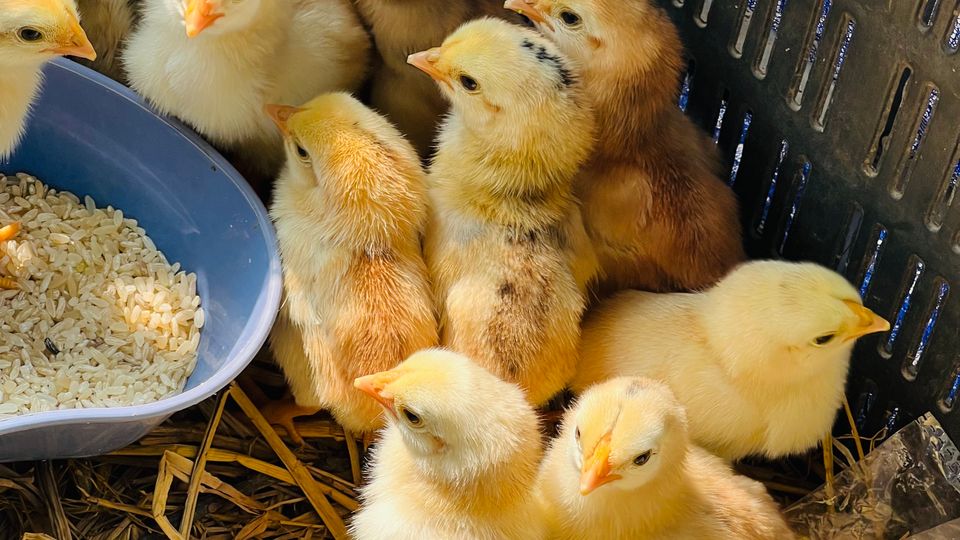
Yellow chicks gathered around a feeder.
A hospital corner that costs almost nothing
Weak chicks fail in the main ring because stronger ones push them off feed and water and walk over them. Give them their own space, inside the brooder so that they share the same heat.
Bend a strip of cardboard into a circle about a metre across, at the edge of the warm zone. That is enough for up to 20 chicks.
Lay rough paper over the litter and scatter feed on it, as well as in a tray.
Give them their own chick drinker with clean pebbles or marbles in the channel, so that a weak chick cannot fall in and get soaked.
Look in at least three times a day. This is where to dip beaks, clean vents and reset hobbles.
Return chicks to the flock as soon as they are eating and moving well, usually after two or three days. Chicks of this age mix back without fighting.
Handle the hospital chicks last on each round and wash your hands afterwards.
The corner is for recovery. A chick that is not improving after a few days has to be dealt with, not left there.
When to stop treating and cull
Culling is part of good chick care. A chick that cannot reach feed and water suffers until it dies, and while it lives it may carry infection. Cull when:
the chick still cannot stand or walk after several days of care;
the belly is swollen and smelly, or the navel is open and wet;
the chick is blind, or its beak is so crossed that it cannot pick up feed;
at seven days it is still tiny, with an empty crop, in spite of help.
The accepted method on farms is a quick dislocation of the neck by someone who has been shown how to do it properly. Do not leave chicks to die in a bucket or throw them out alive. Bury or burn the bodies where dogs cannot dig them up, and enter every cull in the mortality record. A farm that hides its culls cannot see its real losses.
What to write down and who to tell
Each day, note the date, the age of the flock, what you saw, how many chicks were affected and what you did. Take clear photographs on your phone of the vent, navel, legs or eyes. A vet needs that record to make sense of the problem, and a hatchery needs it to trace a fault to a setting or a breeder flock.
If your chicks came from Halaal Farms Ghana and a problem appears in the days after arrival, call us on 024 915 1503 with the hatch date and what you are seeing. Advice after an order is free, and a short call on day two is worth more than a long one on day ten.
Call a vet or the district veterinary office when deaths pass about one in a hundred in the first week, when many chicks show the same sign at once, or when you see gasping, bloody droppings or twisted necks. Those are beyond first aid.
Most of what is described here is prevented by a warm, dry, well-laid brooder and chicks that start eating and drinking within hours. Our chick brooding guide sets out the temperatures and routine. For the next batch, the pages for broiler chicks and layer chicks list what we supply, and you can ask what vaccines a batch has had before it leaves the hatchery.
Questions farmers ask
Is pasty vent contagious?
In most cases it is not. Pasting is usually a reaction to chilling, overheating, a long journey or late access to water, and it clears once the brooder is corrected. The exception is when many chicks have white, chalky droppings, look dull and start dying. That pattern can mean a bacterial infection and needs a vet or the district veterinary office, not home treatment.
Can a chick with splayed legs recover fully?
Yes, if you act early. A soft hobble that holds the legs at normal standing width, fitted within the first day or two and left on for two to four days, lets the hip and leg muscles strengthen in the right position. The chick must stand on rough paper or litter and have feed and water within reach. Cases left for a week rarely recover.
Should I give antibiotics to weak chicks in the first week?
Not without a diagnosis. Most early problems come from temperature, slippery floors, bad air, late feeding or faults at hatching, and no antibiotic corrects those. Giving drugs blindly costs money, hides the real cause and encourages resistance. Fix warmth, water and feed access first, and ask a vet to examine dead or sick chicks if losses keep rising.
How many weak or deformed chicks are normal in a batch?
Even a good batch has the odd small or weak chick, and many well-run farms keep total losses in the first week to about one chick in every hundred. If you are picking out more than two or three problem chicks per hundred, or the number grows each day, treat it as a brooding or chick quality fault and investigate straight away.
Written by the Halaal Farms Ghana team. We hatch and import day-old chicks at Opeikuma, Kasoa, and deliver to all 16 regions. This article is general guidance for farmers. For diagnosis and treatment of sick birds, speak to a vet or your district veterinary office.
Beak trimming limits the damage from feather pecking in layer flocks, but only when it is done early, precisely and by a trained hand. Here is what to expect, what to prepare and how to judge the result.
Day length controls when a pullet starts to lay. This guide sets out a lighting programme for open-sided houses in Ghana, from the first bright days to stimulation at point of lay, with advice for farms on unreliable power.
A measured, step-by-step build for the brooding area: how big to make the ring for any flock, what to make it from, how to lay out heat, feed and water, and when to expand it.