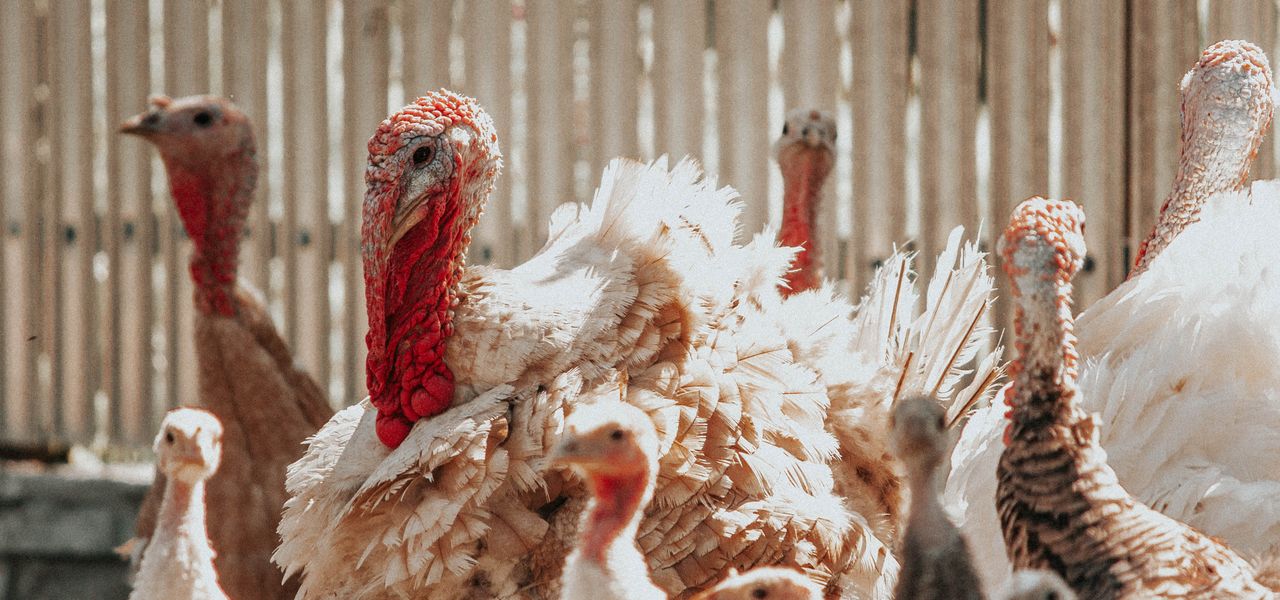
Turkey Farming in Ghana: From Poult to Christmas Table
Rearing turkeys in Ghana for the December market: poult care, feeding phases, space, blackhead and why turkeys stay away from chickens, timing and selling.
Halaal Farms Ghana team4 October 2026 · 13 min read
Key points
Count back from mid-December: local-type turkeys need six to eight months, fast-growing strains about four to five.
Poults are slow to find feed and water, so use bright light, beak dipping and coloured marbles in the first days.
Turkeys need more protein than chickens when young, then a grower and a finisher ration as they age.
Blackhead is carried by chickens and survives in soil, so keep turkeys off any ground chickens use or have used.
Take orders with deposits from October and sell out before New Year, because demand falls sharply afterwards.
The turkey a family carves on 25 December was a poult in the brooder somewhere between April and August. That gap, four to eight months depending on the type of bird, is the first fact of turkey farming. Buy the poults too late and you sell half-grown birds at a discount, or feed them through January when hardly anyone is buying. Almost every other decision follows from the calendar.
Turkeys repay care. Each bird is worth many times what a broiler is worth, which also means each death hurts more. The losses come at two points: in the first three weeks, when poults fail to start, and later from blackhead, a disease that turkeys catch from chickens. This guide takes you from the order date to the sale, with most attention on those two risks.
Count back from December
Start with the week you intend to sell, usually from about 10 December, and work backwards by the rearing time of the birds you are buying.
Step
Local-type turkeys
Fast-growing broad-breasted strains
Typical rearing time
Six to eight months
About four to five months
Poults arrive
April to early June
Late July to mid-August
On heat
First five to six weeks
First five to six weeks
Growing period
June to October
September to November
Take orders and deposits
From October
From October
Sale
Second and third weeks of December
Second and third weeks of December
Treat these as planning ranges. Growth depends heavily on feed quality, and birds reared in heat on chicken-type feeds take longer than a breeder's brochure suggests. Add two or three weeks of margin. A turkey that is ready early can be held on a maintenance ration. One that is too small on 20 December cannot be hurried.
Hatcheries are busiest for festive stock in the middle of the year, so book poults well ahead of the arrival date. Our article on when to order chicks for Christmas, Easter and Eid shows the same back-planning for cockerels, broilers and guinea fowl.
Local turkeys and broad-breasted strains
Two kinds of turkey are reared in Ghana, and they behave like different animals.
Local-type turkeys are the black, bronze and mixed-colour birds seen in compounds across the country. They grow slowly, forage well, cope with simple housing, mate naturally and the hens sit on their own eggs for the 28 days turkeys take to hatch. Their lower feed demand suits a semi-intensive system where the birds graze during the day.
Broad-breasted strains, white or bronze, have been bred for fast growth and a heavy breast. They reach large weights in far less time, but only on high-quality feed, and they are less forgiving of heat, poor litter and rough ground. Heavy males put strain on their legs and need more floor space and softer bedding.
Neither is the better bird in every case. If your buyers want a big bird for an office party and you can afford the feed, fast-growing stock makes sense. If you are selling live birds to households and have land to graze, local types are cheaper to carry. When you order, ask which type the poults are and what age and weight to expect at sale.
Getting poults through the first three weeks
A turkey poult is larger than a chick but slower to work things out. Chicks peck at anything. Poults often stand next to feed and water without touching either. Those that never start are called starve-outs, and they die quietly between about day three and day six, once the yolk they hatched with is used up. Brooding turkeys is mostly about preventing that.
Heat
Have the brooder at 35 to 37°C at poult height before the birds arrive, and lower it by about 3°C a week. Poults generally need heat for five to six weeks, longer than broilers. Read the birds as well as the thermometer: evenly spread and busy means comfortable, a tight heap means cold, and poults pressed to the outer edge with open beaks are too hot. A cold poult stops looking for feed, so chilling and starve-out often arrive together.
Teaching them to eat and drink
Bright light for the first three days, day and night. Poults find feed by sight, and a dim brooder hides it.
Dip every beak. As each poult leaves the box, dip the tip of its beak in water and then set it down beside the drinker. With a valuable bird it is worth doing all of them.
Use colour and shine. Put a few bright marbles or clean coloured pebbles in each drinker trough and on each feed tray. Poults peck at them out of curiosity and find the feed and water. The marbles also stop poults from wading in.
Put feed everywhere. Spread starter on rough paper and on flat trays or egg crates for the first four or five days, alongside the feeders.
Keep feed and water close to the heat, alternating feeders and drinkers around the warm zone, so no poult has to choose between warmth and eating.
Check crops on the first evening. Handle fifteen or twenty birds. The crop at the base of the neck should be full and soft. Empty crops mean you need more light, more trays or more warmth that night.
An old piece of advice says to put a few chicken chicks in with the poults so that the poults copy them. Do not do it. It works as a teaching aid, and it also brings in the disease risk explained in the blackhead section below.
Floor and ring
Brood in a ring with no corners, because frightened poults pile. Cover the litter with rough paper or hessian for the first days, since smooth surfaces cause splayed legs, then keep them on clean, dry wood shavings. For ring materials and layout, see our chick brooding guide. The same build suits poults, with the warmer start and longer heating period given here.
Three feeding phases
Turkeys grow a large frame and a great deal of muscle, and their protein need in the early weeks is higher than that of any chicken. The need falls as they age, which is fortunate, because protein is the expensive part of feed.
Phase
Approximate age
Protein level to aim for
Practical option where turkey feed is not sold
Starter
Hatch to 8 weeks
About 26 to 28 per cent
Good broiler starter as the base; ask a feed mill or nutritionist about a higher-protein mix
Grower
8 to 16 weeks
About 20 to 22 per cent
Broiler starter or grower type feed
Finisher
16 weeks to sale
About 16 to 18 per cent
Finisher or grower type feed, with grazing for local birds
A few points make the phases work:
Offer starter as mash or fine crumble. Poults struggle with coarse particles.
Change from one feed to the next over four or five days by mixing the two, so that intake does not drop.
Never give layer mash to growing turkeys. The calcium level is meant for hens in lay.
From about eight weeks, turkeys graze eagerly. Tender grass, legume leaves and vegetable trimmings can replace a useful part of bought feed for local-type birds. Supply coarse sand or grit so that the gizzard can grind the greens.
Water must never run out. A turkey drinks about twice the weight of the feed it eats, and more on hot afternoons.
Turkeys eat a lot in total. Budget for it before you buy poults, using the sum near the end of this article.
Space, perches and the yard
Crowded turkeys peck each other, foul the litter and grow unevenly. Use the figures below as minimums for deep-litter housing and give more in hot weather.
Age
Floor space per bird
Birds per square metre
1 to 4 weeks
About 0.1 m²
10
5 to 8 weeks
About 0.2 m²
5
9 to 16 weeks
0.3 to 0.4 m²
About 3
Over 16 weeks, hens
About 0.4 m²
2 to 3
Over 16 weeks, toms
0.5 to 0.7 m²
1.5 to 2
So a room of 4 by 5 metres, 20 square metres, finishes about 30 to 40 toms, not the 200 broilers the same floor would carry.
The house itself can be the open-sided type used for chickens: a low wall, mesh above, a roof with a wide overhang and the long axis running east to west. Keep 8 to 10 cm of dry litter on the floor. Heavy birds resting on a bare or wet floor develop breast blisters and sore hocks, which spoil the carcass.
Turkeys like to perch. Provide thick, rounded poles 50 to 60 cm off the floor, low enough that a heavy tom does not injure his legs jumping down. A fenced yard with shade, used from about eight weeks in dry weather, improves leg strength and cuts feed cost. Young poults must not get wet. Keep them under a roof until they are fully feathered, and shut older birds in during heavy rain.
Blackhead: why turkeys and chickens must not share ground
Blackhead, properly called histomoniasis, is the disease that ends many small turkey projects. It is caused by a microscopic parasite that attacks the caeca (the two blind pouches of the gut) and then the liver. In turkeys it can kill most of a flock.
How it reaches your turkeys
The parasite is fragile on its own. It survives by hiding inside the eggs of a small caecal worm that is very common in chickens and is also found in guinea fowl. Those birds carry the worm, and often the parasite, with few or no signs. Their droppings seed the soil with worm eggs, which stay infective for a long time, well beyond a year in favourable conditions. Earthworms take up the eggs and pass them on to any bird that eats them. A turkey that pecks at contaminated soil, droppings, litter or an earthworm becomes infected. Once one turkey has it, the parasite also spreads directly from bird to bird through fresh droppings in the litter.
What it looks like
Listless birds standing with drooping wings and half-closed eyes
Loss of appetite and rapid loss of weight
Sulphur-yellow droppings, the most telling sign
Sometimes a darkening of the skin of the head, which gave the disease its name, though many cases never show it
Birds of any age can be affected, and young growing turkeys are hit hardest. On post-mortem a vet finds round, sunken, target-like patches on the liver and caeca plugged with cheesy material. If you see yellow droppings and drooping birds, call a vet or the district veterinary office the same day. Treatment options for this disease are limited, which is why prevention carries nearly all the weight.
The rules that keep it out
Do not keep chickens or guinea fowl on a turkey farm if you can avoid it. If you must, house them as far apart as the land allows, with separate yards.
Never put turkeys on ground that chickens have used in the past few years, and do not let village chickens wander through the turkey yard.
Use separate boots, tools, feeders and drinkers. Attend to the turkeys first each day, before going near other poultry.
Do not spread chicken litter on land that turkeys range over.
Keep young turkeys on clean litter indoors for at least the first eight weeks.
Control the worm. Ask your vet for a deworming programme that covers caecal worms. Our article on worms, lice and mites explains how these parasites cycle through a flock.
Keep the yard drained and rotate it if you have space. Wet, muddy ground favours both the worm and the earthworms that carry it.
Remove sick birds at once.
These are part of ordinary farm hygiene. The low-cost measures in our guide to biosecurity on a small farm apply to turkeys with extra force.
A farm that already has chickens is not barred from rearing turkeys, but the turkeys need their own house, their own fenced ground that chickens have never used, and their own equipment. If you cannot provide that, expect trouble.
Guinea fowl walking on a farm.
Other health problems to plan for
Chicks from Halaal Farms Ghana are vaccinated at the hatchery before they leave. Ask what your batch of poults has had, then take that to your vet and agree a programme for the rest of the rearing period. The local vet sets it. The conditions most often discussed for turkeys in Ghana are:
Fowl pox. Spread by mosquitoes, it produces wart-like scabs on the bare skin of the head and neck. Turkeys are very prone to it in the rainy season, and a vaccine is commonly given. See our article on fowl pox.
Newcastle disease. Turkeys catch it and can bring it to, or take it from, neighbouring chickens.
Swollen sinuses. A soft swelling below the eye with nasal discharge points to a respiratory infection that needs a vet's diagnosis.
Coccidiosis in young poults on damp litter.
Fowl cholera in older birds, often seen as sudden deaths in well-grown stock.
None of these should be treated by guesswork. A turkey is too valuable to medicate on a neighbour's advice.
Selling: orders, sizes and the fortnight before Christmas
Turkey demand in Ghana is concentrated. Most birds are bought in the two weeks before Christmas, with some at Easter and a thin trade for weddings and parties through the year. Plan the selling as carefully as the rearing.
Start taking orders in October. Approach churches, staff welfare groups, companies that give Christmas gifts, hotels, restaurants and caterers, as well as households. A deposit by mobile money turns a promise into an order.
Match bird to buyer. A family oven or pot suits a hen or a smaller tom. The largest toms go to institutions and parties. Knowing your weights lets you offer both.
Weigh your birds. Live turkeys are often priced per head by eye. Put them on a scale so that you know your price per kilogram and can compare offers properly.
Decide between live and dressed. Live sale needs no freezer and no slaughter labour. Dressed birds fetch more per kilogram and suit corporate buyers, but need clean slaughter, chilling and cold storage that stays cold when the power goes off. Expect the dressed carcass to be roughly three-quarters of live weight. The hygiene steps in our guide to slaughtering and dressing poultry on a small farm apply to turkeys too.
Handle with care. Catch a turkey by holding both legs and supporting the body, never by one leg or a wing. Bruises show on the carcass. Move birds in the cool of the early morning.
Guard the flock in December. A pen of finished turkeys is a tempting target. Lock up at night and have someone sleep on site.
Sell out by New Year. Demand drops sharply in January, and a large tom eats several hundred grams of feed every day he stays.
The sum for one bird
Work out your cost per bird before you order. The figures below are examples to show the method. Replace each with your own.
Item (example)
Working
Amount
Poult
From GH₵ 65 (our starting price on 2 October 2026; prices change)
GH₵ 65
Feed
A 9 kg tom that ate 3.5 kg of feed per kg of weight = 31.5 kg, at an example GH₵ 8 per kg
GH₵ 252
Heat, litter, vaccines, deworming, labour (example)
Your own estimate
GH₵ 40
Share of losses
If 2 poults in 20 die, each survivor carries one-ninth of a poult plus the feed the dead birds ate
About GH₵ 10
Cost per bird sold
About GH₵ 367
Feed is about two-thirds of the total in this example, so the feed-to-weight figure is the one to measure on your own farm: weigh a sample of birds monthly and keep a count of bags used. Grazing lowers it for local birds. Poor early growth, wasted feed and holding birds past Christmas raise it. You can run your own prices through the poultry profit calculator to see the margin at different sale prices.
Halaal Farms Ghana supplies turkey poults and delivers to all 16 regions. The current starting prices are on the price list. Send the order form or call 024 915 1503 with your intended sale date, and we will confirm the hatch date, price and delivery cost before you pay, and tell you what the batch has been vaccinated against.
Questions farmers ask
How long does it take to raise a turkey for Christmas in Ghana?
Local-type turkeys commonly need six to eight months to reach a good festive weight, so poults should arrive between April and early June. Fast-growing broad-breasted strains on proper feed can be ready in roughly four to five months, which means late July to mid-August. Ask your supplier which type the poults are before you fix the date.
Can turkeys be kept with chickens or guinea fowl?
They should not share a house, a yard or equipment. Chickens and guinea fowl often carry a small caecal worm that harbours the blackhead parasite without making them ill. Turkeys that pick it up from droppings or contaminated soil can die in large numbers. Keep turkeys on separate, clean ground, use separate boots and tools, and attend to the turkeys first.
What do I feed turkey poults if there is no turkey starter in my area?
Turkey poults do best on a starter with more protein than chicken feed provides. Where no turkey starter is sold, most farmers use a good broiler starter and accept somewhat slower early growth. A feed mill or animal nutritionist can advise on a higher-protein mix. Do not use grower feed, layer mash or plain maize for young poults.
Why do turkey poults die in the first week even with heat?
The usual reason is that they never started eating or drinking. Poults are slower than chicks to find feed and water, and those that fail die between about day three and day six when the yolk reserve is used up. Bright light, feed spread on paper, coloured marbles in the drinkers and dipping each beak on arrival prevent most of these deaths.
Written by the Halaal Farms Ghana team. We hatch and import day-old chicks at Opeikuma, Kasoa, and deliver to all 16 regions. This article is general guidance for farmers. For diagnosis and treatment of sick birds, speak to a vet or your district veterinary office.
Quail lay at six to eight weeks and fit in a spare room, but the egg market is narrow. Here is how to house, feed, hatch and handle them, and how to check demand before you scale up.
A practical guide to Sasso chickens in Ghana: what weights to expect and when, how to run a house-and-run system, how to feed without overspending, and where coloured birds sell best.
Kuroiler and Noiler birds grow bigger and lay more than local chickens, but only with brooding, a secure night house and a daily supplement. Here is how to manage them and hatch replacements.