Starter, Grower, Finisher and Layer Mash: Poultry Feeds Explained
What each poultry feed is for, typical protein and energy levels, when to change from one to the next, and how mash, crumble, pellets and concentrate differ.
Halaal Farms Ghana team4 October 2026 · 12 min read
Key points
Broilers move from a starter of about 21 to 23 per cent protein to a finisher of about 17 to 19 per cent as energy rises and protein falls.
Layer mash carries 3.5 to 4.2 per cent calcium for eggshells, which damages the kidneys of chicks and growing pullets.
Change feeds by the birds' age and weight, with the next feed already in the store, and blend old and new over two or three days.
Crumbles and pellets suit broilers, while a coarse, even mash is the usual choice for laying hens.
Mix concentrate with maize only at the ratio printed on the bag, because extra maize dilutes protein, vitamins and minerals together.
Put layer mash in front of day-old chicks and the calcium in it, which is there to build eggshells, begins to damage their kidneys. Put chick starter in front of laying hens and within days the shells turn thin and the hens start drawing calcium out of their own bones. The bags look alike and the mash inside looks alike. What differs is the balance of protein, energy and minerals, and each balance is built for one stage of one kind of bird.
The numbers behind every feed
Three figures explain most of the differences between one poultry feed and another.
Crude protein, written as a percentage, tells you how much of the feed is protein. Young birds are building muscle, organs and feathers at great speed while eating very little, so every gram they eat has to be rich. As a bird grows it eats far more each day, and the percentage it needs comes down. Crude protein is a rough guide only. What the bird actually uses are amino acids, with lysine and methionine the ones most often short. Two feeds that both say 18 per cent on the label can perform very differently if one is short of these.
Metabolisable energy is the fuel the bird can extract from the feed, given in kilocalories per kilogram (kcal ME/kg). Most of it comes from maize and from fat or oil. Birds eat largely to meet their energy need. On a low-energy feed they eat more, and on a high-energy feed they eat less. This is why protein and energy have to be set in proportion to each other, and why a feed thinned out with bran makes birds eat more without growing more.
Calcium is the figure that separates layer feed from everything else. Growing birds need about 1 per cent for their bones. A hen puts roughly two grams of calcium into every eggshell, so her feed carries three to four times as much.
Broiler feeds: starter, grower and finisher
A broiler multiplies its hatch weight many times over in six weeks. The feed programme follows that curve, with protein stepping down and energy stepping up.
Feed
Typical age fed
Crude protein
Energy (kcal ME/kg)
Usual form
Starter
Day 1 to about day 10 to 14
21 to 23%
2,900 to 3,050
Crumble or fine mash
Grower
About day 11 to day 24 or 28
19 to 21%
3,000 to 3,150
Pellet or mash
Finisher
About day 25 to sale
17 to 19%
3,050 to 3,200
Pellet or mash
These are typical ranges. The label on the brand you buy gives the real figures, and feeds made for hot climates often sit at the lower end for energy.
Many feed mills in Ghana sell broiler feed in two stages only, starter and finisher. In that system the starter is normally fed for the first three to four weeks and the finisher from then until sale. The principle is the same. Follow the ages printed on the bag for that brand, because the two feeds have been formulated to work together.
The starter is the most expensive feed per bag and the smallest quantity. In a two-feed programme a broiler eats a little over 1 kg of starter and then 3 to 3.5 kg or more of finisher by six weeks. Cutting corners on the starter saves little money and costs a great deal, because frame, gut and immune system are all built in those first days.
Many broiler starters and growers contain an anticoccidial to hold coccidiosis in check. Where a feed is medicated, the label states a withdrawal period before slaughter. Read it, and make sure the last feed before sale is one that meets it.
Layer feeds: chick mash, grower, pre-lay and layer mash
A layer pullet is reared slowly on purpose. The aim over 18 weeks is a strong frame at the right weight, not maximum growth, so her feeds are less dense than broiler feeds and the grower stage is long.
Feed
Typical age fed
Crude protein
Energy (kcal ME/kg)
Calcium
Chick starter (chick mash)
Day 1 to 6 or 8 weeks
18 to 21%
2,750 to 2,950
About 1%
Grower mash
8 weeks to about 16 weeks
14.5 to 16.5%
2,700 to 2,800
About 1%
Pre-lay (where sold)
About 16 weeks to first eggs
16 to 17.5%
2,700 to 2,800
2 to 2.5%
Layer mash
First eggs to end of lay
16 to 18%
2,700 to 2,850
3.5 to 4.2%
As a rough quantity guide, a brown pullet eats 1.5 to 2 kg of chick mash to eight weeks and a further 4.5 to 5.5 kg of grower to 18 weeks. In lay she eats 110 to 120 grams a day.
Why grower mash is not second-rate feed
Farmers sometimes see the lower protein figure on grower mash and assume it is a cheap filler stage. It is deliberate. A pullet fed too richly between 8 and 16 weeks lays down fat, starts laying before her frame is ready and gives small eggs and more prolapse. The grower stage controls weight. The targets it is aiming at are set out in our guide to rearing pullets from day-old to point of lay.
The calcium step at the start of lay
About ten days before her first egg a pullet begins storing calcium in a special reserve inside her bones. A pre-lay feed, with about twice the calcium of grower, supports this without overloading the kidneys of birds that are not yet ready. Where no pre-lay feed is sold, stay on grower until the first eggs appear and then go to layer mash. Do not delay the change beyond about 5 per cent production. Shell faults that trace back to calcium are covered in the article on thin shells, soft shells and misshapen eggs.
What goes wrong when the wrong feed is in the trough
The mistake
What it does
Layer mash fed to chicks or growers
Calcium three to four times what they need damages the kidneys. Expect poor growth, wet droppings and deaths, with lasting harm in the survivors. Protein is also too low for chicks.
Chick or grower mash fed to hens in lay
With only 1 per cent calcium, shells go thin within days, shell-less eggs appear and hens weaken as they strip their bones.
Layer or grower mash fed to broilers
Too little protein and energy. Birds grow slowly and need extra weeks, and extra feed, to reach sale weight.
Broiler finisher fed from day one
Protein is too low for the first two weeks. Chicks start slowly and unevenly and do not fully catch up.
Broiler starter fed all the way to sale
It works, but you pay for protein the older bird does not use. The surplus is excreted, which makes litter wetter and ammonia stronger.
Broiler feed fed to layer pullets for months
Pullets become overweight and fat, which costs more and harms laying later.
Chicken starter fed to turkey poults or guinea keets
These birds need more protein at the start than chick feeds supply. Growth is poor and losses rise.
If the right feed is out of stock for a few days, the least harmful stand-in is always a feed for a younger stage of the same bird, never layer mash for anything that is not laying.
Changing from one feed to the next
The change of feed is a small stress, and a few habits keep it small.
Change by age and weight, not by the last bag. Farmers often stay on starter because there are bags left, or jump early because the starter ran out. Decide the date, then buy to fit it.
Have the next feed in the store first. A day with empty feeders does more harm than any feed change.
Blend for two or three days. Mix about three parts old to one part new on the first day, half and half on the second, one part old to three parts new on the third. Birds notice changes in taste, colour and texture, and intake dips if the switch is sudden.
If the flock is behind target weight, wait a few days. Underweight broilers at ten days, or light pullets at eight weeks, are better kept on the richer feed a little longer. Weigh a sample to decide.
Do not pile stresses together. Avoid changing feed on the same day as vaccination, moving house or beak trimming.
Mash, crumble or pellet
The same formula can be sold in three physical forms, and the form affects how well birds use it.
Mash
Mash is the ingredients ground and mixed. It is the cheapest form to make, and most feed produced in Ghana is mash. A good mash feels gritty, with visible pieces of maize, more like coarse gari than flour. A mash ground too fine is dusty, sticks to beaks, lowers intake and irritates the airways.
Birds pick out the larger particles first, which are mostly maize, and leave the fine material. Unfortunately the fines hold much of the vitamins, minerals, salt and amino acids. For this reason, let the feeders run down to empty for a short period once a day so that the birds clean up the fines before you refill. Do not let them stand empty for hours.
Crumble
Crumble is pelleted feed broken into small pieces that a chick can swallow. Every crumb contains the full formula, so chicks cannot select. It gives broiler chicks the best start, and it is worth paying for in the starter stage even if you use mash later.
Pellets
Pellets are made by steaming the mash and pressing it through a die. Birds fill up faster, spill less and spend less energy eating. In broilers, good pellets usually give better growth and feed conversion than the same formula as mash. The advantage depends on the pellets surviving the journey. Pour some into your hand. If a third or more is dust, you are paying a pellet price for mash.
For laying hens, mash is the usual choice. Hens on pellets finish eating quickly and have idle hours, which encourages feather pecking, and they tend to overeat.
When comparing prices, do not compare bags. Compare the feed cost of each kilogram of weight gained or each crate of eggs. The method is worked through in feed conversion ratio explained, and you can test different feed prices in the poultry profit calculator.
Concentrate plus maize: how the ratio works
A concentrate is the part of a feed that is hard to source yourself, sold in one bag. It contains the protein ingredients such as soya meal and fishmeal, together with the minerals, vitamins and added amino acids. You supply the maize, and sometimes wheat bran, and mix them at the ratio printed on the bag. There are separate concentrates for broilers and for layers, and for different stages.
Inclusion rates vary a great deal between products. Some are designed to make up a quarter to two fifths of the final mix. Others are far more concentrated and are used at 5 or 10 per cent, with the farmer adding soya meal as well as maize. You cannot carry a ratio from one product to another.
The arithmetic shows why the ratio matters. As an example only, take a concentrate with 40 per cent protein, designed to be mixed 30 parts to 70 parts maize, and maize at 8.5 per cent protein:
From the concentrate: 0.30 × 40 = 12.0
From the maize: 0.70 × 8.5 = about 6.0
Protein in the mix: about 18 per cent
Now stretch it to 25 parts concentrate and 75 parts maize to save money. The concentrate gives 10.0, the maize 6.4, and the mix falls to about 16.4 per cent. That alone would slow a broiler. More serious, every vitamin, mineral and amino acid in the mix has also fallen by a sixth, because all of them come from the concentrate. The saving on the bag is paid back in slower growth or fewer eggs.
Three more points decide whether concentrate feeding works. The maize must be dry, clean and free of mould, because it makes up most of the feed. See the article on aflatoxin and mouldy feed for how to judge it. The mixing must be thorough, or some birds get mostly maize. And with layer concentrates, check whether the calcium is already included or whether the label tells you to add limestone or oyster shell. The equipment, weighing and quality checks involved are the subject of our article on mixing your own poultry feed.
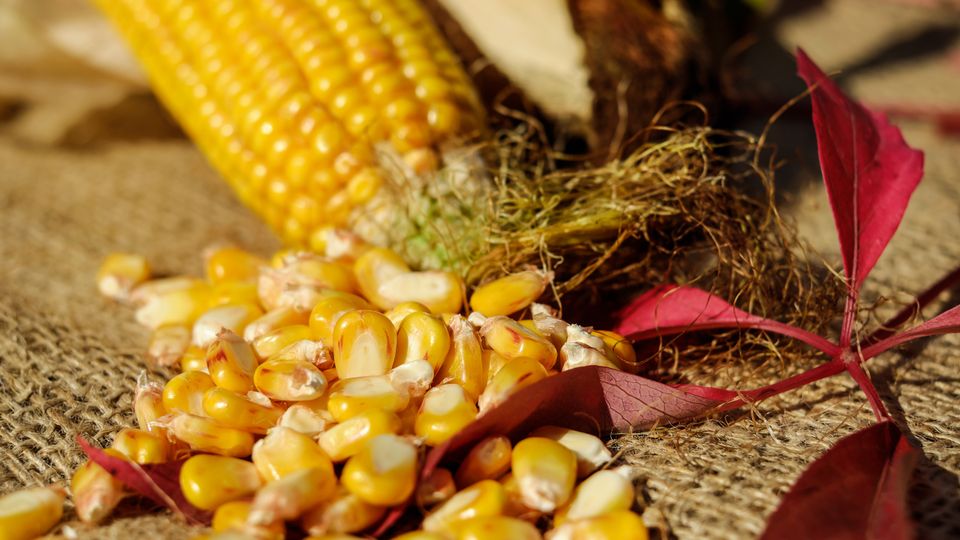
Maize kernels and a cob on sacking.
Feeds for Sasso, cockerels, turkeys, guinea fowl and quail
Dual-purpose and slow-growing chickens such as Sasso, Kuroiler, Noiler and white cockerels are usually started on broiler starter or chick mash for the first four to six weeks and then moved to a grower feed. They do not need dense broiler finisher all the way, and many are finished with access to forage or kitchen and farm by-products alongside a balanced feed.
Turkey poults, guinea keets and quail chicks are a different matter. All three need a higher protein level in the first weeks than chicken feeds provide. Turkey starters are typically around 26 to 28 per cent protein, and keets and quail do best in the mid-twenties. If your feed seller has no turkey or game-bird starter, ask a nutritionist or the feed company how to raise the protein of a broiler starter safely before your keets, poults or quail chicks arrive.
Reading the bag and keeping the feed fresh
Before you pay, read the label or the printed tag sewn into the bag.
The class of feed and the age it is meant for. Bags from one mill often differ only by a small printed word or the colour of the tag.
Crude protein, fibre, fat, calcium and phosphorus. Compare these against the ranges above.
Date of manufacture and batch number. Vitamins fade and fats turn rancid in heat. Buy feed made in the last two to three weeks where you can, and plan to use it within about a month, sooner in the wet season.
Any medication and its withdrawal period.
Net weight. Put a bag on a scale now and then. A 50 kg bag that weighs 47 kg has raised your feed price by 6 per cent.
Smell and feel every delivery. Fresh feed smells of grain. A musty or sour smell, lumps, warmth inside the bag or visible mould are reasons to reject it. Store bags on pallets, off the floor and away from walls, and always use the oldest first.
Having the right feed ready before the chicks arrive
The feed decision is made before the birds come, not after. Know which programme you will follow, where you will buy each stage, and that the first bags are already in the store on the day of delivery. Chicks that wait for feed lose ground they do not recover.
When you order broiler chicks or layer chicks from Halaal Farms Ghana, tell us what feeds are sold in your area and we will help you work out a programme and the number of bags for your batch. Phone 024 915 1503 or use the order form. There is no charge for the advice, and it continues after the birds are on your farm.
Questions farmers ask
Can I feed broiler starter to layer chicks?
For the first few weeks it does no harm, and some farmers do it when chick mash is out of stock. It is more expensive than layer chick feed and richer than pullets need, so do not continue it for long. Pullets kept on broiler feed grow too fat. Check the label too, because some broiler feeds contain an anticoccidial that is not meant for birds kept for eggs.
When should I change pullets from grower mash to layer mash?
Change when the first eggs appear, and no later than the point where about five hens in a hundred are laying each day. For most commercial breeds that is around 18 to 19 weeks. Changing much earlier exposes immature kidneys to high calcium. Changing late gives thin shells and drains calcium from the hens' bones.
Are pellets better than mash for broilers?
Good pellets usually give faster growth and a better feed conversion than the same formula as mash, because birds eat more easily, waste less and cannot pick out favourite particles. The benefit depends on pellet quality. If a third or more of the bag has broken down to dust, you are paying a pellet price for mash.
How much feed does one broiler eat before sale?
A broiler sold at about six weeks eats roughly 4 to 5 kg of feed in total, depending on breed, final weight, feed quality and wastage. In a two-feed programme a little over 1 kg of that is starter and the rest is finisher. Weigh the feed you issue for your own flock, because your figure is what your costing should use.
Written by the Halaal Farms Ghana team. We hatch and import day-old chicks at Opeikuma, Kasoa, and deliver to all 16 regions. This article is general guidance for farmers. For diagnosis and treatment of sick birds, speak to a vet or your district veterinary office.
Home-mixed feed can lower your cost per bag or quietly raise your cost per crate. This guide covers ingredients, premix, equipment, quality checks and the sum that tells you which way it will go.
A buyer's and storekeeper's guide to maize and soya for poultry: Ghana's harvest calendar, the 13 per cent moisture rule, weevil control, pallets and stacking, and a worked sum for deciding how much to stock.
Aflatoxin slows growth, cuts egg numbers and weakens vaccine response long before birds look sick. Learn how grain becomes contaminated, the warning signs in a bag, how to sample for testing and when to refuse a load.