How to run a poultry farm in Ghana while employed elsewhere: choosing a caretaker, daily phone reports, stock checks, surprise visits and when to stop.
Halaal Farms Ghana team4 October 2026 · 12 min read
Key points
Ask for a fixed evening report with numbers: age, deaths, feed bags opened and left, water, eggs and anything unusual.
Reconcile three stocks every week from your own sheet: birds, feed bags and egg crates.
Be on the farm yourself for chick arrival, the first three days, each vaccination and sale day.
Visit at least weekly at times nobody can predict, and count feed bags and birds each time.
Spread the caretaker's wage over the birds sold to find the smallest batch that makes an absent owner's farm worth running.
Two caretakers send their owners a message at seven in the evening. The first says, "All is well, boss." The second says, "Day 23. One dead, nine in total. One bag opened, fourteen left. Tank full. Twenty birds weighed, 21 kilos. Litter dry." The first owner knows nothing. The second knows the flock is alive, eating about what it should, slightly behind on weight and stocked with feed for well over a week. Farms run by owners with jobs elsewhere succeed or fail on that difference.
Keeping birds while you keep your salary is common in Ghana, and sensible: the wage carries the household while the farm finds its feet. It works only when the farm is designed from the start to be run by someone else and checked by you. This article describes that design.
What the farm will still need from you
A caretaker replaces your hands, not your judgment. Even with a good person on site, four things remain yours, and you should be honest about whether your job leaves room for them.
Ten to fifteen minutes every evening. You read the report, enter it on your own sheet and reply. If your work makes that impossible for days at a time, someone you trust must do it for you.
At least one visit a week. This is realistic only if the farm is within about an hour of your home or workplace. A farm in your hometown four hours away will be seen once a month, whatever you intend.
The buying and selling. You order chicks and feed, pay suppliers, agree prices with buyers and receive the money.
Presence on the days that decide the batch. These are chick arrival and the three days after it, every vaccination day and sale day.
The first of those key days can be planned. Ask the hatchery for a hatch date that puts the chicks on your farm on a Friday evening or Saturday morning, or at the start of your leave. Halaal Farms confirms the hatch date and delivery arrangements before you pay, so say on the order form which days you are free. Spend that first weekend in the brooder with the caretaker, following the routine in our chick brooding guide. What happens in those seventy-two hours shapes the batch more than anything you do in the five weeks that follow.
Birds that suit an owner who is away
Different enterprises ask different things of an absent owner, and the right choice depends on your work pattern more than on the profit promised.
Bird
Why it suits an absent owner
Where it bites
Broilers in batches
Six to eight weeks from chick to sale. You can time batches around leave and rest the farm when work is heavy.
Mistakes show within days and cannot be recovered. The whole batch must be sold in a short window, which needs you.
Sasso, Kuroiler, Noiler, cockerels
Hardier and slower, so a late feed change or a warm afternoon does less damage. Sale can be spread over weeks.
Three to five months of feed and wages before the bulk of the income.
Layers
Steady daily income once in lay, and a regular routine that a caretaker learns well.
Eggs are cash lying in a nest every day. The flock is a commitment of well over a year with no pause.
For most salaried beginners a modest broiler batch, or a batch of hardy coloured birds, is the safer first step, because it has an end date. The slower breeds are described on our Sasso, Kuroiler and Noiler chicks page. If you are weighing meat birds against eggs more generally, see broilers or layers: which to start with. Layers can work well for an absent owner, but only after the reporting and counting described below have become habit.
Choosing the person who will be there
The caretaker is the farm for six days out of seven, so this choice outweighs breed, feed brand and house design together. Look for three things in this order: reliability, honesty and willingness to follow a routine exactly. Experience comes fourth. A careful beginner whom you train yourself is usually better than an experienced hand with fixed habits and a side trade in your feed.
Practical requirements matter too. The person must live on the farm, since chicks need attention at night and an empty farm is easily robbed. They must be able to read a scale, write figures in a book and send a message or make a call. They should keep no birds of their own and should not be working on another poultry farm.
Be cautious about putting a relative there by default. A nephew is hard to correct and harder to dismiss, and the family will hear his version first. If you do employ family, set the same written terms as for a stranger.
Whoever it is, run the first batch together on your weekends and evenings before you rely on reports, and name a second person who can step in. A caretaker who falls sick or travels to a funeral with nobody to cover is how a good batch dies in two days. Recruitment, training, pay and incentives are dealt with fully in our article on hiring and managing poultry farm workers.
The evening report: seven numbers by phone
Agree one format and one time, and accept nothing vaguer. The report should carry:
the age of the flock in days or weeks;
deaths today, and the running total;
feed bags opened today, and bags left in the store;
water: tank level, and whether drinkers ran dry at any point;
for layers, eggs collected in crates and loose eggs, and how many were cracked;
any weights, vaccinations or treatments done;
anything unusual: wet droppings, coughing, birds off feed, a broken curtain, a visitor.
The simplest method is a photograph of the day's page in the record book, sent by WhatsApp, with one photograph of the birds and the litter. Where the network is poor, a two-minute call at a fixed hour does the same job, and you write the figures down yourself. Silence is also information: if no report arrives, call that evening, every time, so that it never becomes normal.
Numbers are only useful if you know what they should be. For broilers, daily feed rises steadily with age. Five hundred birds use roughly one 50 kg bag a day in week three and close to two bags a day by week six. Five hundred layers eat a little over one bag a day, every day. Against that background, the report speaks plainly:
What the report shows
What it may mean
Your response
Deaths double from one day to the next
Disease, heat, or a brooding failure overnight
Call at once, ask for photographs, send fresh dead birds to a vet
Feed use falls while birds are growing
Birds off feed, often the first sign of illness or a water problem
Ask about water and droppings the same evening
Feed use jumps without reason
Wastage, rats, or bags leaving the store
Count the store on your next visit, unannounced
Eggs fall by several crates over a week
Disease, feed or water interruption, heat, or eggs going missing
Check feed and health first, then the counting
The same round figures every day
The book is being filled from memory or invention
Visit, and compare ink, handwriting and the store
Stock control from a distance: three counts that must agree
Reports tell you what the caretaker says. Reconciliation tells you whether it is true. Keep your own running sheet at home, in an exercise book or a spreadsheet, and balance three stocks.
Birds
Chicks placed, less deaths, less birds sold or eaten, equals birds in the house. Ask for a photograph of each day's dead birds laid beside a paper showing the date before they go into the pit. Count the live birds yourself whenever the flock is handled, at a vaccination or when a partition is moved, and at night with a torch when they are settled. A difference of a few birds is counting error. A difference of thirty is not.
Feed
Bags delivered, less bags opened, equals bags in the store. Pay the feed supplier yourself and keep the delivery note. Have every empty sack kept and tied in bundles of ten until you have counted them. Then compare the total fed with what a flock of that size and age should eat. Feed is the easiest thing on a farm to sell quietly, and also the easiest to count.
Eggs and money
Eggs collected, less eggs sold and eggs broken, equals crates in the store. Work out the laying rate each week: eggs collected divided by hens alive. Healthy hens on steady feed do not lose five points of production in three days for no reason.
Keep cash off the farm wherever you can. Agree prices with buyers yourself, by phone if necessary, and have payment sent to your own mobile money number or merchant wallet before birds or crates are loaded. The caretaker records what left the gate, and you match it against what arrived on your phone. Suitable layouts for all of these sheets are in our guide to poultry records every farmer should keep.
Surprise visits that tell you something
A visit that can be predicted finds a swept yard and full drinkers. Vary the day and the hour. Go once at six in the morning, once at two in the afternoon when heat and thirst are at their worst, and once after dark when you can hear the birds breathe. A useful visit takes about thirty minutes and follows the same order each time:
Stop at the door and use your senses. Ammonia that stings the eyes means wet litter or closed curtains. Listen for sneezing and rattling. Look at how the birds are spread across the floor.
Check water and feed. Are the drinkers clean and at the right height? Are any feeders empty, or filled to the brim and spilling?
Handle birds. Feel a few crops, look at vents and feet, and weigh a sample of twenty.
Count the store. Full bags, empty sacks, egg crates. Compare with last night's report before you say anything.
Read the book. Entries written daily look different from a week filled in at one sitting.
Look where the dead birds go, and at the vaccine vials or packets kept from the last vaccination.
A visit should not be only an inspection. Bring what was asked for, ask what is going wrong, and say so when the work is good. A caretaker who expects blame at every visit learns to hide problems, and hidden problems are the expensive ones. It also helps to have one other person, a relative or a trusted neighbour, pass by now and then without warning.
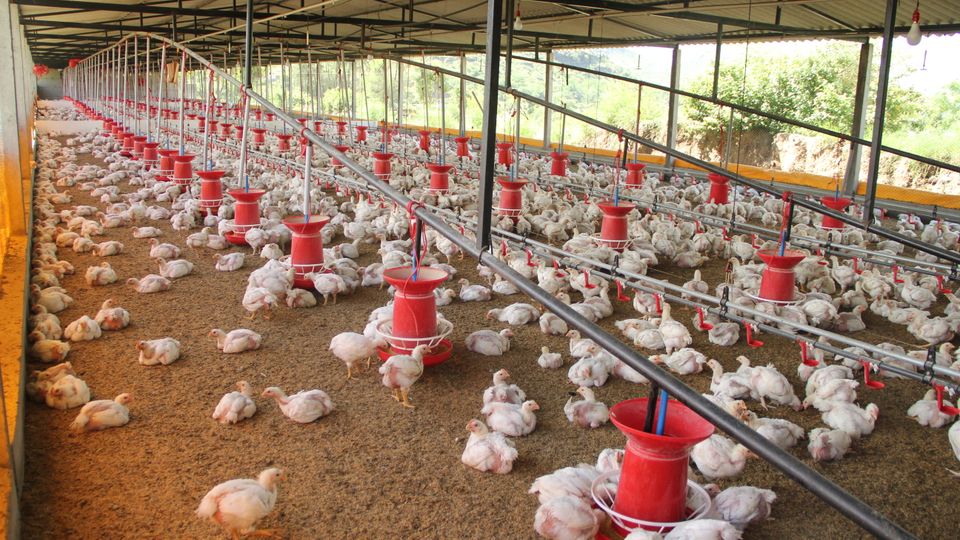
Long poultry house with rows of feeders and drinkers.
What to automate, and what a gadget cannot do
Money spent on equipment should remove the failures that happen when nobody is watching. In rough order of value:
Water that refills itself. An overhead tank feeding bell drinkers or a nipple line through a float valve ends the commonest failure on a caretaker-run farm, which is drinkers standing empty in the afternoon. The options are compared in nipple drinkers or bell drinkers.
Feeders that hold a day's feed. Large hanging tube feeders, filled morning and evening, mean a late start does not leave birds hungry.
A maximum and minimum thermometer. It records the highest and lowest temperature since it was last reset, so you can see on Saturday how cold the brooder became on Wednesday night.
A hanging scale and a weighing bag. Weekly weights turn "they are growing well" into a figure.
Steadier heat and light. A gas brooder holds temperature through the night with less tending than a charcoal pot. Solar lamps or a timer keep the lighting regular through power cuts.
A lock on the feed store, and a clear rule about who holds the key and how each bag taken out is recorded.
Cameras linked to a phone are increasingly affordable and have a place at the gate and the store door. They depend on power and a data signal, and they show only where they point. No camera smells ammonia, feels an empty crop or notices that the birds have gone quiet. Treat equipment as a way of making the caretaker's job easier to do well, never as a substitute for visits.
When it stops being worth it
An absent owner's farm carries a cost that a home flock does not: a full-time wage. That wage is the same for 200 birds as for 1,000, so it sets a minimum sensible size. As an example, suppose a caretaker is paid GH₵ 1,200 a month and a broiler cycle, including cleaning and rest, takes two months. That is GH₵ 2,400 of labour per batch. Spread over 200 birds sold it is GH₵ 12 a bird. Over 1,000 birds it is GH₵ 2.40. Use your own wage figure and your expected margin per bird in the poultry profit calculator to find the batch size below which the wage eats the profit.
If that size is more than you can fund or sell, the honest answer may be a smaller flock at home that you tend before and after work, as described in backyard poultry in Ghana.
Review the arrangement after every batch, or every quarter for layers. These are signs that it is failing:
losses stay far above five birds in a hundred, batch after batch, despite corrections;
the three counts never agree, and the explanations change;
you have not visited for three weeks, or you dread the evening call;
every batch needs topping up from your salary and none has returned it;
your employer has begun to notice the farm;
caretakers leave after each batch, taking what you taught them.
Failing does not have to mean closing. With broilers you can simply rest the house after the current batch and restart when work allows. You can reduce numbers, move to hardier birds, shift the farm closer to home, or bring in a working partner who lives on site and shares the profit under a written agreement. What you should not do is carry on unchanged and hope.
If you are planning a first batch around your job, call Halaal Farms on 024 915 1503 before you order. We can talk through batch size and timing, and advice before and after an order is free.
Questions farmers ask
Can I run a poultry farm in Ghana while working full time?
Yes, provided someone reliable lives on the farm, you can take a short call or message every evening, and you can reach the farm at least once a week. You must also be present for chick arrival, vaccinations and sales. If your job takes you away for weeks at a time, or the farm is several hours from home, the arrangement usually fails.
Which poultry is easiest to manage from a distance?
Broilers in separate batches suit many salaried owners because each batch lasts about six to eight weeks and can be timed around leave, with a pause afterwards. Slower dual-purpose birds such as Sasso and Kuroiler forgive small lapses in management. Layers bring daily income but also daily eggs to count and a commitment of well over a year without a break.
How do I know if my caretaker is stealing feed or eggs?
Keep your own running sheet and compare it with what is physically on the farm. Feed delivered minus bags opened should equal bags in store, and empty sacks should match bags opened. Eggs collected minus eggs sold and broken should equal crates in store. A laying rate that drops several points with healthy birds and normal feed intake deserves an unannounced visit.
How often should an absentee owner visit the poultry farm?
At least once a week, and more often in the first week of a batch. Vary the day and the hour, including an early morning and an evening, because a visit that can be predicted will always find the farm tidy. Use each visit to count feed and birds, weigh a sample, check water and litter, and read the record book.
Written by the Halaal Farms Ghana team. We hatch and import day-old chicks at Opeikuma, Kasoa, and deliver to all 16 regions. This article is general guidance for farmers. For diagnosis and treatment of sick birds, speak to a vet or your district veterinary office.
What a good farm hand does from dawn to dusk, how to choose and train one, how to house and pay staff, which bonuses work, and practical controls that stop eggs, feed and birds leaving unrecorded.
A ten-step roadmap for a first poultry farm in Ghana, from finding buyers to selling the first batch, with a wall countdown and links to the detailed guide for each step.
A working guide to a poultry business plan: the seven sections, the figures you must collect yourself, a labelled 500-broiler example and five stress tests that show where the plan breaks.