How to Start a Poultry Farm in Ghana: A Step-by-Step Plan for Beginners
The right order for starting a poultry farm in Ghana: buyers first, then money, site, house, equipment, feed, vet, chicks, labour and the first sale.
Halaal Farms Ghana team4 October 2026 · 14 min read
Key points
Agree what your buyers want, in what size and at what price, before you decide which bird to raise.
Set aside the feed money for the whole cycle before ordering chicks: about 4 to 5 kg per broiler, or 6 to 7 kg per pullet before her first egg.
Build the house with its long side running east to west, open mesh sides and a floor that stays dry in June.
Book chicks at least three to four weeks ahead, because a hatchery sets eggs 21 days before the hatch date.
Have the brooder warm, the feed in the store and a vet's vaccination programme on paper before the chicks are loaded.
The usual way a first poultry batch goes wrong in Ghana is settled before a single chick arrives. The birds are ordered before any buyer has agreed a price, or the house is roofed with money that should have bought the last three weeks of feed. Starting well is mostly a matter of doing things in the right order: buyers first, then money, site, house, equipment, feed, water, a health plan, chicks, labour and the sale.
What follows is that order, set out as ten steps and a countdown you can pin on the wall. Each step is kept short on purpose. Where a step deserves a full guide of its own, there is a link to it, so you can read the whole roadmap in one sitting and then go deeper on the part you are working on this week.
Step 1: Find the buyer before you choose the bird
Spend a week asking questions before you spend a pesewa. Visit every likely buyer within cheap delivery distance: chop bars, caterers, waakye and kenkey sellers who use boiled eggs, provision shops, school kitchens, cold stores, the live-bird sellers on market day, and households in your church, mosque or workplace.
Ask each one the same five things and write the answers down:
What do you buy now: live broilers, dressed chicken, eggs, cockerels, guinea fowl?
How many each week, and does that change at Christmas, Easter or Eid?
What size do you want? Chop bars often want a particular weight, and egg prices differ by crate size.
What price do you pay today, and who supplies you?
How do you pay: cash on delivery, mobile money, or credit until month end?
The answers tell you what to raise, how many, and what weight to aim for. They also show the ceiling on your price. Imported frozen chicken is cheap and sold everywhere, so local broilers win on freshness, taste and the preference many households have for a live bird. If nobody near you pays for those things, eggs or slower coloured birds may be the better start. Our guide to finding buyers for broilers and eggs covers each channel and how to secure orders before you stock.
Step 2: Pick one enterprise and a modest number
With the market notes in front of you, choose one type of bird for the first batch. Two types or two ages on a new farm double what you must learn at once and let disease pass from older birds to younger ones. The main options behave very differently:
Broilers (Ross 308, Cobb 500) are ready for sale in about six to eight weeks. Money comes back fast, but the birds must be sold on time because they keep eating.
Layers (Hy-Line, Lohmann, Bovans) need 18 to 20 weeks of rearing before the first egg, then produce daily income for a year or more.
Sasso, Kuroiler, Noiler and cockerels grow more slowly, tolerate rougher conditions and suit the live-bird market, especially at festive times.
Guinea fowl, turkeys and quail serve specific markets and are better as a second step.
Then set the number. Four limits apply, and the smallest one wins: what your buyers will take in one week, what your floor can hold, how much feed money you have for the whole cycle, and how many birds you can personally watch every day. For most beginners that lands between 100 and 300 birds. A small batch teaches the same lessons as a large one and costs far less when something goes wrong.
Step 3: Do the sums for the whole cycle, not the first week
Feed is the largest cost on any poultry farm, and it is the one beginners guess. Use quantities, then put your own local prices on them.
A broiler eats roughly 4 to 5 kg of feed between day one and a sale weight of 2 to 2.5 kg. For 100 broilers that is 400 to 500 kg, or eight to ten 50 kg bags. A layer pullet eats about 6 to 7 kg before she lays her first egg, then around 110 to 120 grams every day. For 100 layers that is 13 or 14 bags during rearing, followed by about seven bags a month for as long as they are in lay.
Both patterns lead to one rule: the feed money for the full cycle must exist before you order chicks. A broiler farmer who runs short in week five sells underweight birds at a loss. A layer farmer who runs short in month four has paid for a flock that never reaches its first egg.
Split your budget into one-off costs (house, equipment, water tank, fencing) and running costs (chicks, feed, vaccines, litter, brooding fuel, labour, transport), then add at least ten percent for surprises. How much money you need to start works through each category for 100, 500 and 1,000 birds. Test your own prices in the poultry profit calculator; current chick prices are on our day-old chick price list.
Write the result down as a short plan, even if no bank will ever read it, because assumptions on paper show where the plan is thin. How to write a poultry business plan explains each section.
Step 4: Choose a site that still works in June
Land that looks perfect in January can be a pond in the major rainy season. Visit a possible site after heavy rain, or ask the neighbours where the water stands. You want ground that slopes gently away from the house, a road a loaded tricycle or feed truck can use in the wet months, and water on the site or close enough to pipe.
Distance matters in two directions. Other poultry farms close by are a disease risk to you, and your farm is a smell and fly risk to homes close by. Check who really owns the land, get your agreement in writing, and think about night security before you build. The full checklist is in choosing a site for your poultry farm.
While the site is being settled, find out what your district assembly, the district veterinary office and the business registrar expect from a new farm. Requirements change, so ask the offices directly; registering a poultry farm in Ghana explains who to ask about what.
Step 5: Build for moving air, shade and a dry floor
Most small and medium farms in Ghana use open-sided, deep-litter houses, and the design rules come straight from the climate.
Orientation: run the long side east to west. The sun then travels along the roof ridge and does not shine into the open sides in the morning and afternoon.
Width: keep the house narrow enough for wind to cross it, usually no more than about 9 to 10 metres. A wide house traps hot, stale air in the middle.
Sides: a low wall of two or three block courses with strong wire mesh above it to the roof, to keep out wild birds, snakes and thieves while letting air through.
Roof: high enough to stand under at the eaves, with a generous overhang so driven rain does not wet the litter.
Floor: concrete or well-rammed laterite, raised above the surrounding ground so water never runs in.
Curtains: tarpaulin or stitched feed sacks that can be rolled up and down for brooding, storms and harmattan nights.
Size the house from the number you chose in step 2. A workable figure for broilers in an open-sided house is about 10 birds per square metre, and fewer in the hottest months. Layers on deep litter need roughly twice the space, at about 5 or 6 birds per square metre. So 200 broilers need around 20 square metres of floor, and 200 layers need 35 to 40.
Add a separate, rat-proof feed store. Bamboo, wawa boards and second-hand roofing sheets can all make a sound first house, but never economise on the floor, the mesh or the roof. Poultry house design for Ghana's climate gives the dimensions and the reasons in detail.
Step 6: Buy equipment by count, not by guesswork
Too few feeders and drinkers is a quiet cause of uneven flocks: strong birds eat, weak ones wait, and by week four you have two sizes of bird in one pen. Work out the count before you go to the shop. The table is a working guide for each 100 birds on deep litter.
Item
Guide per 100 birds
Purpose
Brooder guard (hardboard or metal ring)
1 ring, about 2 m across at the start
Keeps chicks near heat, feed and water
Heat source
1 charcoal pot, gas brooder or set of bulbs
Brooding warmth for the first two to three weeks
Thermometer
1, hung at chick height
Ends guessing the temperature
Chick feed trays
2
First 7 to 10 days
Small chick drinkers
2 to 3
First two weeks
Tube feeders
2 to 3
From the second week to sale
Large drinkers
2 to 3
From the second week to sale
Wood shavings
Enough to cover the floor 5 to 10 cm deep
Dry, absorbent bedding
Weighing scale
1
Weekly sample weights, and selling by weight
Layers also need nest boxes before they start to lay (one nest for every four or five hens) and a stock of egg crates. Add a footbath, buckets, a shovel, a water tank that covers at least two days without supply and a rechargeable lamp for power cuts. Wash and disinfect every item before first use, including new ones, and dry them in the sun.
Step 7: Line up feed, water and a vet before the chicks
Feed
Choose your feed supplier before you choose your chick date. Ask what they stock (starter, grower, finisher, layer mash), whether supply is steady through the year, and whether they deliver. Buy the starter feed a few days before the chicks come. In humid weather do not hold more than three or four weeks of feed at a time, because vitamins fade and mould grows. Stack bags on pallets, off the floor and away from the wall.
Water
Birds drink about twice the weight of the feed they eat, and far more on a hot afternoon. Near sale age, 100 broilers can drink 40 to 50 litres a day. If your supply is a pipe that flows three days a week or a tanker that comes when it can, a storage tank is not optional. Keep it shaded and covered. Water you would not drink yourself is a disease route for the flock.
A vet and a vaccination programme
Introduce yourself to the district veterinary office or a private vet now, not on the morning birds start dying. Ask for a vaccination programme suited to your area and bird type. Broilers are commonly vaccinated against Newcastle disease and Gumboro in the first four weeks; layers follow a longer programme through rearing. Typical patterns are in vaccination schedules for broilers and layers, but your local vet sets the final one.
Put the simple protections in place too: a footbath at the entrance, boots that never leave the farm, and a firm rule that visitors stay out of the house.
Step 8: Book the chicks and get the brooder ready
A hatchery cannot produce chicks at short notice. Eggs are set 21 days before the hatch date, so the earlier you book, the more certain your date. Three to four weeks ahead is sensible in normal months. Before Christmas, Easter and Eid, book much earlier, because many farmers want the same hatch weeks.
Count back from your sale date. If buyers want broilers in the week before Christmas and your birds take seven weeks, the chicks must arrive in the first days of November. When you book, confirm the breed, the hatch date, the price including delivery, and which vaccines the chicks will have had.
At Halaal Farms we hatch and import day-old chicks at Opeikuma, Kasoa, and deliver to all 16 regions. Chicks are vaccinated at the hatchery before they leave, and we confirm price, hatch date and delivery cost before you pay. You can see the breeds on the broiler chicks and layer chicks pages and book through the order form.
The 24-hour rule. The brooder must be finished and warm a full day before the chicks arrive, so that the litter itself is warm and not just the air. Check that the thermometer at chick height reads about 32 to 34°C, and set out water and feed in the last few hours before delivery. Chicks placed on cold litter lose days of growth that they never fully recover.
In the week before delivery, disinfect the house, spread dry shavings, set up the brooder ring, hang the curtains and test the heat source through one whole night. On arrival, count the chicks, look them over, and show them water first and feed soon after. The chick brooding guide takes you through temperature, space and feeding day by day.
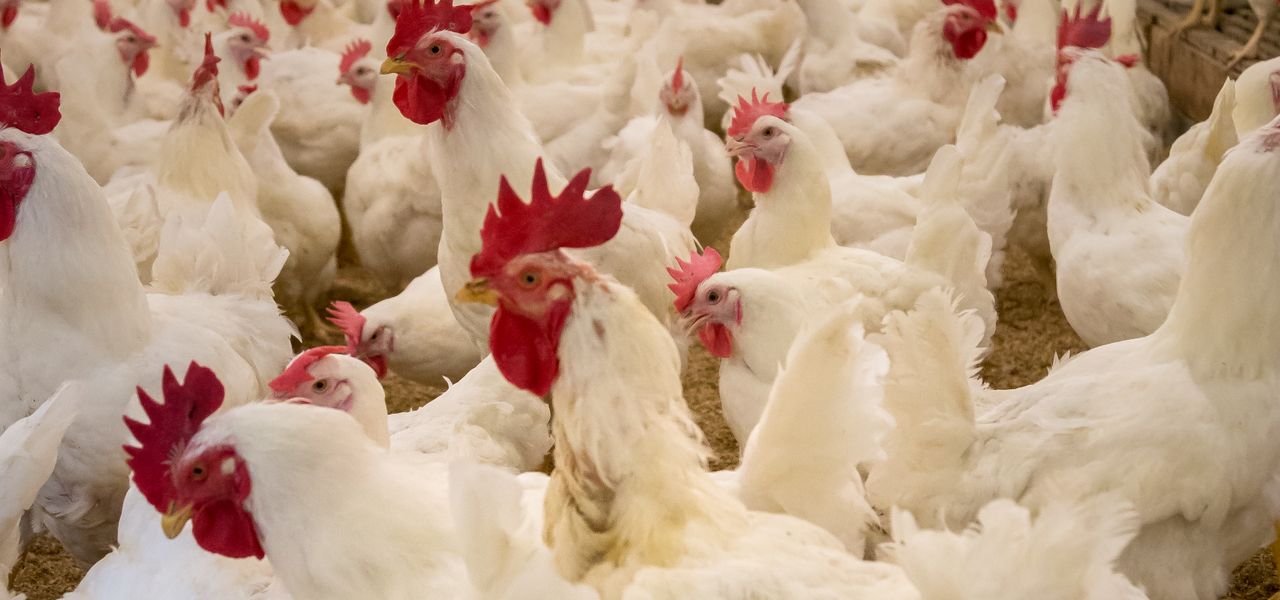
Wide view of a broiler house full of white chickens.
Step 9: Decide who does the daily work
Chickens need the same attention on a Sunday or a public holiday as on any other day. Before the chicks come, settle who will do each of these, daily, at fixed times:
Early morning: check the birds and the temperature, remove and count any dead, wash and refill drinkers, give feed.
Midday: check water, shake or top up feeders, adjust curtains for heat or rain.
Late afternoon: feed, water, turn any wet litter, write the day's record.
Night, during brooding: check the heat and how the chicks are spread.
If that person is you, be honest about your job and travel. If it is a relative or a paid hand, write the routine on a sheet, pin it in the feed store, and work beside them for the whole first week. Agree how they will report to you each day, and visit at times they do not expect. Hiring and managing workers on a poultry farm covers training, incentives and stock control.
Step 10: Keep records from day one and plan the sale early
A notebook with one line per day is enough to begin: date, number dead, bags of feed opened, anything unusual. Once a week, weigh a sample of birds and write the average. Keep every receipt. With those few figures you can work out what each bird cost you to produce, which is the only honest basis for a price. Layouts you can copy are in poultry records every farmer should keep.
The sale needs as much planning as the brooding. Two weeks before your broilers are ready, go back to the buyers from step 1 with the date and expected weight, and take firm orders. A finished broiler eats well over a kilogram of feed every week, so each week you hold unsold birds comes straight out of your margin. For eggs, agree collection days and crate returns before the first egg is laid, because production climbs quickly once it starts.
When the last bird leaves, remove the litter, wash and disinfect the house and equipment, and rest the house for about two weeks before the next chicks. Use that gap to go through your records: how many died and when, how much feed each bird used, what the birds weighed, and what you were paid. Change one or two things for the next batch, and increase the number only when the figures say you are ready.
A twelve-week countdown to your first chicks
If you already have land, the ten steps fit into roughly three months. Allow more building weeks in the rainy season.
Weeks before chicks arrive
What to finish
12 to 11
Visit buyers, record prices and sizes, choose the bird and the number
10
Collect local prices for feed, chicks, materials and labour; work the full-cycle budget
9 to 8
Confirm the site and land agreement; ask the district assembly and veterinary office what they require
8 to 4
Build the house and feed store; install the water tank; fence or secure the site
4 to 3
Book chicks and confirm the hatch date; agree a vaccination programme with the vet; buy equipment
2
Appoint and train whoever does the daily work; write the routine; arrange the feed supply
1
Wash and disinfect house and equipment; spread litter; set up the brooder; take delivery of starter feed
1 day
Light the heat and check the thermometer; set out water and feed shortly before arrival
Day 0
Receive, count and place the chicks; start the records
Keep the order even if the dates slip. A house finished a fortnight late is a small delay. Chicks that arrive before the house, the feed money or the buyer are a loss already under way.
If you would like to talk your plan through before you commit, Halaal Farms gives free advice to farmers before and after an order. Call 024 915 1503 or send the order form with your bird type, number and preferred date, and we will tell you which hatch day fits.
Questions farmers ask
How long does it take to set up a poultry farm in Ghana from scratch?
If you already have land, allow about three months. The market survey and the sums take two to three weeks, building a simple open-sided house takes four to six weeks depending on rain and money, and chicks should be booked three to four weeks before the hatch date. Rushing usually means the house is unfinished when the chicks arrive.
Can I start a poultry farm in Ghana without owning land?
Yes. Many beginners rent a plot or use family land. What matters is a written agreement that covers how long you may stay, whether you may build, and who owns the structure when you leave. Check drainage, water and road access in the rainy season before you sign, and ask the district assembly whether livestock is permitted there.
Which is easier for a complete beginner, broilers or layers?
Broilers are usually the easier first lesson because the cycle is six to eight weeks, so mistakes are found and corrected quickly and the money returns sooner. Layers need about five months of feeding before the first egg and a longer vaccination programme. Start with layers only if you can finance that waiting period without borrowing.
Do I need training before I buy my first chicks?
Formal training is not required, but two or three days working on a well-run farm teaches more than any amount of reading. Ask to help with a brooding week if you can. Your district agricultural office and veterinary office also advise new farmers, and a good hatchery will talk you through preparation before delivery.
Written by the Halaal Farms Ghana team. We hatch and import day-old chicks at Opeikuma, Kasoa, and deliver to all 16 regions. This article is general guidance for farmers. For diagnosis and treatment of sick birds, speak to a vet or your district veterinary office.
A working guide to a poultry business plan: the seven sections, the figures you must collect yourself, a labelled 500-broiler example and five stress tests that show where the plan breaks.
Broilers return your money in about seven weeks; layers take five months to start paying and then pay every day. This comparison shows which pattern fits your savings, time and buyers.
Nobody can give you one figure, but the quantities hardly change: bags of feed, square metres of floor, feeders and drinkers. Here they are for 100, 500 and 1,000 birds, ready for your local prices.