Inside a Hatchery: From Fertile Egg to Boxed Chick
Follow a hatching egg through a commercial hatchery: sorting, storage, 18 days in the setter, transfer, hatch, grading, vaccination, boxing and dispatch.
Halaal Farms Ghana team4 October 2026 · 13 min read
Key points
A chick's hatch day is fixed 21 days earlier when its egg goes into the setter, which is why hatcheries need orders well ahead.
Hatching eggs are held cool, commonly at 15 to 18 degrees Celsius, and hatch best when set within about a week of lay.
Eggs spend 18 days being turned in a setter and the last 3 days lying still in a hatcher at higher humidity.
An egg should lose about 11 to 13 per cent of its weight by day 18, and a good chick weighs about two-thirds of the egg it came from.
Marek's disease vaccine has to be given in the hatchery, so always ask a supplier what each batch of chicks has received.
The chick you place in a brooder on a Thursday morning began as an egg laid about four weeks earlier. For up to a week of that time it rested in a cool room. For 21 days it sat in two different machines. In its last few hours at the hatchery it was sorted, counted, vaccinated and boxed. Each of those stages leaves a mark on the bird you receive, and knowing what happens at each one makes you a better judge of chicks and a better customer of any hatchery.
The timetable every hatchery runs on
A chicken egg takes 21 days to hatch, and nothing a hatchery does can shorten that. The decision that produces your chicks is therefore taken three weeks before you see them, when a set number of eggs is loaded into the incubator.
Day
Stage
Where the egg or chick is
Up to 7 days before setting
Collection, sorting, sanitising, storage
Breeder farm, then hatchery egg store
Day 0
Setting
Setter
Days 1 to 18
Incubation with hourly turning
Setter
Day 18
Candling and transfer
Moved from setter trays to hatcher baskets
Days 19 to 21
Pipping and hatch
Hatcher
Day 21
Take-off, grading, sexing, vaccination, boxing
Chick room
Day 21 to 22
Dispatch and delivery
Holding room, vehicle, your farm
Two things follow for the buyer. Hatch days are fixed points on a calendar, usually the same days each week, and your order is fitted to one of them. And because chicks cannot be stored, a hatchery sets eggs against the orders it expects. A farmer who books three or four weeks ahead is planned for. One who calls on Monday for chicks on Wednesday is asking for someone else's surplus. You can follow what happens inside the egg on each of the 21 days with the incubator slider on our home page.
From the breeder farm to the hatchery door
What the parent flock decides
A hatchery cannot improve an egg. It can only protect what the breeder flock put into it. The parent hens and cocks decide whether an egg is fertile, how well its shell is formed and what nutrients and protective antibodies are stored in the yolk for the chick.
On the breeder farm, eggs are collected several times a day so they do not sit in warm nests, where the embryo would start to develop and then stall. Eggs laid on the floor are kept apart because they are far more likely to be contaminated. Collected eggs are placed on trays with the broad end up, since that is where the air cell sits.
The age of the parent flock shows in the chick. Young breeders lay small eggs that give small chicks, flocks in mid-lay give the best hatch, and old flocks lay large eggs with thinner shells and lower fertility. A hatchery therefore keeps each flock's eggs identified all the way through.
Sorting and sanitising on arrival
At the hatchery door the eggs are checked against the delivery record and sorted. Not every fertile egg is fit to set. Rejected eggs include those that are:
cracked or hair-cracked, because they dry out and let bacteria in
dirty with droppings or yolk
too small or very large, including double yolks
misshapen, ridged or round, which often have weak shells or a misplaced air cell
thin-shelled or rough like sandpaper
Weight matters because a chick weighs about two-thirds of the egg it hatched from. A 60 gram egg gives a chick of around 40 grams. Hatcheries set a minimum egg weight, commonly near 50 grams for chickens, so that chicks are not too small to thrive. The same selection applies if you buy fertile hatching eggs to incubate yourself, and our article on selecting and storing hatching eggs shows how to do it by hand.
An eggshell has thousands of pores. As a freshly laid egg cools, its contents shrink slightly and can draw bacteria from the shell surface through those pores. Hatching eggs are therefore sanitised as early as possible. The traditional method is fumigation with formaldehyde gas in a sealed cabinet. Because formaldehyde is hazardous to people, many hatcheries now use other approved disinfectants applied as a fog or fine spray. Washing in water is avoided, because it removes the shell's natural coating and can push dirt inwards.
Quality check at this stage: the number and percentage of eggs rejected from each flock, recorded by reason. A rise in dirty or cracked eggs is reported back to the breeder farm.
The egg store: keeping the embryo asleep
A fertile egg already holds a tiny embryo of many thousands of cells when it is laid. Kept cool, that embryo stays dormant. In the egg store the temperature is typically held at 15 to 18 degrees Celsius with fairly high humidity, around 75 per cent, so the eggs do not lose water before incubation begins.
Storage is a convenience for the hatchery, which needs to gather enough eggs to fill a machine, but it has a cost. Eggs hatch best when set within about a week of lay. Each day beyond that costs a little hatchability, and stored eggs hatch later, by roughly an hour for every extra day. Eggs of very different ages set together therefore hatch over a wider spread of time, which matters at the end of the process.
Cold eggs are not moved straight into a warm, humid incubator, because water would condense on the shells and carry bacteria in. They are first brought up to room temperature in moving air over several hours.
Quality check at this stage: store temperature and humidity logged daily, and the age of every batch of eggs at setting.
Eighteen days in the setter
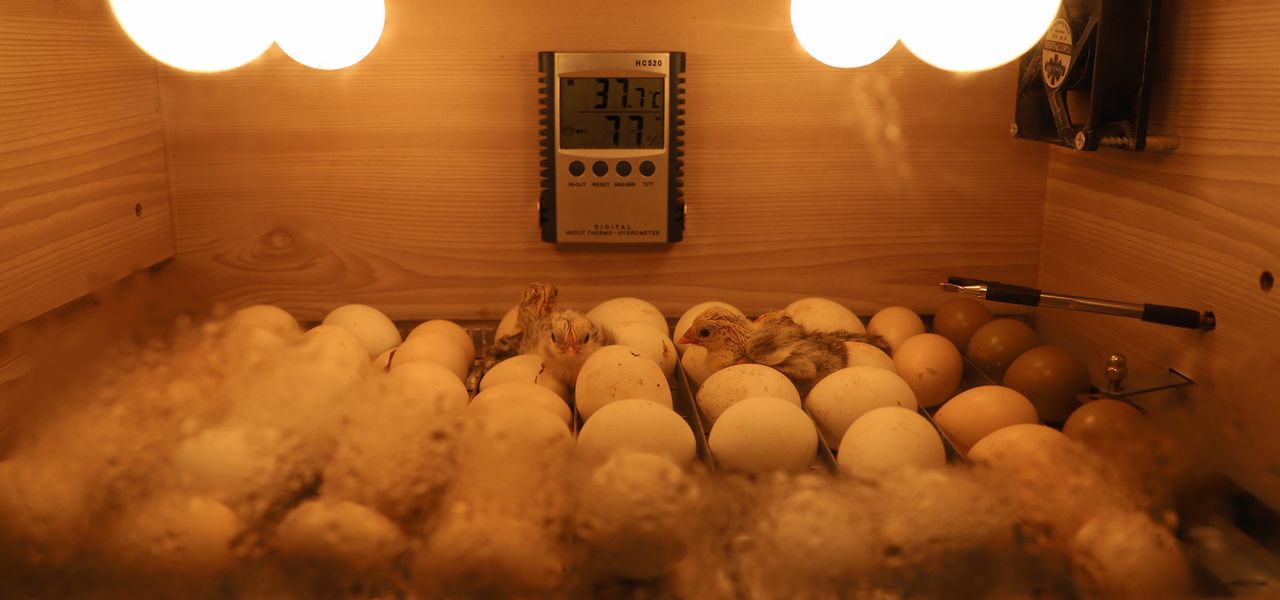
The setter is the large incubator where eggs spend most of their time. They stand broad end up on plastic trays, stacked on trolleys or racks, in a cabinet with fans that keep the air moving evenly past every egg. Four conditions are controlled.
Temperature. The air is held at about 37.5 to 37.8 degrees Celsius. The margin is narrow. A sustained error of half a degree shifts hatch time and chick quality, and a degree or more does real damage.
Humidity. An egg must lose water through its shell so that the air cell grows large enough for the chick to breathe from before it breaks out. The target is a loss of about 11 to 13 per cent of the egg's starting weight by day 18. Relative humidity of roughly 50 to 55 per cent achieves this in most conditions, and the hatchery adjusts it according to what the eggs actually lose.
Turning. Trays tilt about 45 degrees one way and then the other, usually once an hour. Turning stops the embryo from sticking to the shell membranes and helps the network of blood vessels spread around the inside of the shell.
Fresh air. The embryo breathes through the shell. It needs oxygen and gives off carbon dioxide, more of both every day.
Something changes about halfway through. In the first week the embryo is tiny and needs heat from the machine. By about the second week it is producing its own heat, and a full setter of late-stage eggs gives off so much that the machine's main work becomes cooling. Some hatcheries run multi-stage setters, with eggs of different ages in one cabinet so that older eggs warm the younger ones. Others run single-stage machines, filled and emptied in one go, which lets the settings follow the age of the eggs and allows the cabinet to be washed out between batches.
Quality check at this stage: sample trays are weighed at setting and again at transfer to calculate weight loss. Machine temperature, humidity and turning are logged and alarmed. With Ghana's power cuts, a standby generator that starts automatically is core equipment, since a setter full of late-stage eggs can overheat within a short time once its fans stop.
Candling and transfer on day 18
On about day 18 the eggs are taken out of the setter and candled, which means passing them over a strong light. An egg with a living embryo is dark and opaque by this age. A "clear" egg lets the light through, because it was either infertile or the embryo died very early. Clears are removed and counted.
A sample of the clears is then opened. An infertile egg and an early dead embryo look the same under the lamp but different on the plate, and the difference tells the hatchery where to look. High infertility points to the breeder flock, the cocks or their feeding. Early deaths point to egg handling, storage or the first days in the setter. What each stage looks like under the lamp is described in our guide to candling eggs.
The remaining eggs are transferred from setter trays into hatcher baskets, where they lie on their sides with room for a chick to emerge. Transfer is done quickly and gently, since late-stage eggs chill fast and a crack at this point kills the embryo. In some large hatcheries a machine vaccinates the embryo through the shell at transfer, which is called in ovo vaccination.
Quality check at this stage: percentage of clears per flock, split into infertile and early dead, and the number of eggs cracked in handling.
The hatcher: three days without turning
The hatcher is a separate machine in a separate room, because hatching releases clouds of chick down and dust that must not drift back to clean eggs. Here turning stops, the temperature is set slightly lower than in the setter and humidity is raised, peaking as the chicks emerge. The moist air keeps the shell membranes soft so the chick can turn and cut its way round the shell.
Around day 19 the chick pushes its beak into the air cell and begins breathing with its lungs. It draws the last of the yolk into its abdomen, and the navel closes over it. About day 20 it cracks the shell from inside, which is called pipping. It then rests, often for many hours, before cutting round the shell and pushing free.
Not all chicks hatch at the same moment. The time between the first and the last is the hatch window, and a hatchery wants it short, ideally about a day. Chicks that hatch early in a long window sit in the warm hatcher losing water while they wait. If the hatcher is opened too soon, the late chicks are still wet with navels not fully closed. The usual sign that it is time to take the chicks out, the "pull", is that nearly all are dry and fluffy, with only a few still damp at the back of the neck.
Quality check at this stage: the spread of hatch, and a break-out of the eggs left unhatched to see when and why those embryos died.
Take-off, grading and sexing
The baskets are brought into the chick room, where chicks are separated from shells and unhatched eggs, then graded. A saleable chick is dry, clean, alert and standing, with bright eyes, straight legs and toes, and a navel that is closed and smooth. Graders remove chicks that are weak or wet, undersized, deformed, or that have open or knotted navels, since an unhealed navel is the usual route for the yolk sac infections that kill chicks in the first week. You can apply the same checks when your box arrives, using our guide on how to judge day-old chicks.
Layer breeds are sexed at this point, because only the females are sold as future layers. With brown-egg hybrids this is usually done by down colour, and with other birds by wing feathers or by examining the vent. The methods and their accuracy are explained in our article on how chicks are sexed. Since roughly half of every layer hatch is male, each saleable pullet carries the cost of at least two eggs set, which is part of why layer chicks cost more than their size suggests.
Quality check at this stage: the percentage of chicks culled, with reasons, and the average chick weight compared with the egg weight at setting. Chicks well below two-thirds of egg weight were dried out by too much heat or too long in the hatcher. Chicks well above it did not lose enough water and tend to be soft and slow.
Vaccination before the box is closed
Some vaccines are best given in the hatchery, and one can only be given there. Marek's disease vaccine must go into the chick before it meets the virus, which is present in poultry house dust almost everywhere. Most Marek's vaccines are stored frozen in liquid nitrogen and have to be used within a short time of thawing and mixing, then injected under the skin at the back of the neck, chick by chick. That is not practical on a farm.
Hatcheries may also give vaccines against Newcastle disease and infectious bronchitis as a coarse spray over the chicks in their boxes, and some give further vaccines by injection. Programmes differ between hatcheries and between broilers and layers. At Halaal Farms, chicks are vaccinated at the hatchery before they leave, and we encourage every customer to ask what a particular batch has had so that the farm's own vaccination programme, set with a local vet, picks up from the right point.
Quality check at this stage: vaccine storage records, the time between mixing and use, and spot checks that every chick has actually been injected.
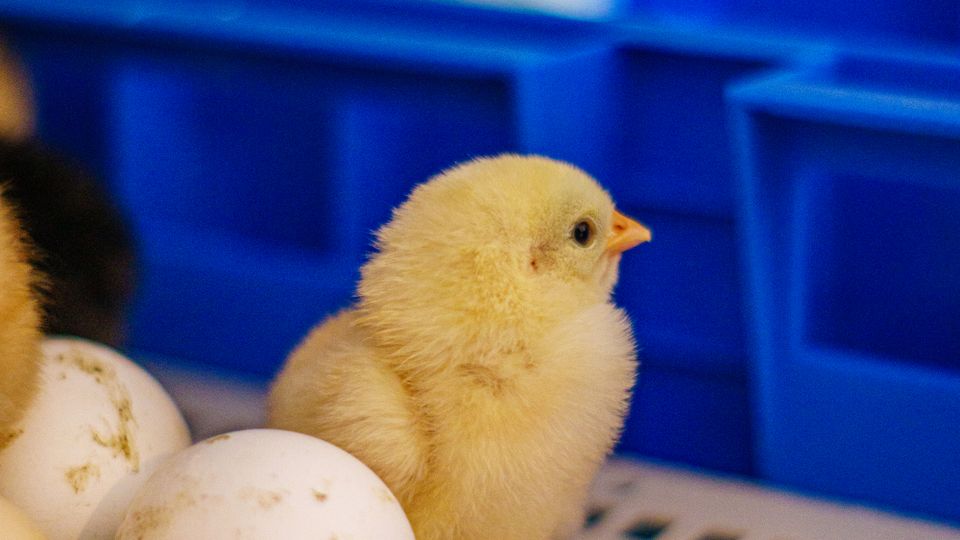
A newly hatched yellow chick beside eggs in a hatcher tray.
Boxing, holding and dispatch
Chicks are counted into ventilated boxes, commonly 50 or 100 to a box with dividers so they cannot pile into one corner. At Halaal Farms the minimum order is one box of 50. The box is designed so that the chicks' own body heat keeps them warm while holes in the sides and lid let heat and moisture out.
Between boxing and loading, boxes wait in a holding room that is kept cooler than a brooder, with good air movement. Packed chicks generate a lot of heat, and overheating in the box is a greater danger than chilling. Panting chicks with open beaks are too hot. Chicks that are huddled tight and noisy are too cold.
A chick lives on its yolk reserve for the first two or three days, which is what makes delivery across the country possible. The reserve is limited, so dispatch is timed to cut waiting, often travelling at night or in the early morning to avoid the heat of the day. What should happen on the road is covered in our guide to transporting day-old chicks.
Quality check at this stage: box counts, holding room temperature, loading time, and afterwards the reports from farms on chicks dead on arrival and losses in the first week. First-week mortality on the customer's farm is the final test of everything that came before.
One direction only: how hygiene is built into the layout
A well-run hatchery is laid out as a one-way street. Eggs enter at the clean end and move through the egg store, setter room, hatcher room and chick room to dispatch at the far end. People, trolleys and air are meant to move in the same direction and not back again. Staff who have handled chicks and hatch waste do not walk back into the setter room without washing and changing. After every hatch, the hatcher, baskets and chick room are washed and disinfected, and shells, unhatched eggs and culls are removed from the site. Many hatcheries also test surfaces and chick down for bacteria and moulds to confirm that the cleaning works.
What this means when you buy chicks
Ask a hatchery which hatch day your chicks will come from, which vaccines they will have had, how they will travel and what happens if some arrive dead. At Halaal Farms the price, hatch date and delivery cost are confirmed before you pay, chicks that arrive dead are replaced free in the next hatch, and farm visits are welcome by appointment. Current starting prices are on the price list.
The most practical lesson is about timing. Your chicks' hatch day is decided three weeks ahead, and before festive seasons the setters are booked much earlier than that. Work back from your sale date, then send the order form or call 024 915 1503 so your chicks are counted in before the eggs are set.
Questions farmers ask
Why can a hatchery not supply chicks immediately when I call?
Chicks cannot be made to order in a few days. Eggs must be collected from breeder flocks, set in the incubator and incubated for 21 days, and the number set is planned weeks ahead against expected orders. Once chicks hatch they must leave within hours, so a hatchery rarely has spare stock. Booking early, especially before Christmas, Easter and Eid, is the only way to be sure of a hatch date.
What percentage of eggs set in a hatchery become chicks?
It varies with the age and health of the breeder flock, egg storage time and incubation quality. A good broiler breeder flock in mid-lay may hatch around 80 to 88 per cent of the eggs set, and young or old flocks hatch fewer. With layer breeds only the female chicks are sold as layers, so fewer than half of the eggs set become saleable pullets.
Are chicks fed or given water before they leave the hatchery?
In most hatcheries, no. A newly hatched chick has drawn the remaining yolk into its body just before hatching, and that reserve carries it through the first two or three days. This is what makes transport possible. The reserve is not a reason to delay, though. Chicks that reach feed and water sooner start better, so have the brooder warm and ready before they arrive.
What is the difference between a setter and a hatcher?
They are two separate machines for two stages of incubation. The setter holds eggs upright on trays for the first 18 days and turns them every hour at a steady temperature and moderate humidity. The hatcher takes the eggs for the last 3 days. There they lie in baskets without turning, at slightly lower temperature and higher humidity, until the chicks break out.
Written by the Halaal Farms Ghana team. We hatch and import day-old chicks at Opeikuma, Kasoa, and deliver to all 16 regions. This article is general guidance for farmers. For diagnosis and treatment of sick birds, speak to a vet or your district veterinary office.
A practical run-through of a 21-day hatch in a tabletop incubator: what to buy, how to test it before trusting it, what to do each day, and how to handle lockdown, hatch day and cleaning.
A practical guide to candling chicken eggs with a torch: what a living embryo, a clear egg, a blood ring and a late death look like at each check, plus a record sheet that shows where your losses come from.
How to carry out a break-out on unhatched eggs, age the dead embryos by what you can see, and trace each pattern of loss back to the breeder flock, egg storage or the incubator settings.